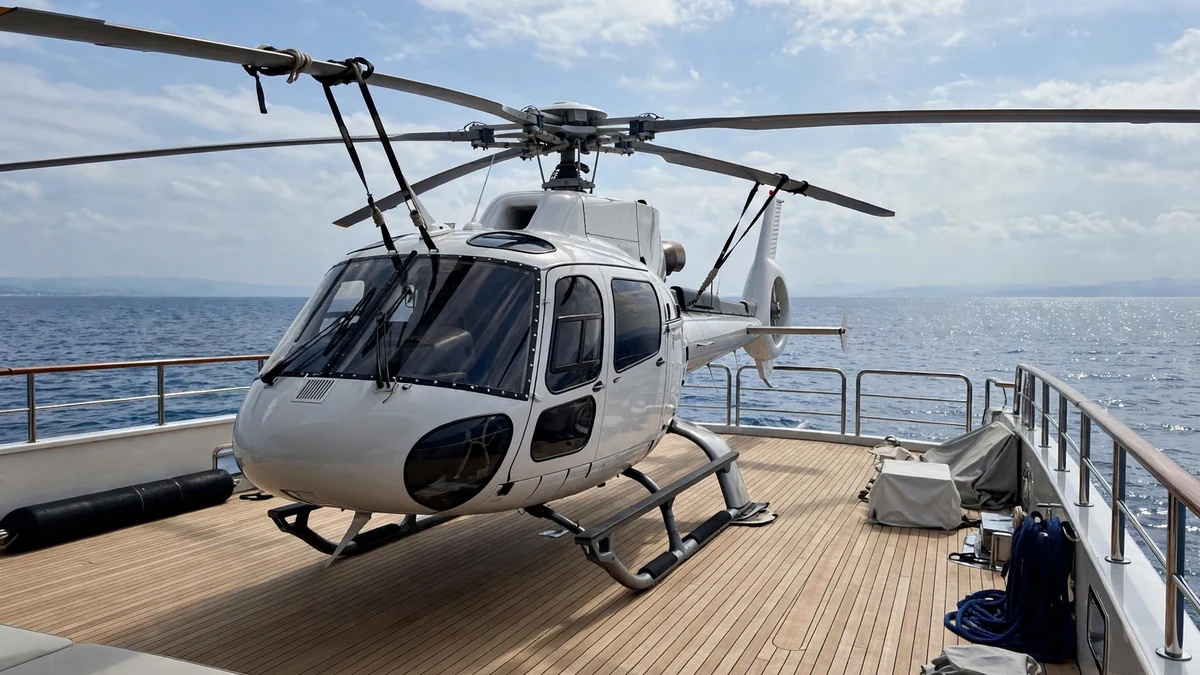
On the deck of a superyacht at anchor, a helicopter sits with its blades tied down and its tail folded back against the hangar door. From the shore it looks small, almost toy-like next to the ship, but the sheet that describes it is full of numbers that decide whether it can lift six people off a moving deck and set them down on a clifftop pad fifty kilometres away. A helicopter is the only aircraft that can do that job, and its specification sheet is a record of the compromises that make it possible.
A luxury helicopter specification sheet lists the rotor, engine, weight and cabin figures that define what the aircraft can lift, how far it can fly and where it can land. It is written for pilots and buyers, so it is thick with terms like disc loading and hover ceiling that mean nothing at first glance. This guide explains what each number means, and what it tells you about the machine behind it.
The Spec Sheet at a Glance
| Specification | Typical Luxury Helicopter | What It Means |
|---|---|---|
| Maximum take-off weight | 6,500–8,500 kilograms | Aircraft, fuel, people and luggage |
| Passenger capacity | 6–8 people | Plus one or two pilots |
| Cruise speed | 250–280 kilometres per hour | Fast for a rotorcraft, slow for a jet |
| Maximum range | 800–1,000 kilometres | With reserves, in still air |
| Rotor diameter | 12–14 metres | Width of the spinning disc |
| Hover ceiling | 3,000–4,500 metres | Highest it can hover out of ground effect |
| Fuel capacity | 1,500–2,000 litres | About three hours of flying |
| Engines | Two turboshafts | One can keep it flying alone |
These are typical figures for a medium twin-engine luxury helicopter, not a single model. A light helicopter will show far smaller numbers, and a heavy offshore machine will beat most of them. Read the figures against the weight of the aircraft and the kind of flying its owner does.
The Rotor: A Wing That Spins
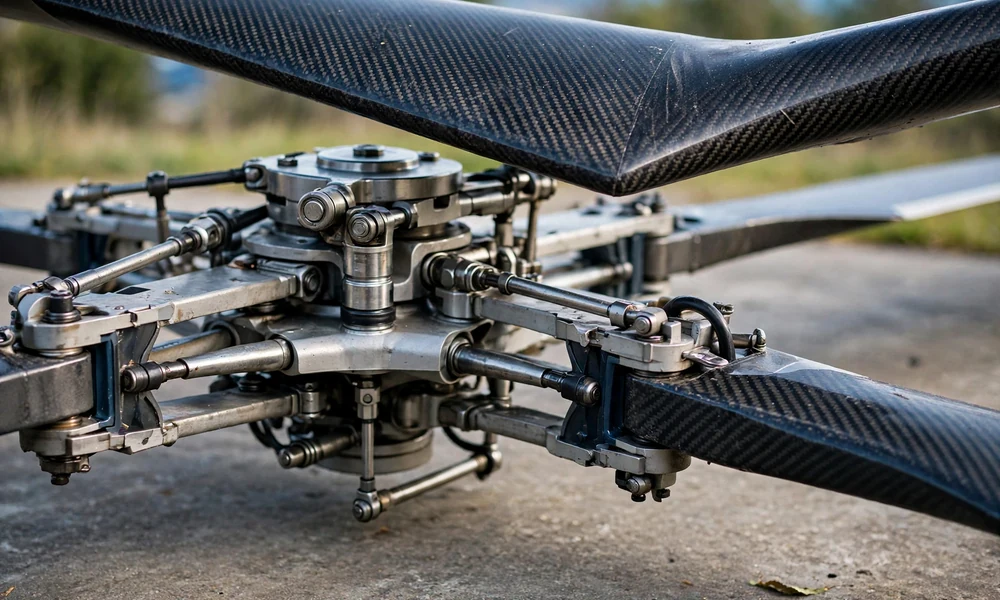
The rotor is the number that defines a helicopter. Twelve to fourteen metres across, it is a wing that spins, and it produces all of the lift the aircraft needs. The blades are made from carbon fibre and metal, shaped like a wing, and they twist slightly along their length so the tip and the root both bite the air evenly. The rotor turns at a few hundred revolutions per minute, and the tips move close to the speed of sound, which is why the blades are so carefully balanced. A helicopter that weighs eight tonnes needs a rotor disc that big because the air can only be pushed down so fast; a smaller disc would need more power and would shake the cabin apart.
Weight and Lift: The Hardest Trade in Aviation
Weight is the hardest trade in a helicopter, because every kilogram the aircraft carries must be lifted straight up by the rotor. Maximum take-off weight of 6,500 to 8,500 kilograms covers the empty aircraft, the fuel, the crew, the passengers and their luggage, and the sheet also lists the empty weight, so a buyer can work out the useful load. Fuel is the biggest variable: fill the tanks and the range stretches to a thousand kilometres, but two passengers may have to stay behind. A helicopter pilot does this sum before every flight, and on a hot day at altitude the numbers get tighter still, because thin air gives the rotor less to bite. The build of the machine behind these numbers is a study in light materials, as our guide to how a luxury helicopter is made explains.
Engines: Two Turboshafts, One Job
Two turboshaft engines power a luxury helicopter, each producing roughly 1,000 to 1,500 shaft horsepower. A turboshaft is a jet engine with a shaft instead of a fan: it burns fuel to spin a turbine, and the turbine turns the rotor through a gearbox. The gearbox is one of the most complex parts of the aircraft, reducing the turbine’s tens of thousands of revolutions per minute down to the rotor’s few hundred, and it needs its own oil cooling system to survive. Having two engines matters more in a helicopter than in a jet, because a helicopter cannot glide the way a fixed-wing aircraft can. If one engine fails, the other must carry the whole aircraft, and the sheet proves it can: the single-engine performance figures show the helicopter climbing away on one engine, which is why twin-engine helicopters are required for flying over cities and open water. The systems that keep those engines running are explained in our guide to how a luxury helicopter works.
Speed and Range: Fast Enough, Far Enough
A cruise speed of 250 to 280 kilometres per hour is fast for a rotorcraft and slow compared with a jet, and the reason is the rotor itself. As the helicopter flies forward, the blade moving forward meets the air faster than the blade moving back, and at around 300 kilometres per hour the retreating blade starts to stall. That limit is physics, not engineering, and every helicopter on the sheet lives under it. Range of 800 to 1,000 kilometres sounds modest next to a jet, but a helicopter is not bought to cross oceans. It is bought to connect places a jet cannot reach: a yacht at anchor, a mountain lodge, a rooftop pad in a city. A jet does the long leg and the helicopter does the last one, which is why the two aircraft so often travel together, as our guide to how a luxury private jet works shows from the other side of the partnership.
Price: What a Luxury Helicopter Costs
A new medium twin-engine luxury helicopter typically costs between 12 and 25 million dollars, depending on the model and the cabin fit. The airframe, engines and rotor system account for most of that, with the cabin interior, avionics and paint taking the rest. Against those numbers the spec sheet starts to make sense. Rotor size, weight and hover ceiling are not curiosities on the sheet; they are the reasons the aircraft costs what it does, and the reasons an owner chooses one helicopter over another.
A Rare Fact Worth Knowing
Here is a detail few spec sheets mention. A helicopter can land on a yacht deck that is moving, because the pilot matches the ship’s roll and touches down in the brief moment the deck is level. It is one of the hardest landings in aviation, and it is practised in simulators for hours before a pilot tries it for real. It is a small reminder that the most demanding numbers on the sheet are not about speed. They are about hanging still in the air, over a deck that will not sit still, and doing it gently enough that the passengers never notice.
Read the sheet slowly, and the helicopter stops looking like a small jet with a propeller on top. Lift is measured in metres of spinning rotor, weight in tonnes that must be raised straight up, speed in the limits of a stalling blade, and range in hours of fuel. Those numbers are the aircraft, and a pilot reads them the way a sailor reads the wind.


