The salesman tapped the spec sheet with his pen and said the number that mattered most, and then he said a second number that mattered more, and by the third number the buyer had stopped listening altogether. Kilowatts, kilowatt-hours, newton-metres, miles of range, minutes to charge, seconds to sixty. The sheet was full of answers, and none of them answered the only question that mattered: what would this car actually feel like to own?
An electric sports car is the hardest car on the market to buy from a spec sheet, because the numbers that look biggest are often the least important. A huge power figure means nothing if the battery cannot feed it for more than a few seconds, and a huge range figure means nothing if the car only reaches it at a crawl.
This guide translates every number on a luxury electric sports car spec sheet into plain English, so the sheet starts making sense.

How to Read a Luxury Electric Sports Car Spec Sheet
Power: kilowatts, horsepower and the peak trap
Power is usually quoted in kilowatts or horsepower, and a luxury electric sports car typically claims about 400 to 800 kilowatts, which is roughly 540 to 1,070 horsepower. The trap is the word peak. Peak power is the most the motors can produce for a few seconds, usually during a launch, while sustained power is what they can hold lap after lap without overheating. Ask for the sustained figure, because that is the power you actually drive with.
Battery: kilowatt-hours and usable energy
Battery size is quoted in kilowatt-hours, and luxury electric sports cars usually carry about 80 to 120 kilowatt-hours. The number that matters is the usable part, which is typically 90 to 95 percent of the total, because the car keeps a small reserve to protect the battery from damage. A 100-kilowatt-hour battery therefore gives you about 90 to 95 kilowatt-hours to drive on. The cleverest cars are the ones that go far on a modest battery, not the ones that carry the biggest one.
Range: the laboratory number and the real one
Range is the figure everyone quotes and nobody quite believes, usually about 300 to 400 miles on the official test. The official test is gentle, with mild weather, no air conditioning and modest speeds, so a real owner should expect about 70 to 80 percent of the quoted figure in everyday driving, and less again in cold weather or at motorway speed. A car that does 3.5 miles per kilowatt-hour will beat a heavier rival with a bigger battery and only 2.5 miles per kilowatt-hour.
Charging: kilowatts in, minutes waiting
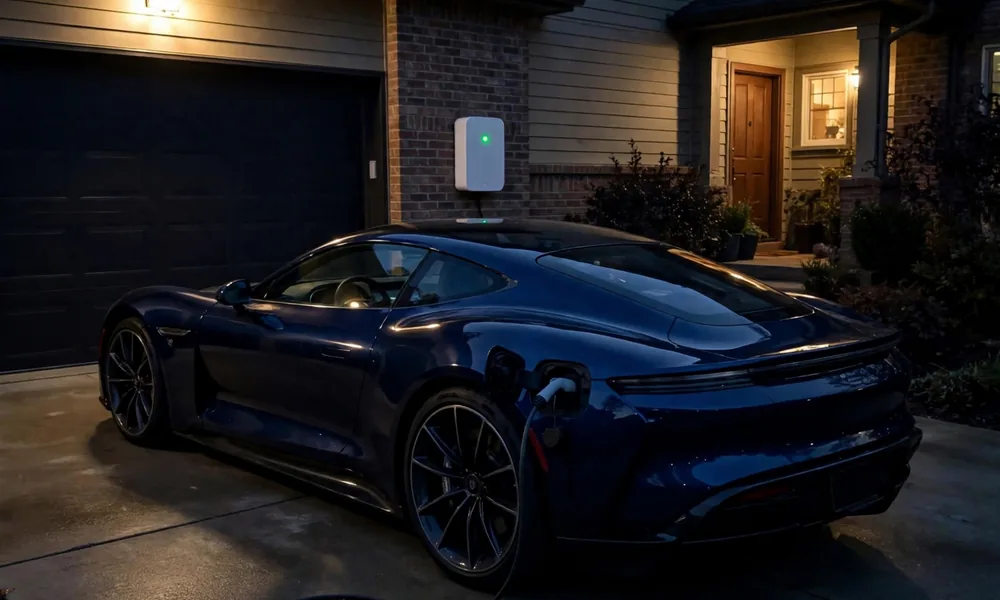
Charging speed is quoted as a peak in kilowatts, often 250 to 350 kilowatts, but the peak only lasts for part of the charge, while the battery is neither too empty nor too full. The honest number is the time for a 10 to 80 percent charge, usually about 18 to 30 minutes on a fast charger. That window is what a road trip actually feels like: pull in, plug in, buy a coffee, and leave with most of a battery. Home charging is slower, about 7 to 11 kilowatts, which fills the car overnight, and that is how most owners charge most of the time. The way the whole car is put together decides whether those charging numbers hold up in daily use, as our guide to how a luxury electric sports car is made shows.
Acceleration and torque: the instant push
Electric motors make their full twisting force, called torque, from the moment they start turning, which is why an electric sports car feels so violent off the line. The headline figure is usually zero to sixty miles per hour in about 2.5 to 3.5 seconds, and the torque figure is often 700 to 1,000 newton-metres or more. What the numbers do not show is how the car delivers that push: the best cars meter it out smoothly so the tyres grip instead of spinning, and they keep pulling hard at motorway speeds instead of running out of breath. A car that is quick to sixty but flat at eighty is less fun than one that pulls all the way.
Weight, handling and brakes: the numbers behind the feel
Weight is the spec electric sports cars least like to talk about, usually about 1,900 to 2,400 kilograms, because batteries are heavy. Engineers fight that weight with aluminium, carbon fibre and clever packaging, and they place the battery low in the floor so the car corners flat despite its mass. The brakes deserve a look too: most of the slowing is done by regenerative braking, which turns the motors into generators and feeds energy back into the battery, while the friction brakes only take over for hard stops. How those systems work together decides whether the car feels sharp or sluggish, as our guide to how a luxury electric sports car works explains.
Luxury Electric Sports Car Specs
| Specification | Typical range |
|---|---|
| Peak power | About 400 to 800 kilowatts |
| Battery capacity | About 80 to 120 kilowatt-hours |
| Official range | About 300 to 400 miles |
| Efficiency | About 2.5 to 3.5 miles per kilowatt-hour |
| Fast charging | About 250 to 350 kilowatts peak, 10 to 80 percent in 18 to 30 minutes |
| Zero to sixty | About 2.5 to 3.5 seconds |
| Torque | About 700 to 1,000 newton-metres |
| Weight | About 1,900 to 2,400 kilograms |
| Top speed | About 155 to 200 miles per hour |
| Motors | Two or three, one per axle or per wheel |
What Does a Luxury Electric Sports Car Cost?
A luxury electric sports car typically costs an estimated 120,000 to 250,000 dollars to buy, with the fastest limited models passing an estimated 300,000 dollars. Running costs are lower than a petrol rival: home charging is estimated at a few dollars per hundred miles, and servicing is estimated at several hundred dollars a year because there is no oil, no gearbox and no exhaust to maintain. The big future bill is the battery, with a replacement estimated at 15,000 to 30,000 dollars outside warranty, though most makers guarantee the battery for eight years or more. Among its electric relatives, the best luxury electric cars of 2027 show how the same technology scales up and down, as our ranking of the best luxury electric cars of 2027 shows.
A Rare Fact
Some luxury electric sports cars play a fake engine sound through their speakers, and the sound is not a recording of a petrol engine but a composition written by sound designers, tuned to rise and fall with the speed. A few makers let owners choose the sound the way they choose the paint, and engineers spend months tuning it, because in a car with no engine noise, the sound the car makes is the only voice it has.
A luxury electric sports car is not a list of numbers, even though it arrives with a sheet full of them. The power figure is a promise, the battery is the fuel tank, the range is a laboratory guess, and the charging time is the one that decides how road trips feel. Read the sustained power, the usable battery, the real-world range and the 10 to 80 percent time, and the sheet stops being a puzzle. What is left is the car itself: silent at a standstill, violent off the line, and cheaper to run than anything with an exhaust pipe ever was.