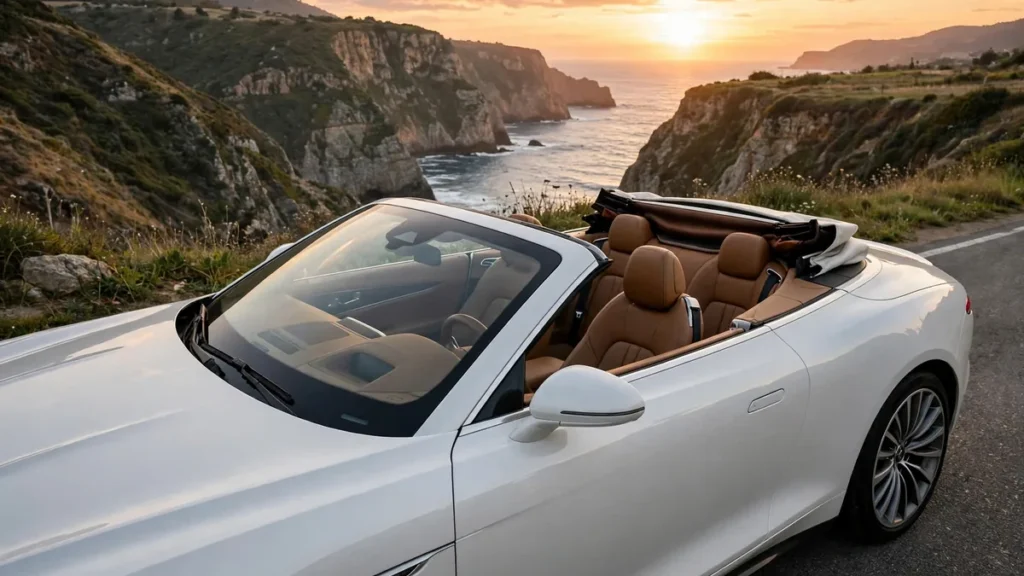
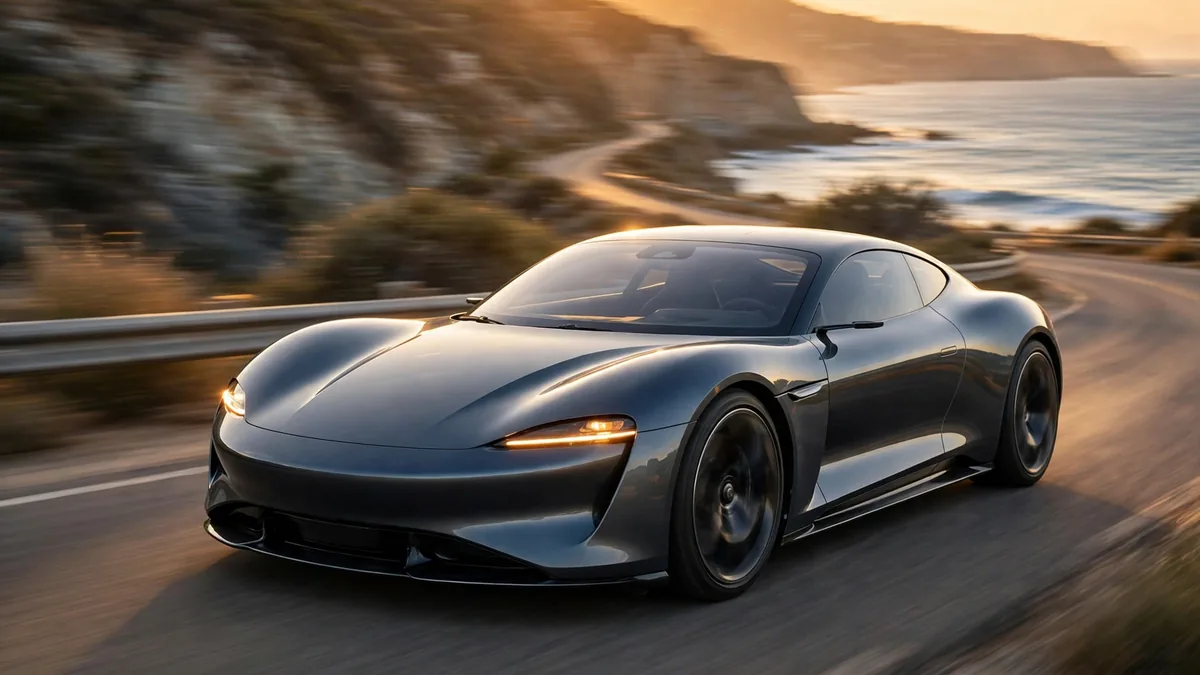
Press the pedal and there is no drama. No engine note rising, no gearbox hunting for a ratio, no shove of a clutch. The car simply gathers speed, smoothly and almost silently, until the world outside the window starts to blur. A passenger might not even notice how fast it is going, and that is the strangest thing about it.
A luxury electric sports car does the job of a petrol sports car with a completely different set of tools. There is no explosion happening under the bonnet, no exhaust, and no gears to change. Instead there is a battery, a pair of motors, and software deciding, hundreds of times a second, exactly how much push each wheel should get.
This is how a luxury electric sports car works, system by system, from the battery under your feet to the motors at each axle.
How a Luxury Electric Sports Car Works
Step 1: The battery delivers the power
Everything starts with the battery, a flat pack of lithium cells sealed under the floor of the car. When the driver presses the accelerator, the battery releases direct current, and it can release it very fast: an electric sports car can draw hundreds of kilowatts in a second, which is why the acceleration feels instant. The pack is managed by a computer that watches every cell, keeping temperatures even and voltages balanced, and cooling the cells with liquid channels when the driver asks for full power. Building that pack is a story of its own, as our guide to how a luxury electric sports car is made explains.
Step 2: Inverters turn the current around
Electric motors run on alternating current, but batteries store direct current, so between the two sits the inverter, a box of power electronics that switches the current back and forth thousands of times a second. The inverter is the translator of the car: it takes the driver’s request from the accelerator pedal and turns it into a precisely shaped wave of current for the motors. Modern inverters use silicon carbide switches, which waste less energy as heat and let the car deliver more of the battery’s power to the road. The inverter also runs the process in reverse when the car slows down, turning the motors into generators and sending energy back into the battery.
Step 3: Motors at each axle do the pushing
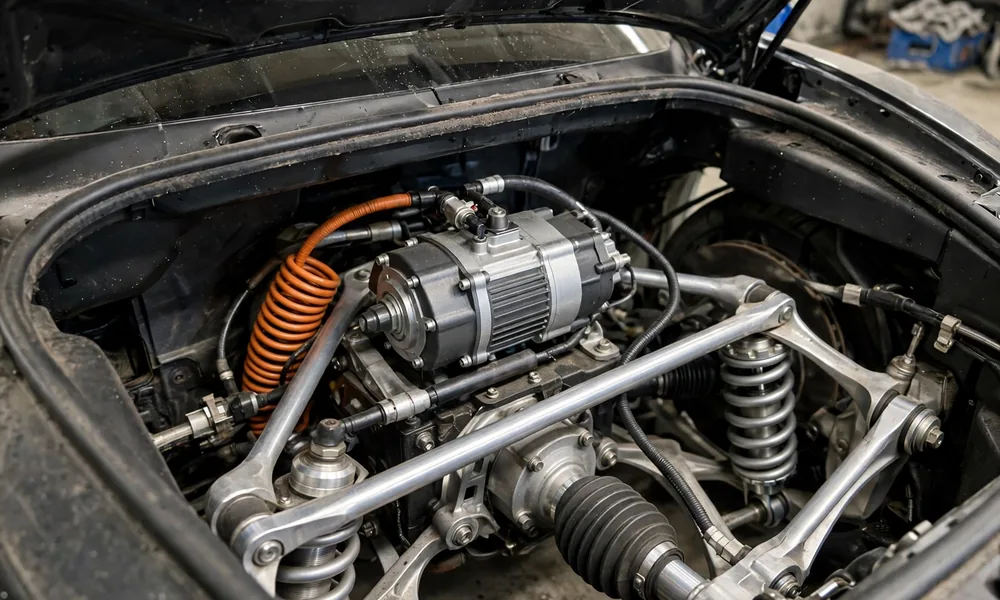
Most luxury electric sports cars have two motors, one on each axle, and some have three. Each motor is a compact unit of copper windings and magnets, spinning at up to twenty thousand revolutions a minute, and each one drives its wheels through a single fixed gear, because an electric motor makes full torque from zero speed and needs no gearbox. The front and rear motors can be driven independently, so the car can send more power to the rear when accelerating, more to the front when cornering, or split it evenly in the rain. The numbers that describe them are worth understanding, as our guide to luxury sports car specs, explained shows.
Step 4: Torque vectoring keeps the car on line
With a motor at each axle, and sometimes one per wheel, the car can do something a petrol car cannot: it can push one wheel harder than the other, in real time, to steer the car through a corner. This is called torque vectoring, and it works alongside the brakes and the steering to keep the car balanced. If the front starts to slide wide, the car brakes the inside wheel and pushes the outside one; if the rear steps out, it trims the power in a fraction of a second. It is the software, not the tyres alone, that makes an electric sports car feel so planted at speed.
Step 5: Regenerative braking recovers the energy
Slow down in an electric sports car and the motors switch roles, becoming generators that turn the car’s motion back into electricity. This is regenerative braking, and on a twisty road it can recover a surprising share of the energy used to speed up. The driver can usually choose how strong the effect is: gentle, like coasting in a petrol car, or strong enough that lifting off the pedal slows the car sharply, a style called one-pedal driving. The friction brakes are still there for hard stops and emergencies, and they are usually large, because a heavy electric car needs serious stopping power.
Step 6: Suspension and steering tuned for silence
A sports car must handle, and an electric one has a head start: the heavy battery sits low between the axles, giving the car a centre of gravity that a petrol car can only dream of. Adaptive dampers read the road and stiffen or soften in milliseconds, the steering is electric and weighted to feel, and the tyres are wide and sticky. Because the motors are quiet, engineers have to work harder on wind and tyre noise, sealing the cabin and shaping the body so the silence is not ruined at speed. The whole car is tuned around the fact that the driver hears everything now, so nothing is allowed to rattle or hum.
Step 7: Charging and the long game
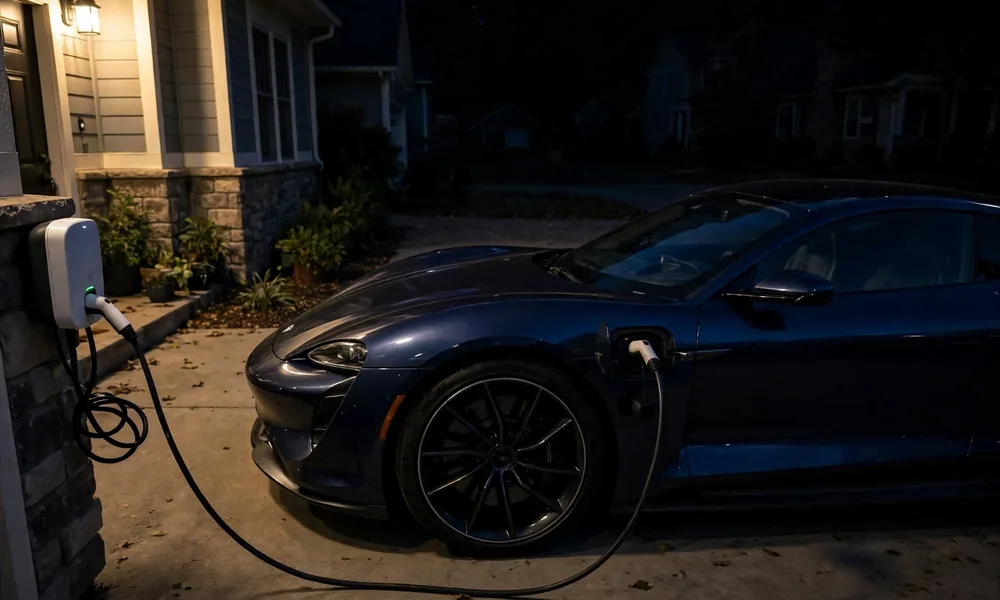
The final system is the one the driver meets most often: charging. A luxury electric sports car can accept very fast charging, often adding hundreds of kilometres of range in twenty minutes at a powerful charger, because its battery and cooling system are built for it. At home, a wall charger refills the car overnight, and the car can schedule charging for cheap electricity hours. The same ideas scale up to the fastest electric machines on the road, as our guide to how a luxury electric supercar works explains.
Luxury Electric Sports Car Specs
| Specification | Typical range |
|---|---|
| Power | About 450 to 750 horsepower |
| 0 to 100 km/h | About 3 to 4 seconds |
| Battery | About 70 to 100 kWh |
| Range | About 400 to 550 kilometres |
| Motors | Two, one per axle |
| Fast charging | About 150 to 270 kW peak |
| Weight | About 1,800 to 2,200 kilograms |
| Top speed | About 200 to 260 km/h |
What Does a Luxury Electric Sports Car Cost?
A luxury electric sports car is estimated to cost roughly $90,000 to $180,000, while the quickest dual-motor models are estimated at $180,000 to $250,000 or more. Home charging is estimated at $500 to $1,500 a year for average driving, and servicing is estimated at $500 to $1,500 a year. Prices are estimates only and vary by maker, battery and options.
A Rare Fact
An electric sports car can brake without ever touching its brake pads. Lift off the accelerator at motorway speed and the motors alone can slow the car hard enough to feel like firm braking, turning the car’s speed back into electricity as it does.
A luxury electric sports car works by replacing explosions with electricity and gears with software. The battery feeds the inverters, the inverters feed the motors, the motors push each axle exactly as hard as it needs, and the whole car is watched over by computers that never blink. There is no noise, no vibration, no drama, just speed that arrives the instant you ask for it.