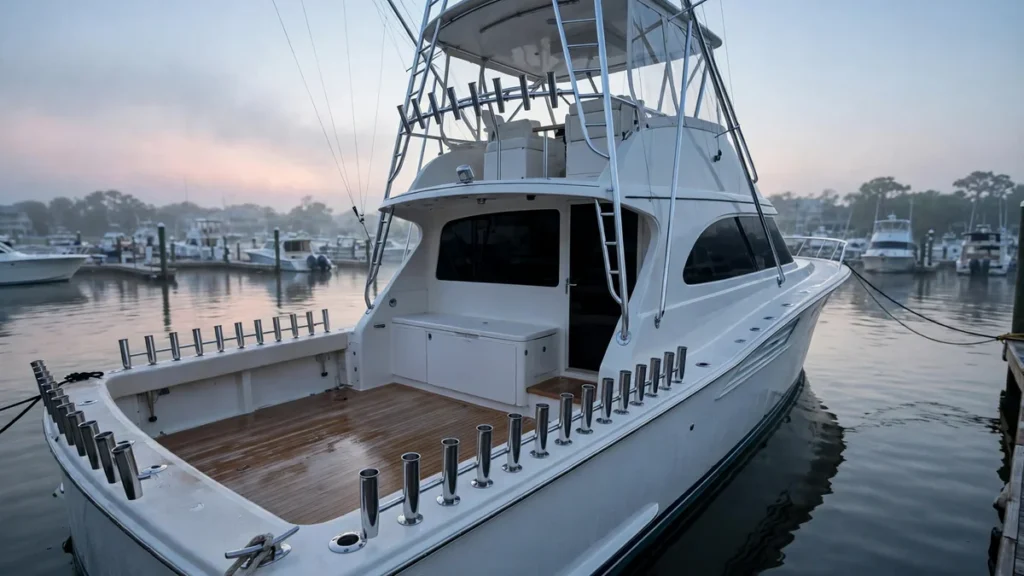
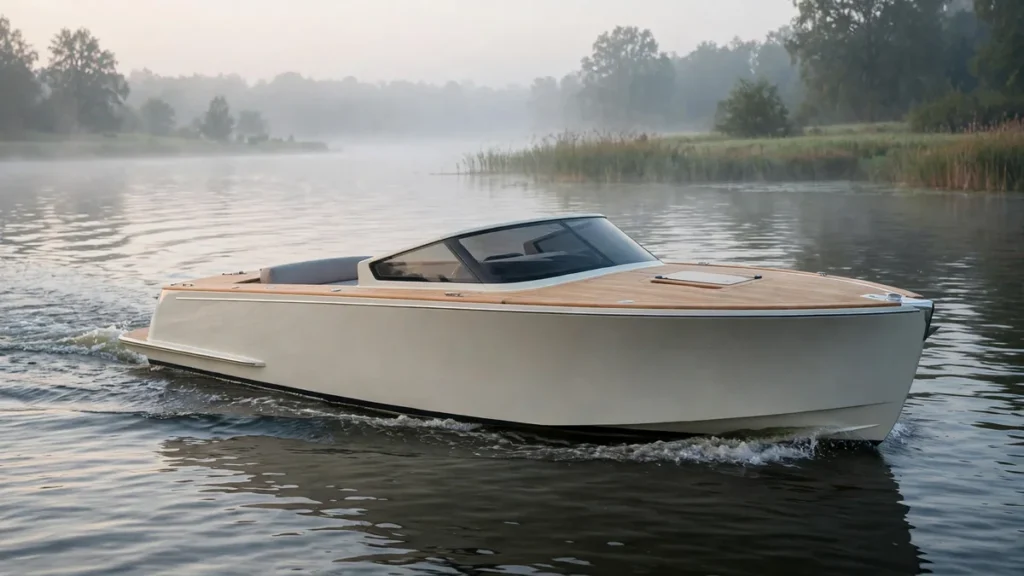
The boat leaves the marina before sunrise, and the harbour is still dark except for the running lights of a dozen other hulls doing the same thing. Out past the breakwater the sea opens up, the throttles go forward, and the boat rises onto the plane with a sound like a long, satisfied sigh. A visitor asks what a boat like this costs, and the captain points at the engines, the electronics and the hull, and says: all of it, and all of it matters.
A luxury fishing boat is a strange machine to read on paper. It is a fast offshore boat, a floating fishing station, and a comfortable day boat for the family, all in one hull, and the spec sheet has to cover speed, range, fishing gear and comfort at the same time. There are numbers for the engines and the fuel, numbers for the cockpit and the rod holders, and numbers for the electronics that find the fish. This guide reads the whole sheet the way a captain does, starting with the figures that decide how far the boat can go and ending with the ones that decide how well it fishes when it gets there.

The spec sheet at a glance
| Specification | Typical luxury figure |
|---|---|
| Length | 11 to 18 metres |
| Beam | 3.5 to 5 metres |
| Hull | Deep-V fibreglass or aluminium |
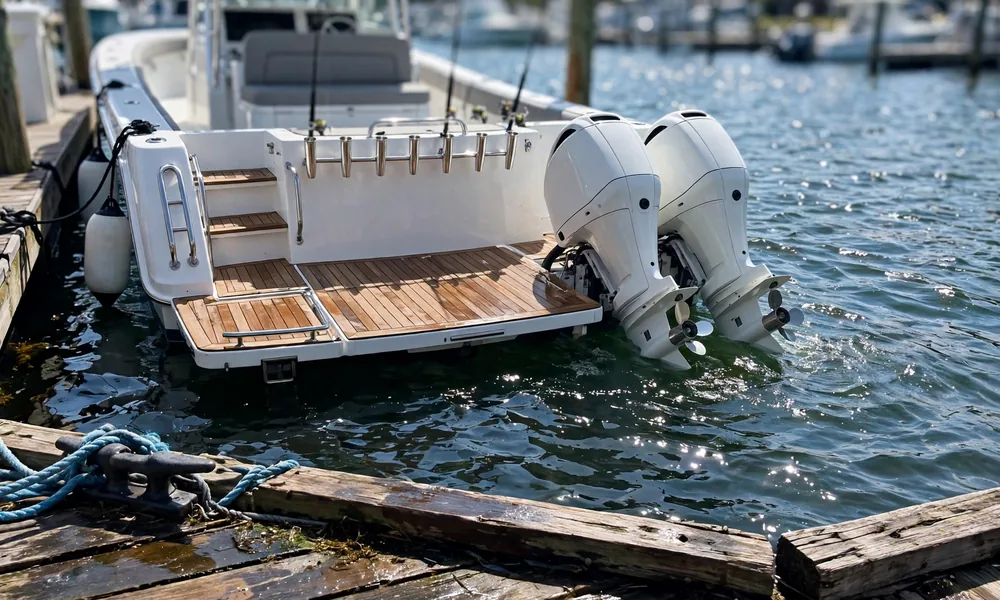
| Engines | Two or three outboards, 300 to 600 horsepower each |
| Total power | 600 to 1,800 horsepower |
| Top speed | 45 to 60 knots |
| Cruising speed | 30 to 40 knots |
| Fuel tank | 1,500 to 3,500 litres |
| Range | 400 to 700 nautical miles |
| Fresh water | 150 to 400 litres |
| Livewell | 200 to 500 litres |
| Fish boxes | 500 to 1,500 litres, insulated |
| Rod holders | 12 to 30 |
| Outriggers | Two, 5 to 7 metres long |
| Berths | Two to six |
Hull and speed: what the shape decides
The hull is the first figure that matters, because it decides how the boat behaves in a rough sea. A deep-V hull, with a sharp entry at the bow that flattens towards the stern, cuts through waves rather than slamming over them, which is what lets a fishing boat run at 30 to 40 knots in a chop without beating its crew to pieces. Beam, the width of the boat, decides stability and deck space: a beam of 3.5 to 5 metres gives a cockpit wide enough for several anglers to work at once, and enough stability that the boat does not roll hard when everyone moves to one side to fight a fish.
Speed is the number that sells the boat, but range is the number that uses it. A top speed of 45 to 60 knots is thrilling, yet most fishing is done at a cruising speed of 30 to 40 knots, where the engines are efficient and the ride is comfortable. The engines themselves are usually two or three outboards of 300 to 600 horsepower each, and the total of 600 to 1,800 horsepower is what gets a heavy, fuel-laden boat onto the plane quickly. The way the whole boat is put together is covered in how a luxury fishing boat works, from the hull to the steering.
Fuel and range: the maths of going offshore
Fuel is the real limit on a fishing trip, and the spec sheet tells the truth about it. A tank of 1,500 to 3,500 litres sounds enormous until the consumption is counted: big outboards at cruising speed can burn 150 to 300 litres an hour, which means a full tank gives roughly 400 to 700 nautical miles of range, and a wise captain keeps a third of it in reserve. Fresh water of 150 to 400 litres covers drinking, washing and the shower, and it is the second tank the crew watches.
The cockpit: where the fishing happens
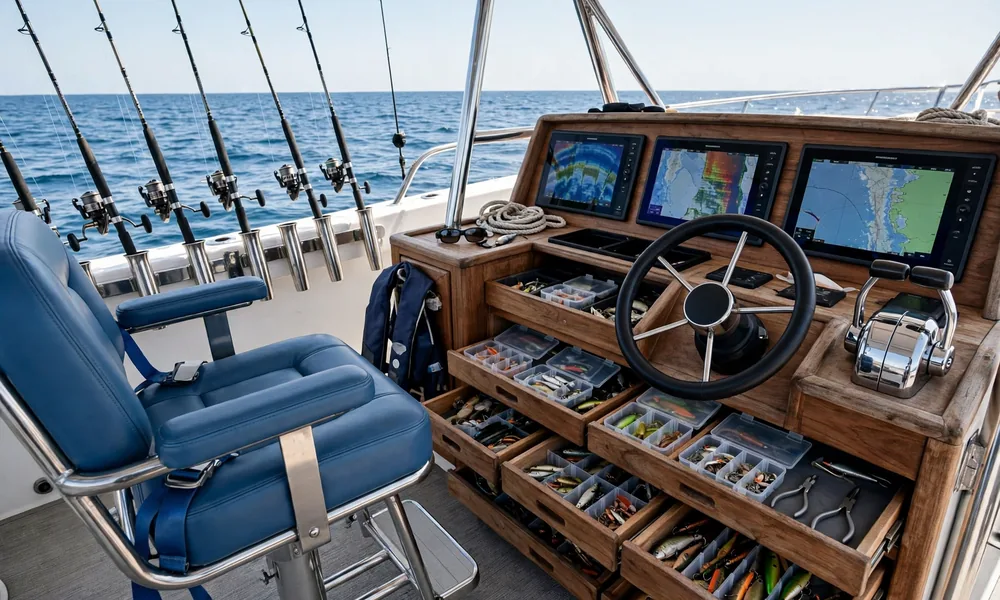
The cockpit is where a fishing boat earns its name, and its figures are measured in holders, boxes and litres. Twelve to thirty rod holders line the gunwales and the rocket launcher, so a spread of trolling rods can be set without tangling. The livewell of 200 to 500 litres keeps bait alive with circulating seawater, and the insulated fish boxes of 500 to 1,500 litres keep the catch cold on ice for the run home. Outriggers of 5 to 7 metres spread the lines wide, so more baits can be trolled at once without crossing. The fighting chair in the middle of the cockpit is where the biggest fish are fought, bolted to the deck and built to take the strain of a fish that weighs more than the angler.
Below deck, the boat turns into a small cruiser: two to six berths, a compact galley, a head with a shower, and air conditioning for the nights spent at anchor. The bigger sportfishing yachts take this further still, as how a luxury sportfishing yacht is made shows, with a full tower, a tuna door and a cockpit built for tournament fishing.
Electronics: finding the fish
The electronics are where the spec sheet turns into a treasure map. A modern luxury fishing boat carries sonar that shows the bottom and the fish beneath it, a chartplotter with detailed offshore charts, radar that sees weather and other boats, and an autopilot that holds a course while the crew works the rods. The helm itself, with its screens and throttles, is a smaller version of a ship’s bridge, and the centre console layout that many fishing boats use is covered in how a luxury center console boat is made, where the console holds the electronics and the deck stays open for fishing.
Comfort, safety and running costs
Comfort on a fishing boat is measured in shade, seating and a dry ride. A hardtop over the helm keeps the sun off, the seating is built to be hosed down, and the hull is designed so spray goes outwards rather than into the cockpit. Running costs are honest figures: fuel is the biggest, followed by engine servicing, antifouling paint on the hull, and insurance that reflects the value of the boat and its electronics.
Price: what the money buys
A luxury fishing boat typically costs an estimated 500,000 to 2,500,000 dollars, with the largest tournament boats going well beyond that. The hull and the engines are a large part of it, and the rest is the fishing gear, the electronics, the air conditioning, the generator and the finish below deck, plus the warranty and dealer support that come with a flagship model. Options add up fast: a tower, a gyro stabiliser, a bigger electronics package and a custom paint finish can add hundreds of thousands more.
A rare fact worth knowing
Some luxury fishing boats carry a sea keeper: a heavy flywheel spinning inside a vacuum, mounted low in the hull, that steadies the boat at rest. It is listed on the spec sheet as a single line about stabilisation, but it changes the fishing entirely: the boat stops rolling at anchor, the crew stops feeling seasick, and the rods stop swinging. For a boat that spends hours drifting over a reef waiting for a bite, it is the most useful number on the whole page, and the one that never appears in the brochure photographs.