The harbour was still dark when the crew of the Marlin Queen pushed off for the tournament grounds, forty miles out where the water turns a deeper blue. On board, rods stood ready in gold-anodised holders, the live bait well hummed quietly, and the fighting chair at the stern waited for its first marlin of the day. None of it looked improvised. Every rail, hatch and handhold had been placed for a single purpose: to let a small crew fight a very large fish from a very fast boat, in comfort, without anything getting in the way.
A luxury sportfishing yacht is built around that moment. It is not a superyacht with rods bolted on, nor a plain workboat with a fancy cabin. The hull must run fast in rough water, the cockpit must work like a clean workshop, and the interior must still feel like a proper yacht when the day is done.

How a Luxury Sportfishing Yacht Is Made
The build usually begins long before any fibreglass is laid, with a naval architect shaping the hull on a computer and testing it in a towing tank or simulation. The deadrise, the sharp entry at the bow, the lifting strakes and the wide transom are all tuned so the boat can cruise at thirty knots or more and still stay dry and stable when it slows to trolling speed. Once the lines are settled, a full-size mould is prepared, polished and waxed until its surface is almost mirror smooth, because every flaw in the mould will show up in the finished hull.
Step 1: Laying Up the Hull
Builders lay gelcoat into the mould first, then layer after layer of fibreglass cloth and resin, often with a foam or balsa core sandwiched between the skins for stiffness without heavy weight. Carbon fibre goes into the high-load areas, around the keel, the engine beds and the transom. The laminate is cured under controlled temperature and humidity, then the hull is lifted from the mould and checked for thickness, fairness and voids.
Step 2: Fitting the Engines and Running Gear
With the hull upright, the engine beds are aligned to a fraction of a millimetre. Most modern luxury sportfishing yachts use two or three large outboards, or a pair of powerful inboard diesels driving shafts and propellers. Fuel tanks, often holding several thousand litres, are fitted low and central to keep the centre of gravity down, and every hose, filter and seacock is installed where a mechanic can actually reach it at sea. The steering, trim tabs and gyroscopic stabiliser, if fitted, are wired and plumbed now, while the hull is still open and easy to work inside.
Step 3: Building the Cockpit for Fishing
The cockpit is the working heart of the boat, and it is built like a stage. The deck is finished in a non-slip surface that drains fast through large scuppers, so a wave or a wash-down leaves no standing water. Rod holders are set into the covering boards at the right angle, the live bait well is plumbed with a steady flow of fresh seawater, and insulated fish boxes sit under the deck. A fighting chair is bolted through the deck into a reinforced base, and the transom door is sized so a large fish can be brought aboard without a struggle.

Step 4: Joinery and the Interior
While the cockpit is being fitted, joiners work on the interior in a separate shop, building the saloon, galley and cabins as modules that are later lowered into the hull. Teak, walnut or light oak veneers are matched grain to grain, and the upholstery is cut for a space that will move in a seaway, so cushions have proper bolsters and handholds sit exactly where a hand reaches. The galley gets a proper cooker, refrigeration and a freezer for bait and food, and the cabins are insulated against engine noise and heat.
Step 5: Electronics, Helm and Tower
The helm is where the boat becomes a fishing machine. Large multi-function displays show charts, radar, sonar and engine data side by side, and a chirp sounder reads the water column for bait and fish below. Outriggers spread the trolling lines wide, and many boats add a tuna tower above the flybridge, giving the captain a high view to spot birds, weed lines and breaking fish. The tower itself is a piece of engineering, a welded aluminium structure that must be stiff, light and safe to climb in a rolling sea, with its own controls and gauges repeated at the top.
Step 6: Fairing, Painting and Sea Trials
Finally, the hull is faired, primed and painted, often in a deep fighting colour with a boot stripe and a name in gold leaf on the transom. Then comes the sea trial, the moment every builder waits for. The boat is run through its full speed range, the engines are checked at every rev, the steering is tested hard over at speed, and the fishing systems are run as they would be on a real day. Any vibration, leak or awkward detail is fixed now, before delivery, because a fault found by the owner at the tournament is a fault found too late.
Key Specifications
| Feature | Typical Range |
|---|---|
| Length overall | 12 to 25 metres (40 to 82 feet) |
| Beam | 4 to 6.5 metres |
| Engines | Two or three outboards, or twin inboard diesels |
| Top speed | 30 to 45 knots |
| Cruising speed | 25 to 35 knots |
| Fuel capacity | 2,000 to 8,000 litres |
| Construction | Fibreglass and carbon fibre composite, cored hull |
| Crew and guests | 2 crew, 4 to 8 guests |
The numbers vary widely with size; the figures above are typical ranges rather than a single model.
What a Luxury Sportfishing Yacht Costs
Prices depend heavily on size, builder and level of custom work, so treat the following as estimates. A production luxury sportfishing yacht of around 12 to 15 metres typically starts at roughly $1.5 million to $3 million. A larger semi-custom boat of 18 to 21 metres can cost an estimated $4 million to $8 million, and a fully custom build of 23 metres or more can pass $10 million. Running costs are also serious: fuel, berthing, insurance, crew and maintenance can add an estimated $150,000 to $400,000 a year on a mid-size boat. For context, the specifications of a luxury sportfishing yacht show where the money goes.
The price of the boat is only part of the story. A tournament season can burn through thousands of litres of fuel in a single weekend, and a full electronics package can cost as much as a family car. The reasons a luxury sportfishing yacht is so expensive explain why the bill climbs so fast once custom work begins.
A Rare Fact
Some of the finest sportfishing yachts are built by yards that produce only a handful of boats each year, and the waiting list for a new build can stretch to two or three years. A few famous boats have even been built around a single owner’s favourite fishing style, with the cockpit, chair and rod positions set to the owner’s exact height and reach.
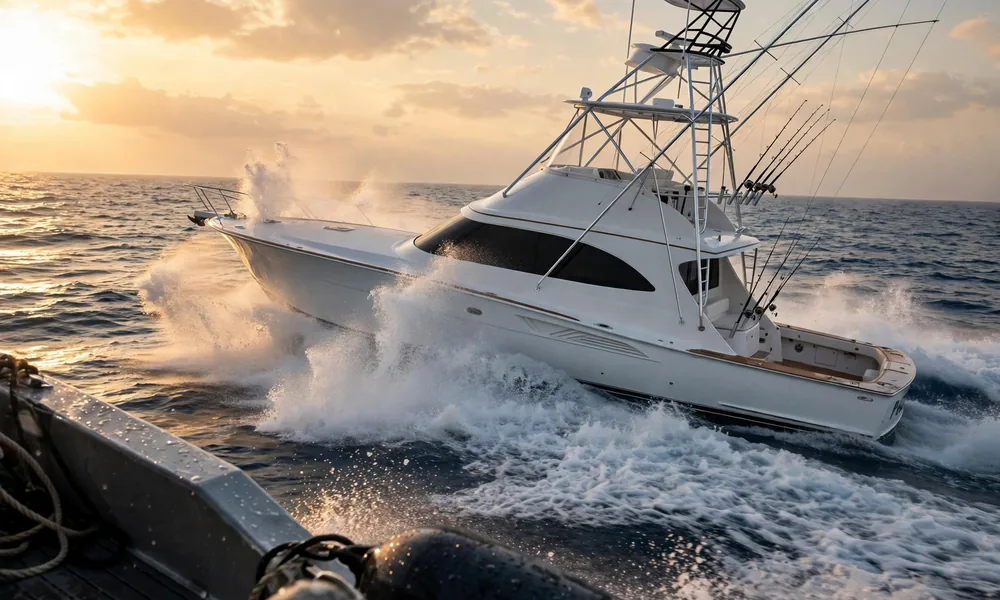
When the build is finished, the boat is handed over with trials, manuals and a shakedown cruise, and the owner finally gets to do what the whole project was about: leave the harbour before dawn and wait for the rod to bend. A centre console boat offers a simpler take on the same idea, as the specifications of a luxury centre console boat show.


