Two thousand metres below the surface, where sunlight has never reached and the pressure would crush an ordinary hull like an eggshell, a small craft the size of a minibus hangs in the dark, its lights picking out a wreck, a vent, or a reef nobody has ever seen. Inside sit two or three people in a sphere barely wider than they are tall, watching the ocean floor through a porthole the thickness of a dinner plate. The craft is a research submersible, and every number on its spec sheet is a matter of survival.
This guide explains the numbers on a luxury research submersible spec sheet in plain English: what each one means, which ones decide how deep it can go and how long it can stay, and how to tell a genuinely capable submersible from a merely expensive one.
Depth rating: the number that decides everything
The depth rating is the first number on the sheet and the most important, because it decides where the submersible can work. A rating of 1,000 metres opens the continental slopes, 3,000 metres reaches the abyssal plains, and 6,000 metres covers almost the entire ocean floor, and each step deeper demands a stronger pressure hull and a higher price.
The pressure hull: a sphere, and why it must be one
The pressure hull is almost always a sphere, and the reason is pure physics: a sphere spreads pressure evenly over its whole surface, with no corners or flat panels for the water to push in. The sphere is made from titanium, machined from a single forging and polished until it is perfectly round, because a dent or a flat spot becomes the place the pressure attacks first. The guide to how a luxury personal submarine is made follows a similar sphere built for private owners, and the lesson is the same: the sphere is the submersible, and everything else hangs off it.
Viewports: windows thicker than dinner plates
The viewport is the submersible’s window on the deep, and it is a disc of acrylic up to fifteen centimetres thick, shaped to sit in a conical seat so the water pressure pushes it tighter into its housing the deeper the craft goes.
Life support: air, power and time on the bottom
Life support is measured in hours, and the sheet quotes two numbers: the normal endurance, and the emergency reserve. The crew breathe oxygen from tanks, and the carbon dioxide they breathe out is scrubbed from the air by chemical canisters, the same system used in spacecraft, and the air is circulated by a small fan that must never stop. A typical research dive lasts eight to ten hours, with a seventy-two-hour emergency reserve, and the guide to how a luxury tourist submarine works shows a simpler version of the same system, where the dives are shorter, the water is shallower, and the passengers are looking at a reef rather than a vent.
Thrusters and manipulators: hands and feet in the dark
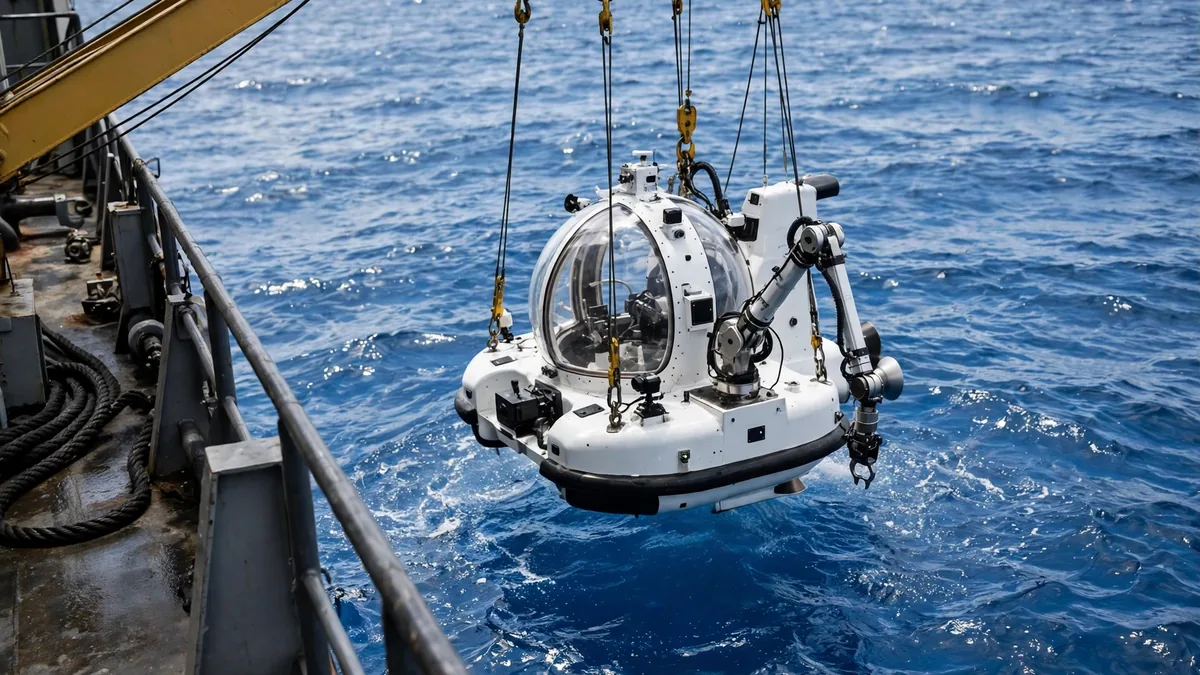
A submersible moves with electric thrusters, small propellers in ducts mounted around the hull, which let it hover, turn and hold position against a current without disturbing the sediment it came to study. The sheet quotes the number of thrusters and their power, because a submersible that cannot hold still cannot take a sample, and the most important tool aboard is the manipulator arm, a jointed robotic arm with a gripper that collects rocks, animals and water samples and places them in baskets on the skid below. The guide to luxury research vessel specs, explained sets out the numbers for the ship that carries the submersible, and the two sheets belong together, because the submersible never dives without its mother ship above it.
Sonar and cameras: seeing what the lights cannot reach
The last numbers describe how the submersible sees. Its lights are powerful LEDs, but light dies quickly in deep water, so beyond a few metres the craft relies on sonar, which maps the sea floor in sound, and on cameras, which record everything the lights touch in high definition. The sheet quotes the sonar frequencies and the camera resolution, and the best submersibles carry both a scanning sonar that looks ahead and a multibeam sonar that maps the ground below, so the crew know what is coming and what they are standing on.

The spec sheet at a glance
| Specification | Typical luxury figure | What it tells you |
|---|---|---|
| Depth rating | Roughly 1,000 to 6,000 metres | Where the submersible can work, and what it costs to go there |
| Pressure hull | Titanium sphere, machined from one forging | How the crew survive the pressure at depth |
| Viewport | Acrylic disc, up to 15 centimetres thick | How clearly the crew can see, and how safe the window is |
| Endurance | Roughly 8 to 10 hours, 72-hour emergency reserve | How long a dive lasts, and how long the crew can wait for rescue |
| Crew | Usually 2 to 3 people, pilot plus scientists | Who fits inside the sphere, and what they can do there |
| Thrusters | Four to eight electric thrusters, ducted | How precisely the craft can hover and hold position |
| Manipulator | One or two jointed arms with grippers | How samples are collected from the sea floor |
| Sonar | Scanning ahead, multibeam below | How the crew navigate and map what they cannot see |
| Batteries | Lithium, tens of kilowatt-hours | How long the lights, thrusters and life support can run |

What it costs
A luxury research submersible typically costs an estimated $3,000,000 to $10,000,000, depending on its depth rating, its sphere and its scientific equipment. The estimate covers the submersible alone, not the mother ship, the launch system or the support crew, which are a permanent part of putting a small sphere two thousand metres down and bringing it safely back.
A rare fact
One detail few people on land ever learn is that the pressure at 6,000 metres is about six hundred times the pressure at the surface, roughly the weight of a car pressing on every square centimetre of the hull, and the sphere survives it not by being thick alone, but by being round. A flat panel of the same thickness would bend and fail, but a sphere turns the crushing force into compression, which the metal carries easily, and that is why every deep submersible, from the first bathyscaphes to the newest research craft, has carried its crew inside a ball.
Read the spec sheet in that order, depth first, then the sphere, the window, the life support, the thrusters and the sonar, and the numbers stop looking like a code and start looking like a description of a small machine. The best research submersibles are not the ones with the biggest single number, but the ones whose numbers agree with each other, a depth rating the sphere can hold, a battery that outlasts the dive, and a manipulator that can pick up what the cameras found.


