Dinner on a cruise ship is usually served indoors, under a roof, at a table with a cloth. The barbecue is the exception. On the open deck, in the sun, a row of grills cooks for hundreds of passengers at once, and the smell of smoke and seared meat drifts across the whole deck. The grill station looks like a row of steel boxes, but the spec sheet behind it is about feeding a crowd outdoors without ever stopping.
A luxury ship barbecue grill is a built-in outdoor cooker on the open deck of a large ship, usually one of a row of identical units, used by the ship’s chefs to grill meat, fish, and vegetables for passengers at deck barbecues and buffets. It is a fleet fitting, not a single grill, so the numbers are about output and uniformity as much as cooking: every grill must match every other grill, and every spare part must fit any unit. This is a plain translation of the numbers that matter.
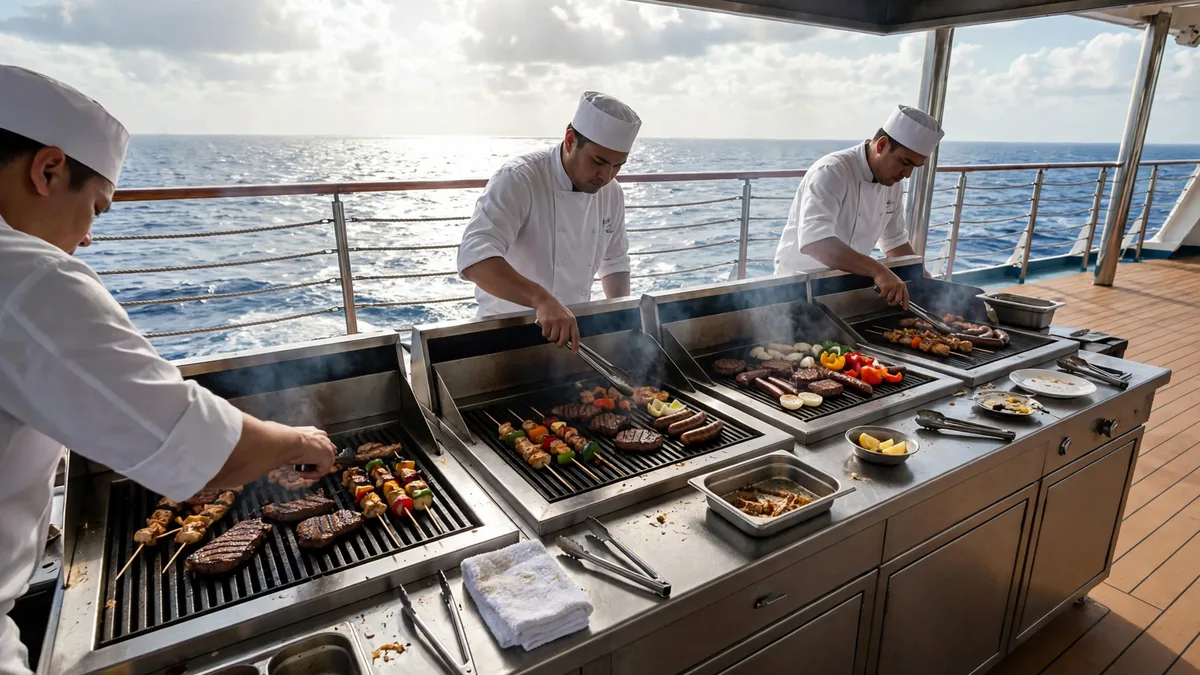
1. Cooking area and size, and the grill drawn for a crowd
The first numbers on the sheet are the cooking area and the size of each unit. A ship barbecue grill usually offers 1,500 to 3,000 square centimetres of cooking surface, on a unit 90 to 150 centimetres wide and 60 to 80 centimetres deep. That is enough for one chef to grill for 50 to 100 passengers an hour, and a station of four to six grills feeds a whole deck barbecue.
The figure to read next to the size is the height of the cooking surface, usually 85 to 95 centimetres off the deck. That is standing height for the chef, and it keeps the grill clear of spray when the ship rolls.
2. Heat output and burners, and a grill that never cools down
The heat is the second number on the sheet. A ship barbecue grill usually delivers 20 to 40 kilowatts across four to six burners, and it reaches grilling temperature, around 250 to 300 degrees Celsius, in 10 to 15 minutes from cold.
The number to check next to the output is the recovery time, usually under two minutes after a cold load of meat lands on the grate. A grill that loses its heat when the food arrives cannot keep up with a queue of a hundred passengers, and the queue is the whole point of a deck barbecue. The flat steel grill beside it is described in how a ship teppanyaki grill works, and the same rule applies: the surface must hold its heat.
3. The steel and the marine build, and grills that never rust
The steel is where the marine price appears. A ship barbecue grill is usually built from marine-grade 316 stainless steel, chosen because it resists salt water where ordinary stainless steel pits and stains. The lid, the firebox, and the frame are all the same grade, and every weld is ground smooth so grease has nowhere to hide.
The figure to read next to the grade is the steel thickness, usually 3 to 4 millimetres in the firebox and 2 to 3 millimetres in the lid. The galley it works beside is measured in the ship galley spec sheet, explained.
4. Fuel, gas lines, and the supply for a whole station
The fuel is the number the ship’s buyer asks about first. A ship barbecue station usually runs on propane or natural gas from the ship’s own supply, with fixed stainless lines to every grill and a shut-off valve the crew can reach in seconds. A charcoal station, rarer on a ship, uses lump charcoal and needs a fireproof ash system, because embers and a crowded deck do not mix.
The number to check next to the fuel is the consumption, usually 1 to 2 kilograms of gas per grill per hour of cooking. A station of six grills uses roughly 6 to 12 kilograms an hour, so a deck barbecue evening burns through 30 to 50 kilograms.
5. Wind, grease, and the grill that cooks in a gale
The wind is the enemy a land grill never meets. A ship barbecue has a deep lid, a raised lip around the cooking surface, and a wind guard at the back, so a gust does not blow the flame sideways or push the heat off the grate. The lid is heavy enough to stay shut in a breeze, and it is hinged so it cannot blow open and hit a guest.
The figure to read next to the wind guard is the grease system, usually a slide-out tray holding 3 to 5 litres per grill, with a drain to a central tank the crew empties after every service. The deck the station sits on is described in how a luxury ship deck works.

6. Cleaning and care, and a station built for a decade
The last number on the sheet is the service life. A ship barbecue grill usually lasts eight to twelve years, the burners three to five, and the grates one to two before they are replaced, because a ship grill works far harder than a yacht grill. The crew brushes the grate after every service, oils the steel weekly, and covers the station whenever the ship is under way in bad weather.
The figure to read next to the life is the cleaning time, usually 30 to 45 minutes per grill after a service. The covers are fitted, not loose sheets, so they do not blow off in the first squall.
The Specifications at a Glance
Here are the numbers that matter most on a luxury ship barbecue grill.
| Specification | Typical Luxury Range |
|---|---|
| Cooking area per grill | 1,500 to 3,000 square centimetres |
| Grill width | 90 to 150 centimetres |
| Heat output | 20 to 40 kilowatts, gas |
| Burners | 4 to 6, independently controlled |
| Grilling temperature | 250 to 300 degrees Celsius |
| Steel grade | Marine-grade 316 stainless steel |
| Fuel use | 1 to 2 kilograms of gas per grill per hour |
| Grills per station | 4 to 6 identical units |
What Does a Luxury Ship BBQ Grill Cost?
A luxury ship barbecue grill is estimated to cost roughly $15,000 to $45,000 per unit installed, depending on size and fuel. A standard gas grill in marine-grade steel is estimated at roughly $15,000 to $25,000, while a larger custom grill with a rotisserie, a side burner, and a plumbed gas line is estimated at roughly $25,000 to $45,000. A full station of six grills is estimated at roughly $90,000 to $270,000.
A Rare Fact
A ship barbecue station is counted like a lifeboat, not like a grill. The crew counts the grills, the lids, and the grease trays every morning and every evening, because a missing lid is either in the wrong place or over the side, and the count is part of the deck log. No other cooking equipment on the ship is counted twice a day.

Once you know which numbers do the work, the sheet makes sense. Cooking area decides whether a hundred passengers eat together or in shifts, steel grade decides whether the station survives a decade of salt air, and recovery time decides whether the queue keeps moving or stalls at the grill.


