Step aboard a luxury ship and the first surface you meet is the deck. A deck looks simple, just a flat surface to walk on, but the specification sheet for a ship’s deck reads like the description of a machine, because that is what it is: a working surface that carries thousands of people, tonnes of equipment, and the full force of the sea, all while staying dry, level, and safe.
Decks are where the ship’s two worlds meet. The deck has to serve both worlds at once, strong enough for the machinery below and comfortable enough for bare feet above, and the numbers on the sheet record exactly how that compromise was struck.
This guide explains the main figures on a luxury ship deck specification, from the thickness of the plating to the camber that sheds rainwater, and what each of them means for the way the ship feels underfoot.
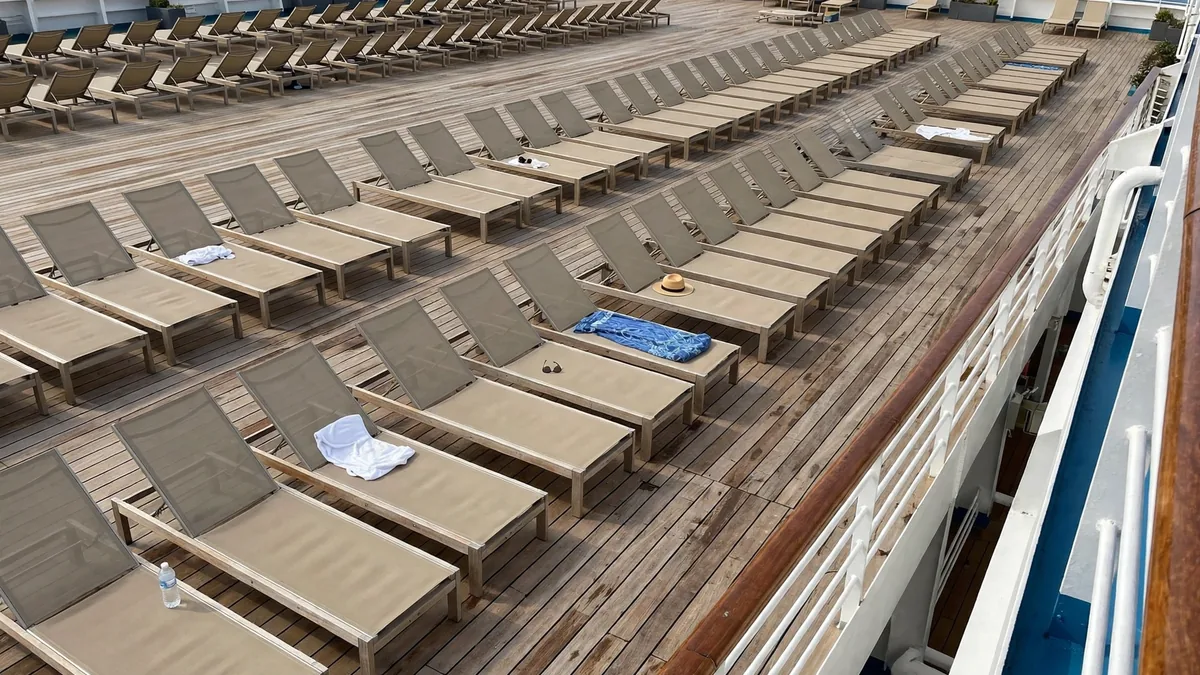
Luxury Ship Deck Specs at a Glance
| Specification | Typical range | What it decides |
|---|---|---|
| Deck plating thickness | 10 to 20 millimetres | Strength under load |
| Camber (rise from edge to centre) | 150 to 300 millimetres | Rainwater drainage |
| Design load, public deck | 3 to 5 kilonewtons per square metre | Crowd and furniture capacity |
| Design load, vehicle or tender deck | 10 to 20 kilonewtons per square metre | Heavy equipment capacity |
| Teak overlay thickness | 8 to 12 millimetres | Grip, insulation and lifespan |
| Bulwark and railing height | 1.0 to 1.2 metres | Passenger safety at the edge |
Plating and Load: What the Deck Can Carry
The deck itself is steel, usually ten to twenty millimetres thick, laid over a frame of beams and girders that run the length and breadth of the ship. Public decks, where crowds gather, are built to carry three to five kilonewtons per square metre, which is roughly the weight of a dense crowd standing shoulder to shoulder, plus the furniture, the planters, and the occasional grand piano. Vehicle and tender decks are built far heavier, ten to twenty kilonewtons per square metre, because they carry machines on wheels that concentrate their weight onto four small patches of tyre.
The load figures matter because a deck that flexes too much underfoot feels wrong, even if it is perfectly safe. The designers therefore build for stiffness as much as for strength, adding depth to the beams under the deck so the surface stays flat and quiet. The steel is also part of the ship’s overall structure. The main deck is one of the strongest parts of the hull, acting like the top flange of a giant beam, carrying the bending loads as the ship rides over waves. That structural role is why deck openings are so carefully controlled. The wooden surface laid over that steel has its own specification, and how a yacht teak deck is specified explains the planks, the caulking and the thickness that decide how long it lasts.
Camber, Drainage and the Curve You Cannot See
Stand in the middle of a luxury ship’s deck and look towards the edge, and the surface appears perfectly flat. Every deck is built with camber, a gentle rise from the edges to the centreline, usually between one hundred and fifty and three hundred millimetres across the full width of the ship. The curve is too slight to notice underfoot, but it is enough to make rainwater run off to the scuppers at the sides instead of pooling in the middle, and it is enough to give the deck extra stiffness, the way a shallow arch is stronger than a flat beam.
The drainage system that works with the camber is on the spec sheet too. Scuppers are spaced along the deck edge, each one sized to clear a set volume of water per minute, and the freeing ports in the bulwark are sized to clear a wave that breaks over the deck in seconds. On an open deck, the difference between a scupper that works and one that is blocked is the difference between a deck that dries in minutes and one that stays slippery for an hour, so the crew inspects them constantly. Interior decks slope gently towards drains in the galleys and bathrooms, small enough that a glass of water would not slide, but enough that a spill finds its way to a drain instead of into a cabin. The decks that carry the most specialised equipment sit high on the ship, and the specification of a yacht helipad shows what happens when a deck has to land a helicopter as well as drain the rain.
Surfaces, Railings and the Human Edge
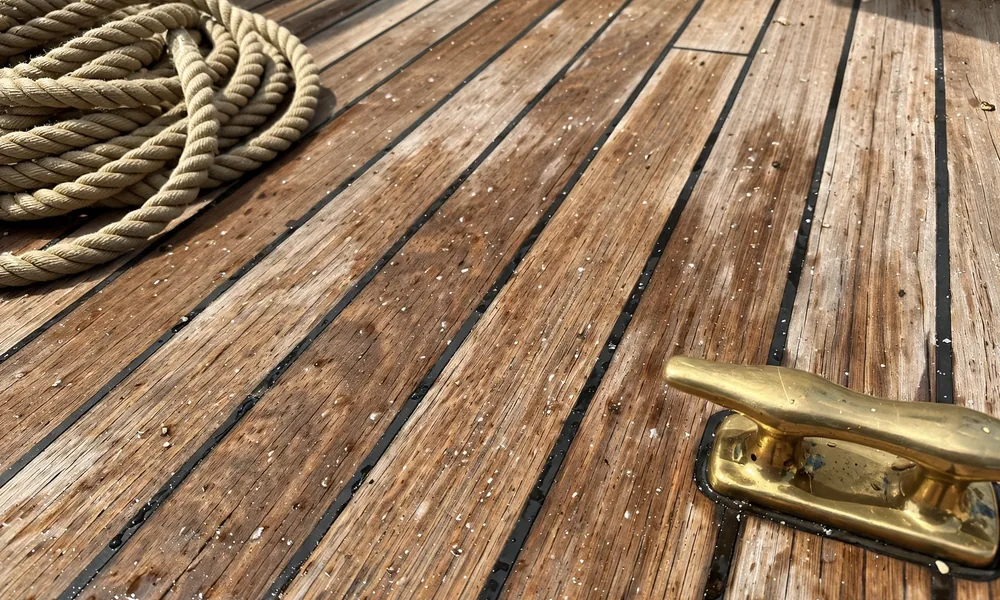
The surface passengers actually touch is rarely the steel itself. On open decks it is usually teak, laid eight to twelve millimetres thick in planks with dark caulking between them, or a synthetic equivalent that looks like teak and behaves like it underfoot. The thickness decides the deck’s life, because the surface is sanded over the years to remove stains, and every sanding takes a fraction of a millimetre away. A deck laid at twelve millimetres can be sanded many times before it becomes too thin, while one laid at six millimetres has almost no life left to give. Teak is chosen because it grips when wet, stays cool enough to walk on barefoot in the sun, and does not splinter the way cheaper woods do.
At the edge of every deck stands the bulwark or railing, and its height is fixed by regulation at one to one point two metres, high enough that a person leaning on it cannot topple over, and strong enough to take the weight of a crowd pressing against it. The railings are tested to a horizontal load, and the glass panels used on modern ships are laminated, so even if they crack they stay in place.

A Rare Fact About the Deck
Here is a detail that surprises even seasoned cruisers. The main deck of a large luxury ship is not a single flat piece of steel. It is built in sections with expansion joints, narrow gaps that let the deck grow and shrink as the ship moves between tropical heat and cold northern seas. The steel of a three-hundred-metre ship can change length by more than a metre between a hot day in the Caribbean and a cold morning in the North Atlantic, and without those joints the deck would buckle or tear its own fittings apart.
What the Specs Mean for You
If you are choosing where to spend your time on board, the deck specification tells you what to expect underfoot. A deck built to a high load rating means you will not feel it flex under a crowd, and railings built to the full regulation height mean you can lean on them and watch the sea without a second thought.
The next time you walk a promenade deck, notice the almost invisible curve under your feet, the dark lines between the planks, and the way the water runs to the edges after a shower. The scale of the vessels these decks belong to is part of the wonder, and the full specification of a luxury ocean liner shows how one deck fits into a ship that carries thousands of people at once.