There is a small moment on every cruise that nobody photographs. The ship is tied up, the dock is busy, and a long metal ramp reaches from the ship’s side down to the concrete. People walk up it without thinking, chatting, carrying bags, trusting the thin-looking bridge under their feet. That ramp is the gangway, and behind it sits a specification sheet that decides whether the walk aboard is safe, comfortable and dry.
The gangway is one of the hardest-working parts of a luxury ship. It carries hundreds of people a day, swings with the tide, folds away for sea, and still looks smart enough for a ship that cost a fortune. The specification sheet is where the designers prove it, recording how long it is, how much it can carry, and how steep it may get.
This guide walks through the figures on a gangway specification sheet and explains what each one means in plain language, so the next time you walk up a gangway you will know what you are standing on.
Luxury Ship Gangway Specs at a Glance
Before the detail, here are the headline numbers for a typical gangway. A smaller ship sits at the modest end of each range, while the largest ships push further, but the pattern of a long, light ramp that moves with the tide stays the same.
| Specification | Smaller Ship | Mid-Size Ship | Large Ship |
|---|---|---|---|
| Gangway length | 8–12 metres | 12–18 metres | 18–25 metres |
| Walkway width | 1.0–1.2 metres | 1.2–1.5 metres | 1.5–1.8 metres |
| Safe working load | 1.5 tonnes | 2.5 tonnes | 4 tonnes |
| Gangway weight | 800 kg–1.2 tonnes | 1.2–2 tonnes | 2–3.5 tonnes |
| Handrail height | 1.0 metre | 1.1 metres | 1.1 metres |
| Sections | One section | Two, telescoping | Two, telescoping |
Length and the Tide: Why the Ramp Is So Long
Length is the first number, and it is fixed by the tide, not by the ship. The gangway must reach from the side door to the dock at low tide, when the gap is widest and the ramp steepest, and be short enough to stow on board when the ship sails. On a smaller ship it is usually 8 to 12 metres long, and on the largest it can reach 18 to 25 metres, longer than most houses.
Length also decides the slope, and the slope decides whether passengers can walk it comfortably. The sheet records the steepest working angle, usually around 30 degrees, because a steeper ramp is hard work with luggage, and impossible for a wheelchair. The how a luxury ship gangway is made guide shows how builders work out that length and angle before any metal is cut, but the sheet is where the finished numbers are recorded.
Load Rating: How Many People It Can Hold
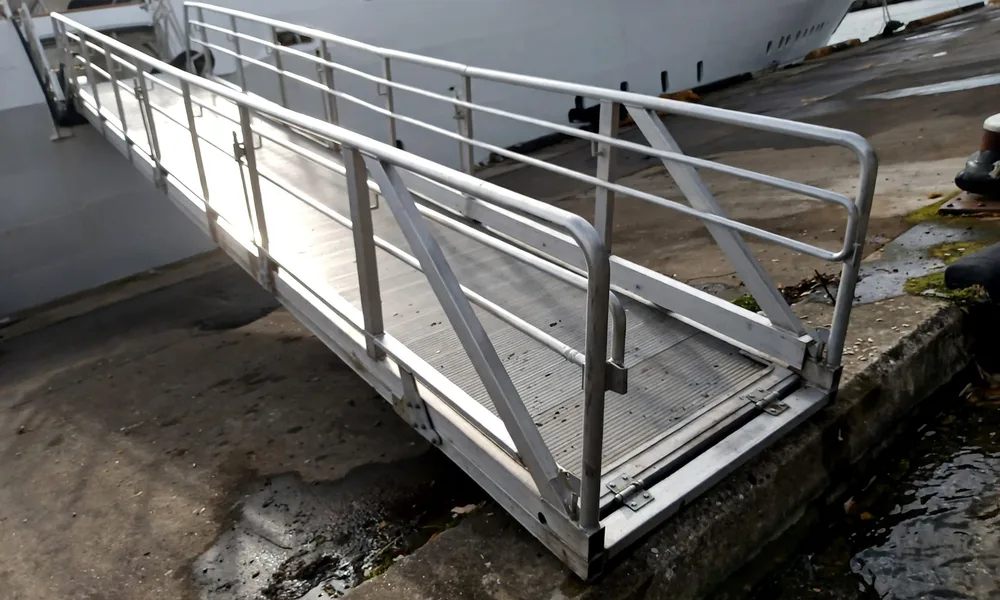
The second number is the safe working load, and it is the figure the crew check first. A smaller ship’s gangway is usually rated to 1.5 tonnes, a mid-size ship manages 2.5 tonnes, and the largest reach 4 tonnes, the weight of several dozen people standing on the ramp at once. The rating is not a guess. The gangway is load-tested with weights before the ship enters service, and the test is repeated every year.
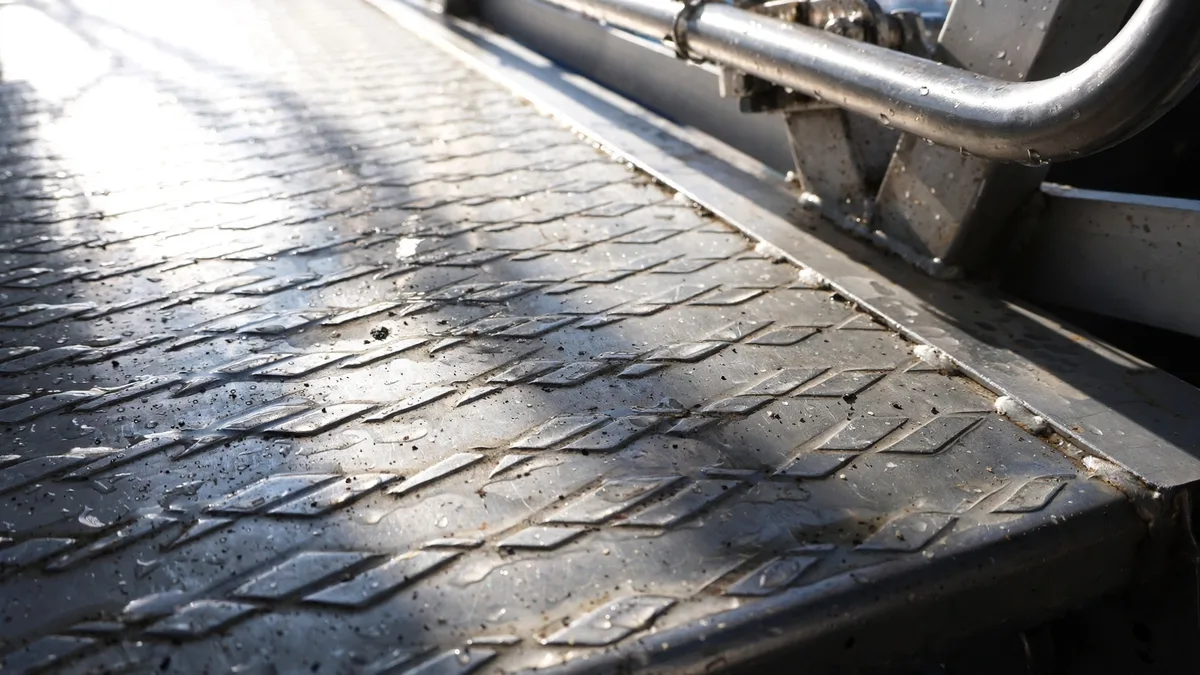
Width is tied to the load: a wider ramp carries more people and lets them pass each other. The walkway is usually 1.0 to 1.2 metres wide on a smaller ship and 1.5 to 1.8 metres on the largest, wide enough for two people with bags to pass without one stepping aside. The deck is aluminium grating or diamond-plate tread, chosen to grip wet shoes, because a gangway in the rain is slippery, and the sheet records the tread type alongside the width.
Materials and Weight: Why Aluminium Wins
The third group covers the material, and on a luxury ship the gangway is almost always aluminium. Steel would be stronger but far heavier, and a gangway must be swung out by a small crane or a pair of davits, so every kilogram counts. Aluminium also shrugs off salt spray far better than bare steel, which matters for a ramp that works outdoors for its whole life. The sheet records the weight: 800 kilograms to 1.2 tonnes on a smaller ship, and 2 to 3.5 tonnes on the largest.
The handrails are part of the same story: the sheet records their height, usually 1.0 to 1.1 metres, and the gap between them, kept narrow enough that a child cannot slip through. The rails are stainless steel tubes, bent to follow the slope, and set at a height that suits a hand, not a shoulder. The luxury ship deck specifications describe the decks the gangway leads onto, but its own numbers decide whether the step aboard feels safe.
Pivot, Roller and Stowage: The Moving Parts
The last figures cover the moving parts, because a gangway that cannot move is a gangway that will break. At the ship end, a heavy pivot pin lets the ramp swing up and down and side to side as the ship moves, and the sheet records the pivot’s load rating and range of movement. At the dock end, wide rollers let the ramp roll along the quay instead of digging in when the tide lifts the ship, and the sheet records the roller size and the load they carry.
Stowage is the final number, the one the crew care about most at sea. The gangway must fold or slide away on board, and the sheet records how it stows: one straight section on a smaller ship, or two telescoping sections on a larger one. A gangway that stows badly rattles, leaks and takes up deck space, and the luxury ship bow specifications show the same thinking at the front of the ship, where every fitting must earn its place.

A Rare Fact About the Luxury Ship Gangway
Here is a detail that surprises people who have never watched a gangway being rigged. The dock end often carries a small roller that looks like an afterthought, but it is one of the most important parts of the ramp. As the tide rises and falls, the ship moves up and down by a metre or more, and without that roller the end of the gangway would scrape across the concrete, grinding away the metal and jerking the ramp under everyone’s feet. The roller lets the ramp glide instead, so it stays still underfoot while the ship and the sea move around it, and the passengers never notice a thing.
What the Specs Mean for You
If you are buying, chartering or boarding a luxury ship, the gangway sheet tells you how safe and comfortable the step aboard will be. A long ramp with a gentle slope, a generous load rating, a wide walkway and a proper roller all point to a ship built for hundreds of passengers a day, in rain and in sun.
If the numbers are vague, or the load rating barely covers a crowd at once, ask questions. A good gangway is light, strong, wide enough to pass on, and fitted with moving parts that let it follow the tide. That is the ramp you want under your feet when you step aboard.


