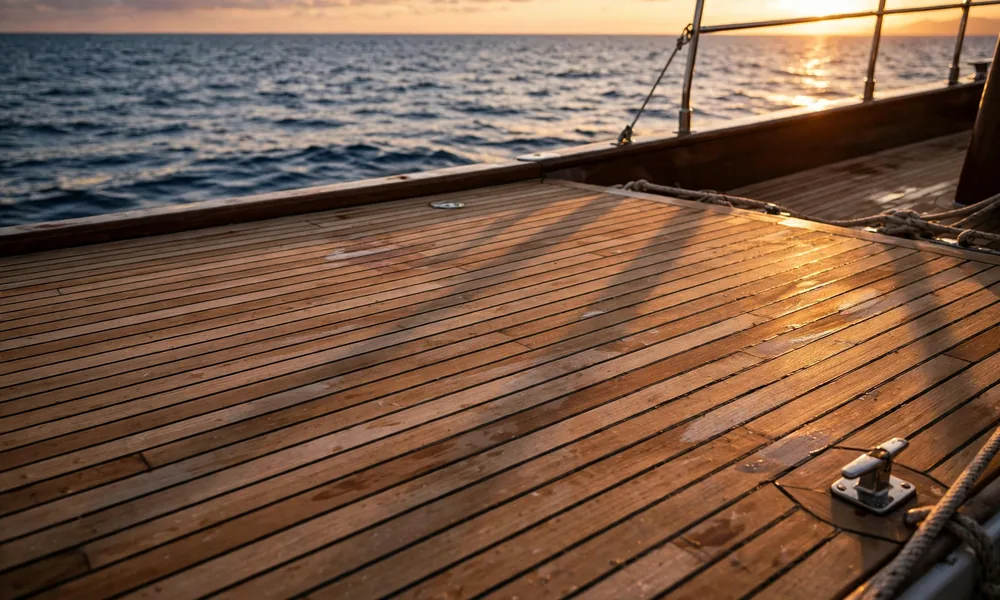
The yacht is tied up in the marina on a warm morning, and the first thing you notice before you step aboard is the deck. It is warm under bare feet, golden brown, and striped with dark lines that run straight from bow to stern. A guest reaches down and touches it, half expecting varnish, and finds instead a surface that grips gently, even where the morning dew has not yet dried.
That is a teak deck, and it has been the standard for yacht decks for more than a century, not because it looks traditional, but because the wood itself is unusually well suited to life at sea. The specification sheet for a teak deck, though, is not about the romance of the wood. It is about planks, gaps, glue, and thickness, and every number on it decides how long the deck will last.
Read the sheet properly and you can tell a deck that will still look good in twenty years from one that will need replacing in five. Here is what each of those numbers means, and how to read them together.

Yacht Teak Deck Specs Explained
1. Plank width and thickness
Plank width is the first number on the sheet, and on a yacht it is usually between 40 and 60 millimetres, with a thickness between 8 and 12 millimetres for a glued deck laid over a fibreglass or steel sub-deck. Thickness is the deck’s life: a teak deck is sanded over the years to remove stains and restore its colour, and every sanding takes a fraction of a millimetre away. A deck laid at 12 millimetres can be sanded many times before it becomes too thin, while a deck laid at 6 millimetres has almost no life left to give.
2. Teak grade and origin
Not all teak is the same, and the grade on the sheet matters more than the price. The best decking teak is slow-grown, quarter-sawn, and free of knots, with a tight, even grain and a high natural oil content. Quarter-sawn timber, cut so the grain runs straight through the plank, moves less with moisture and wears more evenly than flat-sawn timber. The way those planks are prepared and laid is described in how a yacht teak deck is made, from selecting the timber to the finished deck.
3. Caulking width and compound
The dark lines between the planks are caulking, and their width is usually between 4 and 6 millimetres. Caulking has two jobs: it seals the gap between planks so water cannot reach the sub-deck, and it stays flexible while the wood moves. Modern decks use a flexible polyurethane or polysulphide compound rather than the traditional pitch, because it bonds to the wood, stretches as the planks expand and contract, and can be sanded flush with the deck.
4. Glue and fixing method
How the deck is fixed down decides how long it stays down. Modern teak decks are usually glued to the sub-deck with a flexible epoxy or polyurethane adhesive, with no screws through the planks at all. Older decks were screwed down, with each screw hidden under a wooden bung, and every screw hole was a potential leak. The adhesive must stay flexible, because teak expands and contracts with moisture, and a rigid glue would crack and let the planks lift. The full working principle is set out in how a yacht teak deck works, including how the wood, the glue, and the caulking move together through sun, rain, and salt water.

5. Slip resistance when wet
Slip resistance is the specification that matters most to anyone who walks on the deck in bare feet. Teak is naturally grippy when wet, because its oily surface and open grain give a shoe or a foot something to hold onto, and a well-maintained teak deck is far less slippery than painted fibreglass or varnished wood. The specification is usually given as a coefficient of friction, and a good teak deck measures around 0.6 to 0.8 when wet, against about 0.4 for a smooth painted surface. It is what keeps the deck safe underfoot.
6. Heat and barefoot comfort
A teak deck in full sun gets hot, and the specification sheet sometimes gives a surface temperature for a standard sunny day. Teak typically reaches about 45 to 55 degrees Celsius in direct Mediterranean sun, which is hot to the touch but cooler than a dark painted deck, which can pass 70 degrees, and cooler than bare fibreglass in a dark colour. The wood’s low thermal conductivity means the heat stays near the surface and the deck cools quickly when shade or a breeze arrives.
7. Service life and maintenance
Service life is the specification that decides whether a teak deck is an investment or a burden. A well-laid teak deck on a yacht can last 20 to 30 years, because the wood is dense, oily, and resistant to rot, and because it can be sanded and re-caulked several times over its life. That life depends on maintenance: washing with salt water, avoiding harsh detergents and pressure washers, and re-caulking the seams when they crack or pull away from the wood. A comparable piece of deck engineering is described in the yacht propeller specifications, where the same trade between performance, maintenance, and service life decides the design.
Yacht Teak Deck Specs
| Specification | Typical range |
|---|---|
| Plank width | About 40 to 60 millimetres |
| Deck thickness | About 8 to 12 millimetres |
| Caulking width | About 4 to 6 millimetres |
| Fixing method | Glued, no screws through planks |
| Wet slip resistance | About 0.6 to 0.8 coefficient of friction |
| Surface temperature in sun | About 45 to 55 degrees Celsius |
| Service life | About 20 to 30 years |
| Timber grade | Quarter-sawn, knot-free, high oil content |
What Does a Yacht Teak Deck Cost?
A teak deck for a yacht is estimated to cost roughly $400 to $800 per square metre fitted, depending on the size of the yacht, the grade of the teak, and the complexity of the deck shape. A full deck on a 15-metre yacht is estimated at roughly $25,000 to $50,000, and a deck on a 30-metre superyacht can be estimated at well over $150,000. Re-caulking an existing deck is estimated at roughly $100 to $200 per square metre, which is why regular maintenance is far cheaper than letting the seams fail and water reach the sub-deck.
A Rare Fact
Teak was once the decking of choice for warships, not just yachts. The decks of early twentieth-century battleships were laid in teak because the wood did not splinter into dangerous shards when hit by shellfire, unlike steel decking, and because it stayed grippy underfoot in wet weather. The same properties that protected sailors in battle still protect bare feet on a yacht today.
A teak deck never gets the attention the engine or the sails get, yet it is the surface everyone touches, walks on, and remembers. Read the plank width, the thickness, the caulking, and the service life together, and the deck stops being a pretty golden floor and becomes what it really is: a working surface engineered to survive sun, salt, and twenty years of bare feet.