Two hundred metres below the surface, in a steel tube where every centimetre is accounted for, a crew member pedals a stationary bike while the hull creaks around them. There is no window, no fresh breeze and no horizon to run towards. The gym is a small room wedged between machinery and bunks, and yet it is one of the most carefully specified spaces on a luxury submarine. Without it, a crew living underwater for weeks would lose strength, sleep badly and fray at the edges.
A luxury submarine gym is a compact fitness room fitted inside a pressure hull, built so a small crew can train daily during long dives. It is not a hotel gym shrunk to fit. Every machine must survive salt air, fit through a hatch, bolt down against the motion of the sea, and share power and air with the rest of the boat. The specification sheet is where those compromises are written down. This guide explains what each number means.
The Spec Sheet at a Glance
| Specification | Typical Luxury Submarine Gym | What It Means |
|---|---|---|
| Floor area | 8–14 square metres | Room for two people to train |
| Ceiling height | 2.0–2.2 metres | Headroom under the hull curve |
| Exercise machines | 3–5 pieces | Bike, rower, bench and bands |
| Air changes | 8–12 per hour | How fast stale air is replaced |
| Power draw | 1.5–3.0 kW | Electricity the kit can use |
| Deck loading | 500 kg per square metre | Weight the floor must carry |
| Noise limit | Under 45 decibels | Quiet enough not to disturb rest |
| Equipment weight | 300–600 kg total | Kit bolted to the deck |
These are typical figures for large private submarines, not rules. A smaller boat may have a single bike and a mat, while a large yacht submarine may stretch to a full training corner. Read the numbers against the boat’s size and the length of its dives.
Space: A Room Measured in Centimetres
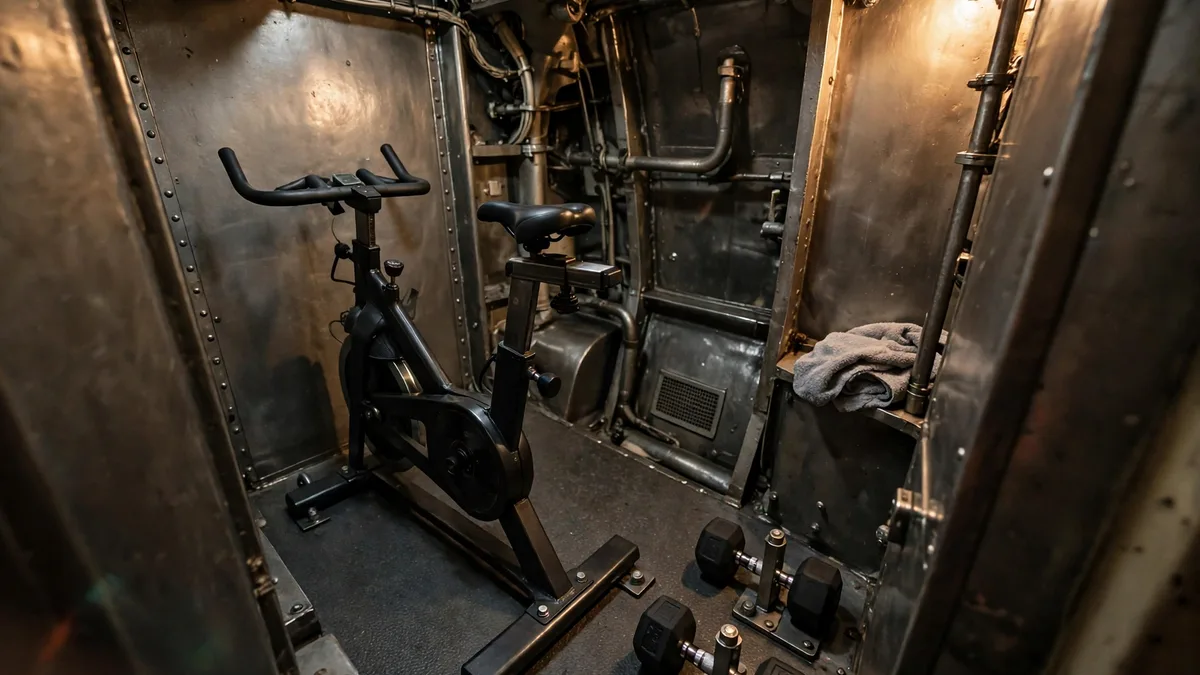
Space is the hardest limit on a submarine gym, because the room sits inside a pressure hull that curves in every direction. A typical gym measures eight to fourteen square metres, about the size of a large bathroom, and the ceiling is only two to two point two metres high, lower at the edges where the hull curves down. That is enough room for two people to train at once, which is all a small crew needs, but it means every machine is chosen for its footprint first and its features second. A rowing machine must fold flat against the wall, a bench must slide under a shelf, and nothing may block the walkway to the next compartment, because that walkway is also an escape route. The floor is the most honest number on the sheet: it is rated to carry five hundred kilograms per square metre, since a loaded barbell dropped on a steel deck is a serious shock.
Equipment: Small, Bolted Down and Built to Last
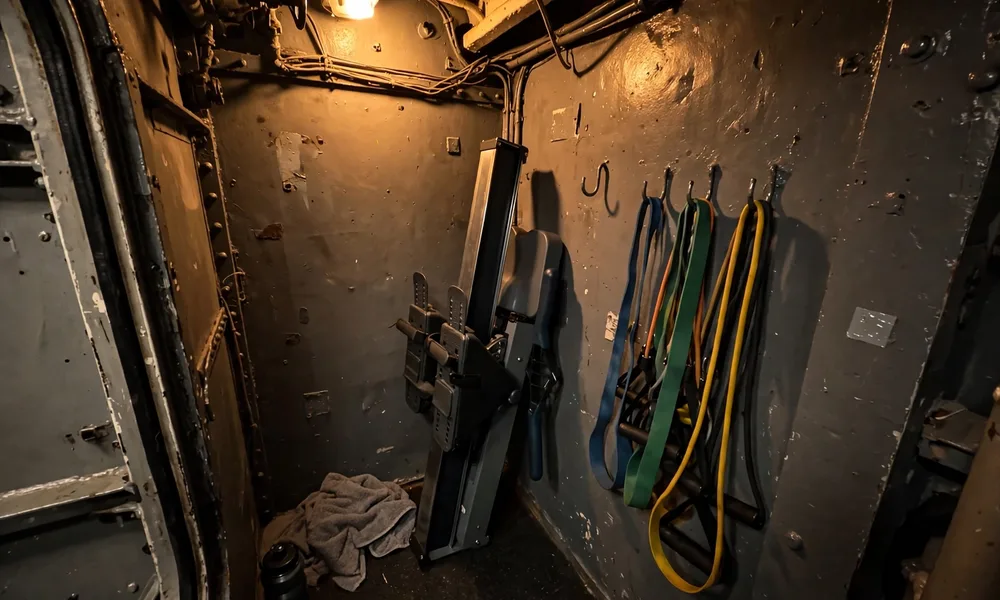
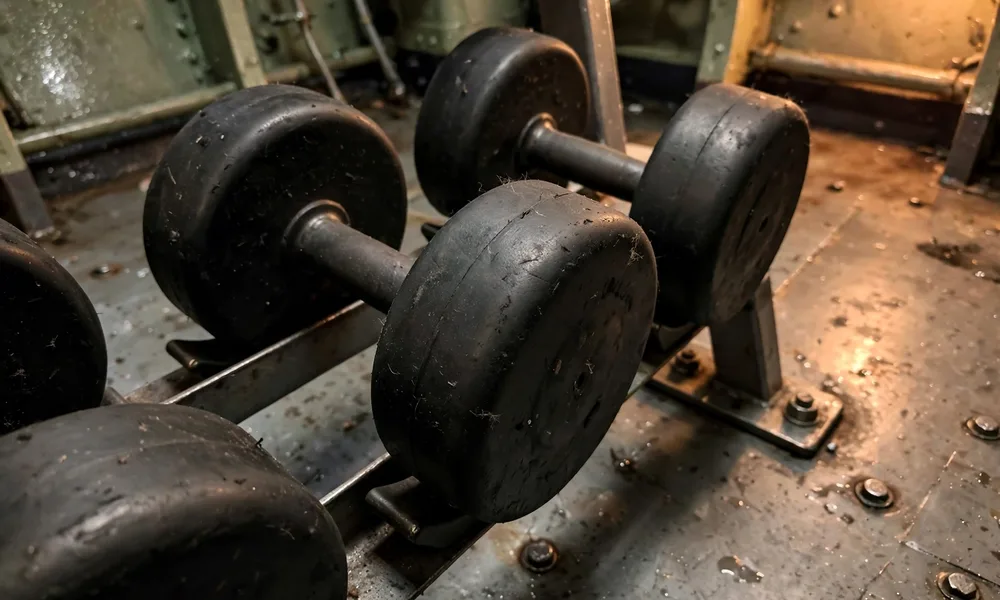
The equipment list on a submarine gym sheet is short on purpose. Three to five pieces cover the whole crew: a stationary bike or rower for cardio, a bench with dumbbells for strength, and resistance bands for stretching and rehab. Everything is bolted to the deck or to wall rails, because a loose dumbbell becomes a missile when the boat rolls. The machines are built from stainless steel and sealed against salt air, with no exposed electronics that humidity can kill. Weights are rubber-coated so they do not chip the deck paint or ring like a bell through the hull. The total kit weighs three hundred to six hundred kilograms, and every kilogram is counted in the boat’s weight budget, since a submarine must balance precisely to dive and surface safely. The galley faces the same discipline in miniature, and our guide to how a luxury submarine galley works shows how another small room feeds the same crew.
Air and Climate: Training on Recycled Air
Air is the specification that surprises most readers, because a submarine gym has no windows and no fresh air. The boat’s life-support system replaces the air eight to twelve times per hour, scrubbing out carbon dioxide and adding oxygen, and the gym gets the highest rate of any small room because exercise doubles the air a person uses. The sheet lists a noise limit of under forty-five decibels, about the level of a quiet library, because the gym shares thin steel walls with cabins where crew sleep between watches. Ventilation fans are mounted on rubber bushes so their hum does not travel through the hull, and the room is kept a few degrees cooler than the rest of the boat, since a training crew generates real heat in a sealed space. The engine room sets the standard for managing heat and air in tight spaces, as explained in our luxury submarine engine room specs guide.
Power and Weight: Every Watt Is Counted
Power on a submarine comes from batteries, and the gym’s draw of one and a half to three kilowatts is a real slice of the boat’s budget. A bike with a magnetic brake uses almost nothing, while a motorised treadmill would eat power the boat cannot spare, which is why you will rarely find one aboard. Weight matters just as much as power: the kit’s three to six hundred kilograms must sit low in the hull, close to the keel, so the boat stays balanced. Move that weight a metre higher and the submarine trims differently, which the captain feels on every dive. This is why the gym is never on an upper deck and never near the sail. The bridge faces the same balance rules at the other end of the boat, and how a luxury submarine bridge is made shows how much engineering goes into placing rooms inside a hull.
Price: What a Submarine Gym Costs
A luxury submarine gym typically costs between one hundred and fifty thousand and four hundred thousand dollars to fit out, depending on the boat and the equipment. The machines themselves are only part of it: marine-grade stainless kit costs several times more than the same machine in a land gym, and the ventilation, soundproofing and deck reinforcement cost as much again. The real expense is the design time, since the gym must be drawn into the boat’s plans before the hull is built, and changing it later means cutting steel. Compared with the price of the submarine itself, which runs into tens of millions, the gym is a small line on the bill, but it is the line the crew notices every single day.
A Rare Fact Worth Knowing
Here is a detail few spec sheets mention. On some long dives, the gym doubles as a medical room, because it is the only space on the boat with a flat floor, good light and room to lay a person down. It is a quiet reminder that on a submarine, no room ever has just one job, and the gym’s specification is really a specification for keeping people well, far from any hospital.
Read the sheet slowly, and the submarine gym stops looking like a compromise. Space is measured in centimetres, equipment is chosen to be bolted down, air is recycled and counted, and power is rationed like food. Those limits are not failures. They are the reason the gym works at all, two hundred metres down.


