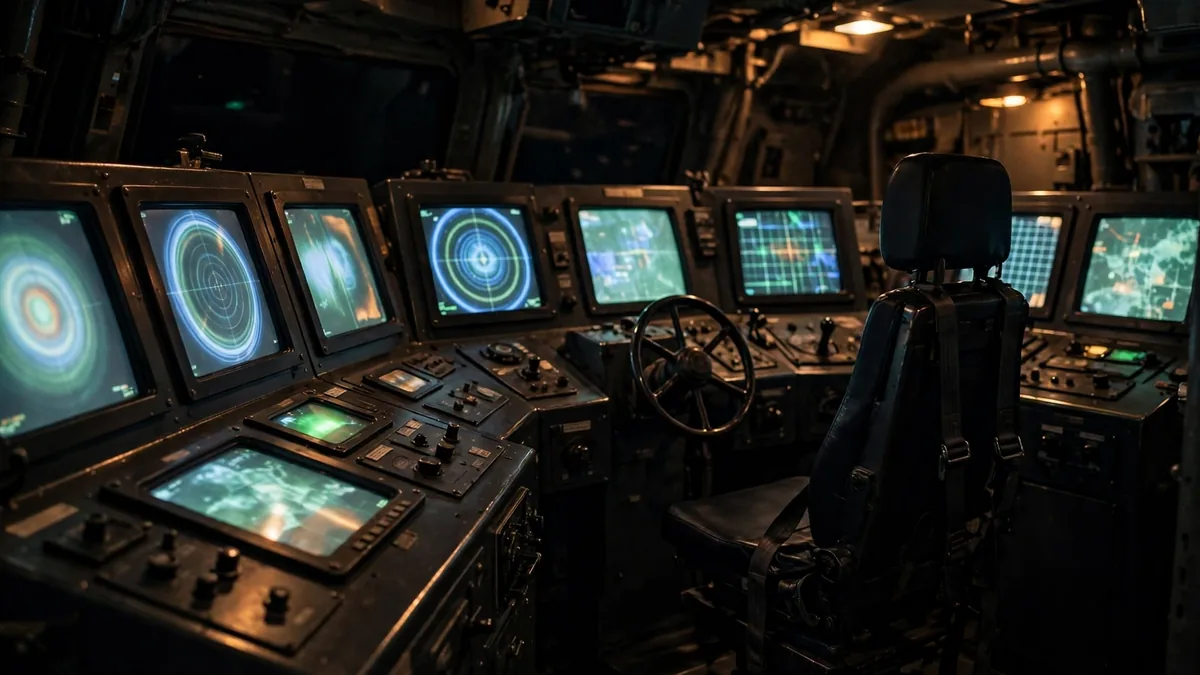
When a submarine runs on the surface, the captain stands on a small open platform at the top of the sail. But the bridge that truly drives the boat sits below, inside the pressure hull: a quiet, windowless room where the helm, the planes, the ballast controls and the navigation screens all come together. It has no view of the sea at all, yet every dive, every turn and every surfacing is ordered from here.
A luxury submarine bridge is the interior command room built inside the pressure hull, beneath the sail, where the crew steer the boat, control its depth and watch its sensors. It is made by fitting out a steel compartment with shock-mounted consoles, sealed wiring, sound-deadening linings and low-light displays, then testing every control until the crew can run the boat in the dark. This is the room the boat is driven from, not the platform above it.
How It’s Made
Step 1: Carving out the compartment
The bridge begins as an empty compartment inside the pressure hull, a steel cylinder framed by the same ring frames that hold back the sea. Builders weld in a flat deck and a low ceiling, sized so a standing crew can reach every control without crowding each other. The compartment sits directly below the sail, so the periscopes and masts can drop straight down through its roof. Every weld is tested, because this room must hold the same pressure as the rest of the hull. The space is small by design: on a submarine, every cubic metre is precious, and the bridge takes only what it needs.
Step 2: Lining the room for silence
Before any equipment arrives, the steel is lined for sound and for comfort. Acoustic panels go up on the walls and ceiling, damping the hum of pumps and fans so the crew can hear a whispered order and a faint sonar contact. The deck is covered with a non-slip, sound-absorbing layer, and the lights are fitted on dimmers, because the bridge often runs in red light to protect the crew’s night vision. The air system is balanced last, so the room stays cool without a draught blowing across the screens. A noisy bridge is a tired crew, and a tired crew makes mistakes a submarine cannot afford.
Step 3: Building the consoles
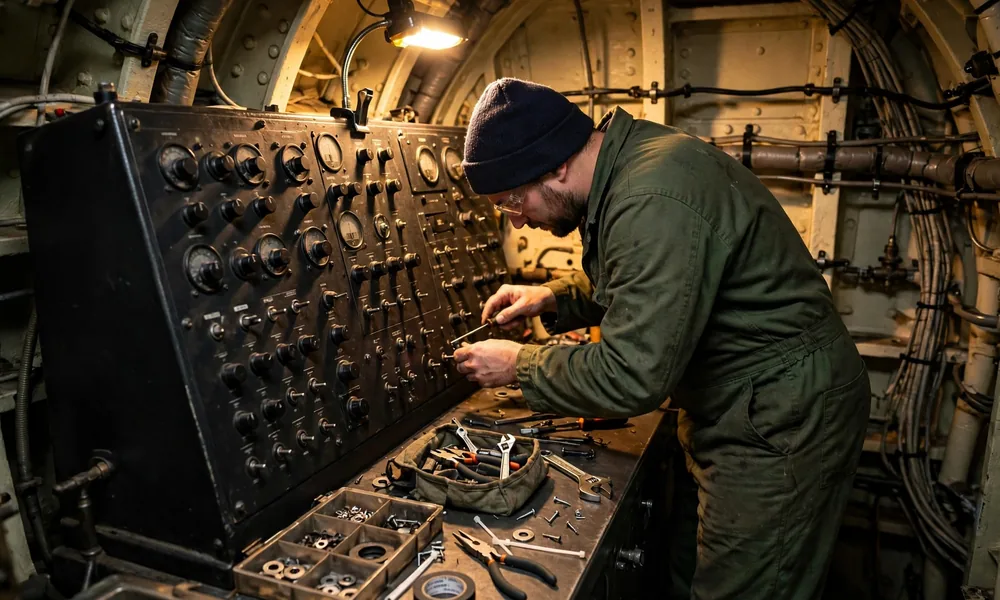
The heart of the bridge is its consoles: the helm, the planesman station, the ballast panel and the navigation desk. Each console is built as a steel frame with a sloped face, holding dials, switches and screens at an angle the seated crew can read without leaning. The frames are mounted on shock absorbers, so a jolt from a wave or a sudden dive does not smash the crew’s hands into the controls. The wiring for each console is loomed and labelled before it is fitted, because tracing a fault behind a finished console is slow, miserable work. The conning tower above carries the masts and the hatch, but the consoles below are where the boat is actually driven.
Step 4: Fitting the periscope and sensor stations
Through the roof of the bridge drop the periscopes, long optical tubes that rise through the sail when the boat is near the surface. Each periscope gets its own station, with a seat, handles and a display that shows what the optics see. Beside them sit the sensor stations, where the radar picture, the sonar contacts and the radio messages are watched. The stations are placed so the captain, standing in the middle of the room, can see every screen with a turn of the head. The submarine hull around the bridge is built to keep the sea out, and every cable and tube that passes through its walls is sealed twice, because a single leak at depth is a disaster.
Step 5: Wiring, power and backup controls
Every control on the bridge needs power, and a submarine carries no room for failure. The wiring runs in sealed trunking along the walls, with separate circuits for the helm, the sensors and the lights, so one fault cannot darken the whole room. Batteries below the deck feed the bridge if the main power fails, and the most vital controls, the dive planes and the ballast blow, have manual backups that work with no power at all. The crew test the changeover again and again: lights out, batteries on, and the boat still answers the helm. Redundancy is not a luxury here. It is the difference between a bad day and a lost boat.
Step 6: Testing the bridge as a crew
The last step is not a fitting but a rehearsal. The crew take their stations and run the boat through dives, turns and emergency surfacings, Instructors watch every order and every response, checking that the helm answers smoothly, the planes hold depth, and the ballast panel reads true. The bridge is tested in the dark, in red light, with alarms sounding, because the real sea will not wait for good conditions. Only when the crew can dive the boat smoothly, blind, is the bridge signed off. A yacht bridge is driven by sight, with glass all around, but a submarine bridge is driven by instruments alone, and the crew’s trust in those instruments is built here, one drill at a time.
A submarine bridge looks plain beside the gleaming bridge of a yacht, But it is the most worked room on the boat, and the most tested. Every switch has been pressed a thousand times before the boat ever leaves harbour, every alarm has been answered in drill after drill, and every console has been built to keep working when the sea is doing its worst. The captain may stand on the open platform in fair weather, but the boat is driven from this small, quiet room below.
Submarine Bridge Specifications
| Feature | Typical Detail |
|---|---|
| Location | Inside the pressure hull, directly below the sail |
| Consoles | Helm, planes, ballast panel and navigation desk |
| Mounting | Shock-absorbing mounts under every console |
| Lighting | Dimmer-controlled white and red light |
| Periscopes | Two optical tubes dropping through the roof |
| Power | Main supply plus battery backup, manual overrides |
| Sound | Acoustic lining on walls, ceiling and deck |
How Much Does a Submarine Bridge Cost?
Prices are estimates and vary with the size of the boat and the sophistication of its systems. Fitting out the bridge of a luxury submarine can run an estimated $2 million to $8 million or more, with the consoles, sensors and periscope optics the largest costs. A single periscope assembly can cost an estimated $500,000 or more, and the shock-mounted consoles and sealed wiring add heavily to the bill. It is a small room with a very large price, but the bridge is where every decision about the boat is made, and no owner wants the cheapest possible version of that room.
A Rare Fact About Submarine Bridges

Here is a detail most people never hear: on older submarines, the bridge had no screens at all, and the planesman steered by watching a bubble in a glass tube, a simple spirit level that showed whether the boat was climbing or diving. The bubble bridge worked because it could never fail: no power, no wiring, nothing to break. Modern bridges still carry a version of it, a small inclinometer tucked beside the digital depth gauge, as a last resort the crew can trust with their eyes alone. When every screen in the room goes dark, the bubble still tells the truth.


