The little cream scooter was parked in a narrow lane in Tuscany, leaning on its stand in the late afternoon sun, and a crowd of tourists had stopped to photograph it. Yet its owner, a man in his sixties who had ridden it there from the next village, said it had cost him more than his first car. The tourists laughed, until he opened the seat and showed them the leather underneath, the chrome trim, the hand-painted pinstripe and the small metal plate on the frame. Then they stopped laughing, because they could see that the scooter had not been assembled. It had been made.
A luxury Vespa is not a scooter in the ordinary sense. It is a piece of Italian design history, built by hand in small numbers, from steel, leather and chrome, and finished to a standard that mass-produced scooters never reach. The price is not for speed. It is for the materials, the labour, the heritage and the fact that so few of them exist. Here are seven reasons why a luxury Vespa costs so much, and why the people who buy them rarely regret it.

Reason 1: A steel body, pressed and welded by hand
Most modern scooters are built around a plastic body clipped onto a steel tube frame. A Vespa is different. Its body is a pressed-steel monocoque, a single structural shell that is both the frame and the bodywork, and it has been built that way since the first model in 1946. The steel panels are pressed, welded and finished by hand, and the seams are smoothed until they disappear under the paint. The result is a scooter that feels solid in a way a plastic-bodied machine never does, and that can be repaired, repainted and ridden for decades.
Reason 2: Paint that takes days, not minutes
The paint on a luxury Vespa is not sprayed on in a few minutes by a robot. It is applied in multiple coats, with sanding and polishing between each one, until the finish is deep, glossy and free of any orange-peel texture. The paint is the scooter’s skin, and on a luxury Vespa it is flawless.
Reason 3: An engine built for smoothness, not speed
The engine in a luxury Vespa is a small single-cylinder unit, usually around three hundred cubic centimetres, and it makes modest power by motorcycle standards. That is deliberate. The engine is tuned for smoothness, quiet running and a gentle delivery of power, not for top speed, because a Vespa is meant to be ridden through a city, not raced. The engine is assembled by hand, with its components balanced and checked individually, and it is run on a test bench before it is fitted to the scooter. The way the numbers on an old scooter are read is set out in the vintage scooter spec guide, where engine capacity and horsepower are only the beginning of the story.
Reason 4: Leather, chrome and details that are fitted by hand
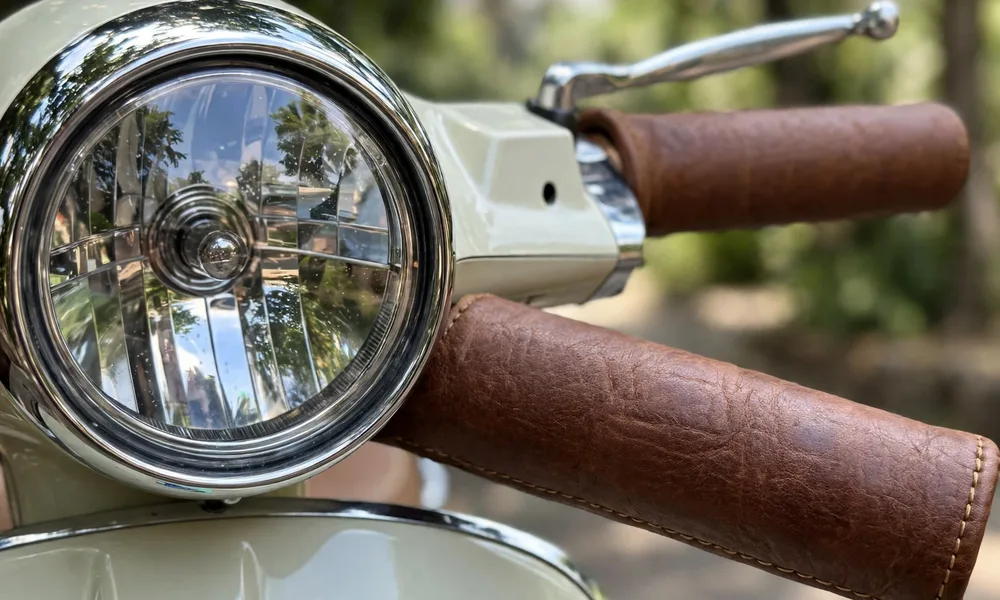
The seat on a luxury Vespa is covered in real leather, stitched by hand, and it is shaped to be comfortable for hours rather than minutes. The grips are leather too, and they are fitted individually, so they sit exactly right in the rider’s hands. The chrome trim, the mirrors, the headlight surround and the luggage rack are polished metal, not plastic painted silver, and each piece is fitted and adjusted by hand. The same care goes into the small things: the horn cover, the badges, the fasteners, the stitching on the seat.
Reason 5: The name, the history and the badge
Vespa means wasp in Italian, and the name was given to the first scooter because its shape and its buzzing engine reminded its maker of the insect. That was in 1946, and the scooter has been in production ever since, which makes it one of the longest-running designs in the history of transport. A luxury Vespa carries that history in its badge, and the badge is worth money. Limited editions, anniversary models and collaborations with fashion houses are made in small numbers, and they sell out quickly, which means they hold their value and sometimes increase in it. A buyer is not just buying a scooter. They are buying a piece of a story that began in the ruins of post-war Italy, when a country needed cheap transport and got an icon instead. That story is printed in every brochure, stitched into every seat and polished into every badge, and it is part of what the price pays for.
Reason 6: Made in Italy, in small numbers
A luxury Vespa is built in Pontedera, in Tuscany, in the same town where the first one was made, and the factory is not a high-volume production line. It is a workshop where scooters are built in small batches, by workers who have often spent their whole careers there. The low volume is a cost, because the factory cannot spread its expenses across millions of units the way a mass producer can. Every jig, every press and every paint booth has to be paid for by a small number of scooters, so each one carries a larger share. The same logic applies to the engines, and the choice between petrol and electric power is set out in the diesel versus electric scooter motors comparison, where the old and new ways of moving a scooter are weighed against each other.
Reason 7: It holds its value, and sometimes gains it
The final reason is the one that surprises buyers most: a luxury Vespa often holds its value better than almost any other two-wheeled machine. A mass-produced scooter loses half its value in the first year, because there are thousands of identical ones for sale. A limited-edition Vespa, built in small numbers and finished by hand, has a waiting list of buyers before it is even delivered. The makers who build the best small machines are ranked in the best electric scooter brands ranked, where heritage and resale value are part of what separates the leaders from the rest.
What a luxury Vespa costs, and a rare fact
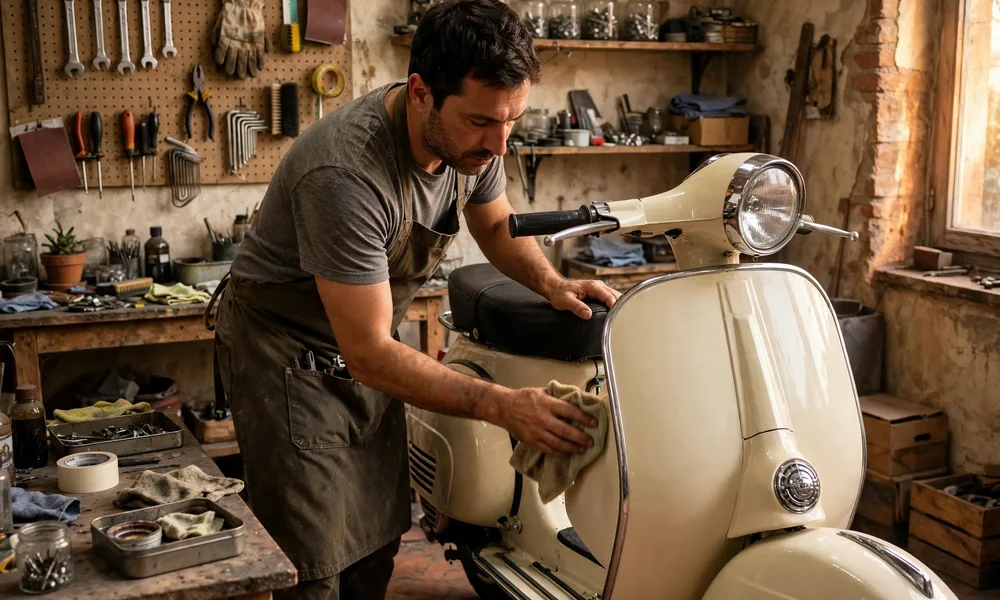
A luxury or limited-edition Vespa typically costs an estimated $10,000 to $18,000, depending on the model, the finish and the size of the production run. The money is in the steel body, the paint, the engine, the leather and chrome, the history and the small production numbers, and each one is visible if you know where to look. The rare fact is that the very first Vespa, the MP6 of 1946, had no proper seat at all. It had a bicycle saddle, and its engine was mounted beside the rear wheel, where it could be cooled by the passing air. The design was so unusual that the company’s own engineers thought it would fail, yet more than nineteen million Vespas have been built since. Buy the scooter whose paint you love and whose badge means something to you, because those are the things that will still matter when the engine is old and the price is forgotten.


