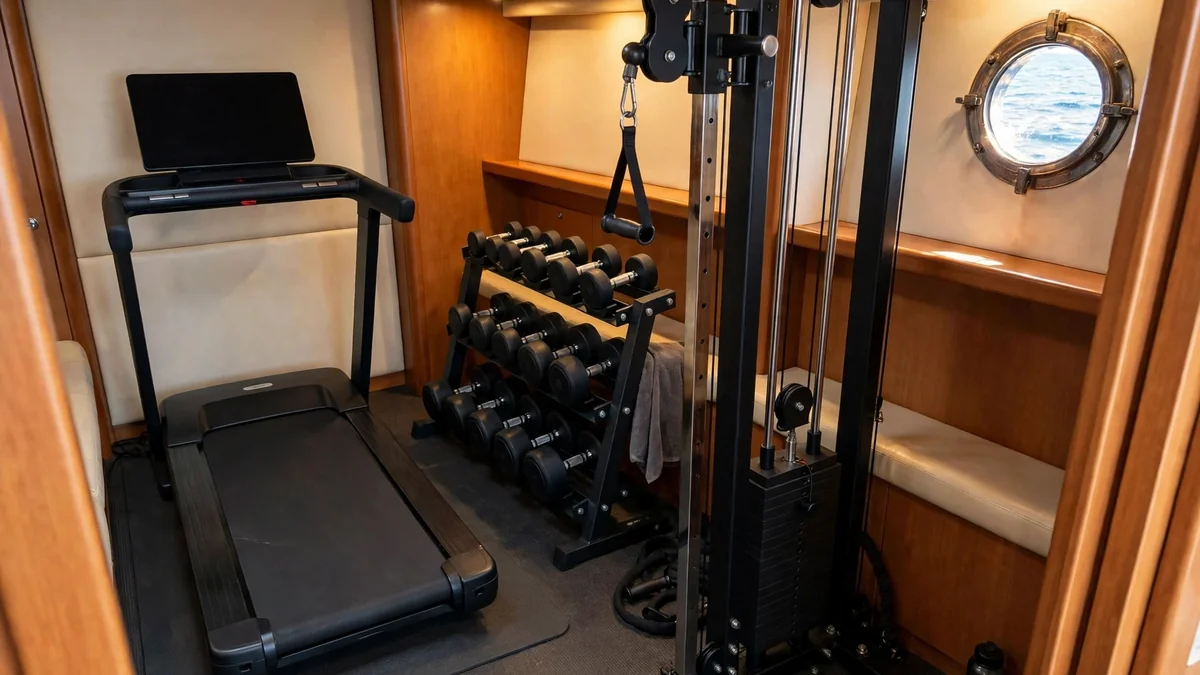
The owner walked into the gym on the lower deck, looked at the treadmill, the rack of dumbbells and the cable machine bolted to the wall, and asked the captain a question nobody had asked before. How heavy is all of this, and what happens to it when the yacht rolls? It is a room full of moving weight, inside a moving boat, and every figure on its spec sheet is a figure about the boat as much as the workout.
A luxury yacht gym is a dedicated exercise room fitted below deck or on a lower deck, with cardio machines, free weights and resistance equipment that are fixed, bolted or lashed down so they cannot move in a swell. It looks like a small hotel gym, but it is engineered like an engine room, because a treadmill that weighs 150 kilograms, a rack of dumbbells that weighs 300 kilograms, and a guest running at full speed all push against a hull that is itself moving. This is a plain translation of the figures that matter, and the ones that are mostly decoration.
1. Floor area and headroom, and the room that decides everything
The first numbers on the sheet are the floor area and the headroom, and a luxury yacht gym usually measures between 12 and 25 square metres, with a ceiling height of 2.1 to 2.4 metres. That sounds generous until the machines are in place, because a treadmill needs a metre of clear space behind it, a cable machine needs room for a guest to stretch their arms wide, and a free weights area needs a clear circle where nobody can trip.
Headroom is the figure guests notice first, because a tall guest doing an overhead press needs the bar to clear the ceiling by a safe margin, and a low ceiling turns a press into a hazard. The floor area to check is the usable area, the space left after the machines, the mirrors and the storage are counted, not the size of the room on the plan. The spa beside the gym is covered in luxury yacht spa specs explained.
2. Treadmill power and belt size, and running on a moving deck
Treadmill power is measured in horsepower, and a yacht treadmill usually has a motor rated between 3 and 5 horsepower, with a belt between 50 and 60 centimetres wide and 150 to 160 centimetres long.
The belt size is the figure that decides comfort, because a narrow belt forces a runner to watch every footstep, and a short belt forces a tall runner to shorten their stride. The number to check beside the motor is the maximum speed, usually 20 to 22 kilometres per hour, and the maximum user weight, usually 150 to 180 kilograms, because a heavy guest running at full speed loads the motor, the belt and the deck underneath it all at once. The sauna that often sits next door is measured in luxury yacht sauna specs explained.
3. Free weights and load ratings, and the weight that never leaves
Free weights are measured by their total weight, and a yacht gym usually carries between 200 and 500 kilograms of dumbbells, kettlebells and plates, stored on racks that are bolted to the deck and the bulkhead. That weight never leaves the yacht, so it is part of the yacht’s permanent load, and the designers must allow for it in the stability calculation, just as they allow for the fuel and the water.
The load rating to check is the rating of the rack, not the weights themselves, because a rack that holds 300 kilograms of dumbbells must hold them when the yacht rolls 20 degrees and every dumbbell presses sideways against its cradle. A gym on a larger ship is covered in luxury ship gym specs explained.
4. Resistance machines and cable stacks, and the pull that stays steady
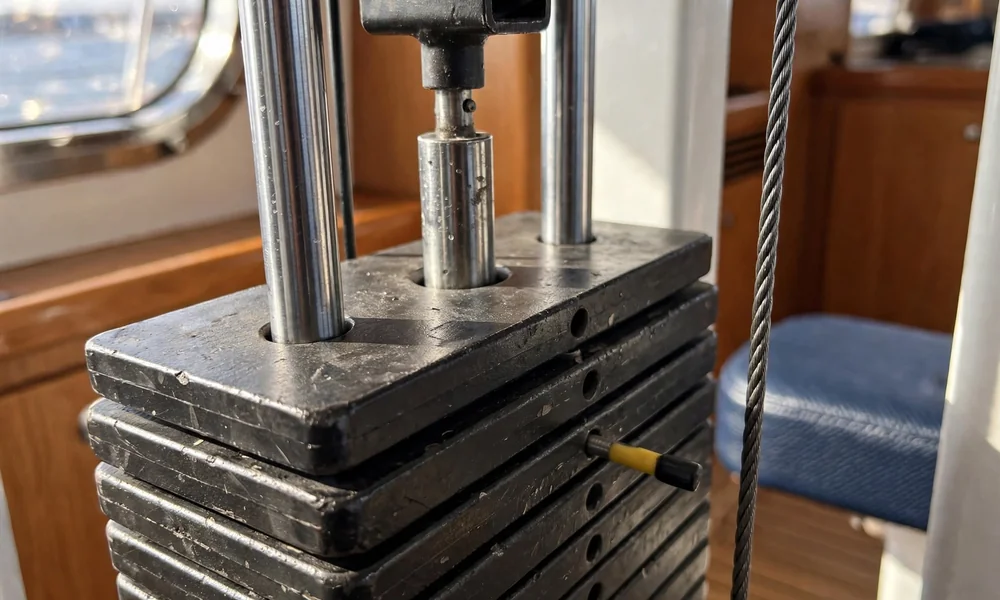
Resistance machines are measured by their weight stack, and a yacht cable machine usually carries a stack of 70 to 100 kilograms per side, with a cable that runs over pulleys to a handle the guest pulls.
The figure to check beside the stack is the cable ratio, because a cable that runs over two pulleys halves the weight the guest feels, so a 100 kilogram stack can feel like 50 kilograms at the handle. A sheet that quotes the stack weight without the ratio is quoting a number that tells you nothing about the workout. The machine must also be bolted through the floor, not just screwed to it, because a guest pulling hard on a cable pulls the whole machine toward them, and in a swell that pull comes from a different direction every few seconds.
5. Power, ventilation and weight, and what the yacht pays for the gym
Power is measured in kilowatts, and a yacht gym with a treadmill, a bike and air conditioning usually draws between 5 and 10 kilowatts at full use, all of it from the yacht’s generators.
Ventilation is measured in air changes per hour, and a gym needs between 8 and 12 changes, far more than a cabin, because a training guest produces heat and moisture that must be removed before it condenses on the mirrors and the steel. That low, heavy room is one reason the gym is usually on a lower deck, not on the sun deck. The crew check the bolts and the lashings every morning, because a machine that is tight today can work loose after a week of rolling seas.
6. The numbers at a glance, the price, and the rare fact
| Figure | Typical range | What it means |
|---|---|---|
| Floor area | 12 to 25 square metres | Usable floor, not room size on paper |
| Headroom | 2.1 to 2.4 metres | Must clear an overhead press |
| Treadmill motor | 3 to 5 horsepower | Steady speed on a moving deck |
| Free weights | 200 to 500 kilograms | Permanent load, low in the hull |
| Cable stack | 70 to 100 kilograms per side | Check the cable ratio too |
| Total gym weight | 1,500 to 3,000 kilograms | Machines, weights and flooring together |
As a typical and indicative range, fitting out a luxury yacht gym usually costs roughly 100,000 to 400,000 dollars, depending on the size of the room, the machines chosen and the marine grade of every fitting, before the cost of the ventilation, the rubber flooring and the structural reinforcement underneath it.
The rare fact is that yacht gym mirrors are not glass. They are polished stainless steel, because a glass mirror in a gym below deck would be a sheet of sharp edges waiting for the first heavy swell, and the crew would have to replace it after every rough passage. The steel mirror is heavier, dimmer and far more expensive than glass, and it is also the only mirror on the yacht that can survive a dropped dumbbell. Read the floor area, the rack rating and the total weight before the treadmill, and the gym will tell you the truth about itself.


