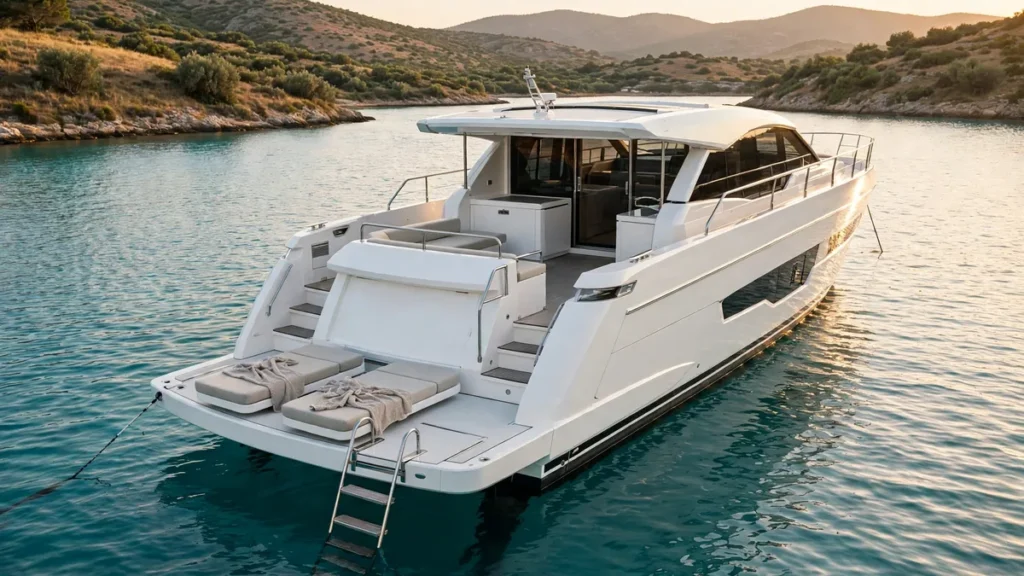
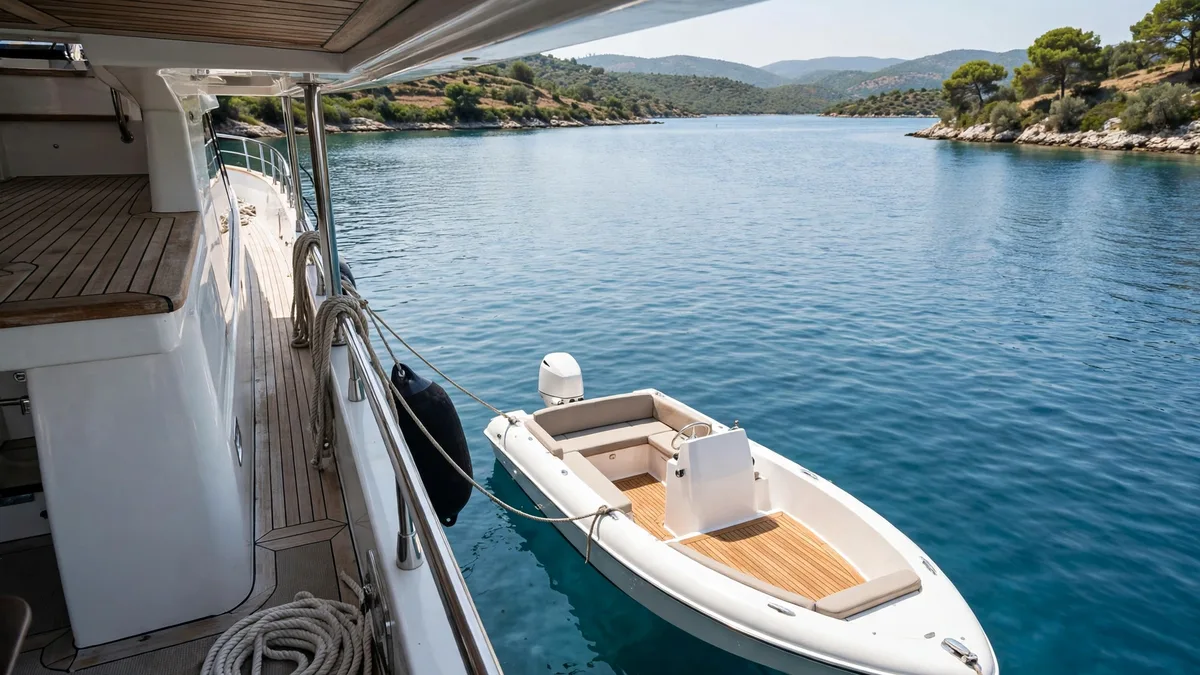
The yacht is anchored in a bay so clear you can see the anchor chain on the sand below, and the guests want to go ashore. Nobody lowers a rope ladder and rows. A small boat is lifted from its cradle on the deck, lowered into the water, and within minutes the guests are stepping from a teak deck onto a white sand beach, dry and unhurried. That small boat is the yacht tender, and it is one of the hardest-working machines on the whole yacht. It ferries guests, lands the crew on docks, runs to the harbour for fuel and provisions, and rescues the occasional swimmer who has drifted too far.
A luxury yacht tender is a small boat built to be a small yacht in its own right, and its spec sheet is a list of promises about size, speed and seating. This guide reads that sheet number by number, from the length of the hull and the power of the engine to the fuel it carries and the price, so you can tell a tender that will serve a yacht for twenty years from one that will be a headache by the second season. It is a different machine from its bigger cousin, and the guide to a superyacht tender’s specs, explained covers the larger boats, which run from five metres up and carry a dozen guests, while the tender in this guide is the smaller boat that serves an ordinary luxury yacht.
The spec sheet at a glance
| Figure | Typical range | What it tells you |
|---|---|---|
| Length overall | Roughly 3 to 6 metres | How long the tender is, and how many guests it carries |
| Beam | Roughly 1.8 to 2.6 metres | How wide it is, and whether it fits the cradle |
| Weight | Roughly 300 to 900 kilograms | How heavy it is, and what crane can lift it |
| Engine power | Roughly 40 to 150 horsepower | How much power drives it |
| Top speed | Roughly 25 to 40 knots | How fast it can run flat out |
| Cruising speed | Roughly 15 to 25 knots | How fast it travels day to day |
| Passenger capacity | Roughly 4 to 8 guests | How many people it carries, plus crew |
| Fuel capacity | Roughly 25 to 90 litres | How far it can go between fills |
| Price | Roughly $30,000 to $250,000 | What the tender costs, as an estimate |
Length and beam: built to fit the boat it serves
Length overall on a luxury yacht tender usually runs from roughly 3 to 6 metres, and the length is decided backwards, by the place it has to live. The tender spends most of its life on a cradle on the yacht’s deck or in a small garage in the stern, and every centimetre of length has to clear the cradle, the rails and the lifting gear, so a tender is sized to its mother ship first and to its passengers second. Beam, the width, usually runs from roughly 1.8 to 2.6 metres, and it decides how stable the tender feels when guests step aboard in a swell. A wider beam means a steadier deck and more seating, but it also means a wider cradle, so designers shape the hull with flared sides that give stability without adding width at the waterline.
Weight: the number the crane feels
Weight on a yacht tender usually runs from roughly 300 to 900 kilograms, and it matters twice over, because the yacht’s crane or davit has to lift the tender out of the water, and a heavy tender eats into the yacht’s own weight budget. That is why the best tenders are built from vacuum-infused glass fibre over a foam core, with teak decks laid thin and fittings made from polished stainless steel, while cheaper tenders use solid glass fibre and feel the difference in every lift. The weight figure on the sheet is usually quoted dry, without fuel, engine oil or gear aboard, so add a hundred kilograms or more for the real lifting weight.
Engine power and speed: enough, not too much
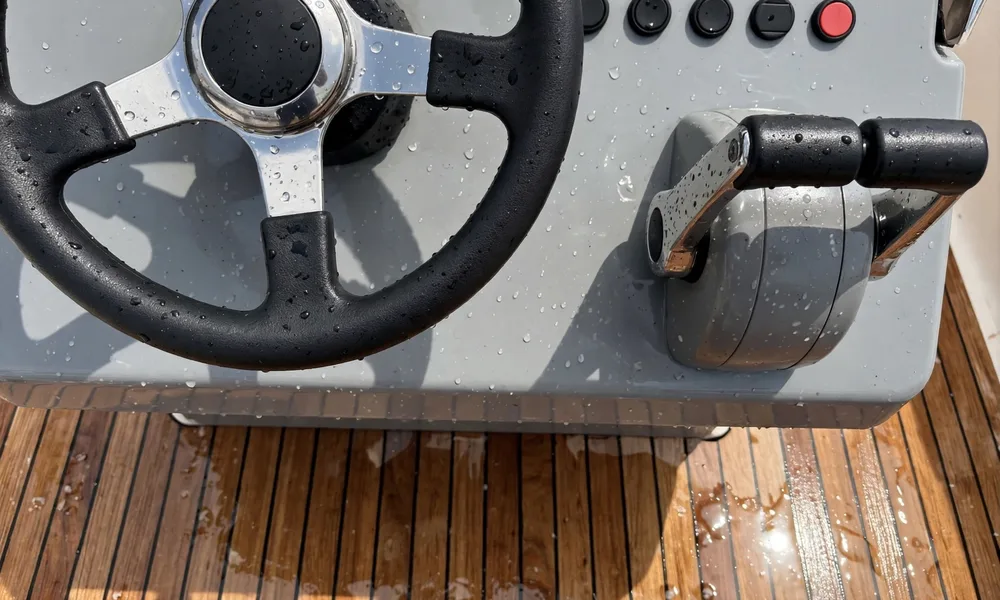
Engine power on a luxury yacht tender usually runs from roughly 40 to 150 horsepower, and the figure to read is not the headline but the way the power is delivered. Most tenders hide a small inboard petrol or diesel engine below the deck, connected to a jet drive or a small propeller, because an outboard motor on the stern would spoil the clean lines and take up the space where guests sit. Top speed usually runs from roughly 25 to 40 knots, and cruising speed from roughly 15 to 25 knots, which is the speed the tender actually travels at, day after day, carrying guests to the beach and back. The engine is lowered into the hull on a crane and aligned to the millimetre, and the way it is fitted is set out in the guide to how a luxury yacht tender is made, from the moulded hull to the hidden engine and the hand-finished deck.
Passenger capacity and fuel: how far, and with whom
Passenger capacity on a luxury yacht tender usually runs from roughly 4 to 8 guests, plus crew, and the figure is set by the seating and by the safety rules, not by how many people can squeeze aboard. Look at the layout behind the number: a bench at the stern, a seat in front of the console, and storage lockers under each one, all upholstered in marine vinyl that can be hosed down after a day at sea. Fuel capacity usually runs from roughly 25 to 90 litres, and it decides how far the tender can go between fills, which matters when the nearest fuel dock is an hour away. The larger yachts carry the same systems on a grander scale, and the guide to luxury yacht specs explained shows how the numbers grow when the boat itself grows.
Price: what a luxury yacht tender costs, as an estimate
Price on a luxury yacht tender spec sheet usually runs from roughly $30,000 to $250,000, as an estimate, and the spread is wide because the boats are so different. At the lower end sits a well-built rigid tender with a modest engine and simple fittings, and at the upper end sits a hand-finished boat with a moulded hull, a hidden engine, teak decks, a chartplotter and a VHF radio, built to match the yacht it serves down to the colour of the upholstery. Read the price beside the weight and the engine figures, not beside the teak, because a beautiful tender with a weak engine and a heavy hull will be a disappointment every time it is launched.
A rare fact worth knowing: some luxury yacht tenders are built with a hull that is deliberately shaped so the boat can be beached on sand without damage, with a flat section under the bow and a keel that protects the propeller, so the crew can run the tender straight onto a beach, let the guests step off dry, and float it off again on the next wave