In a quiet factory hall, a machine the size of a wardrobe is building something out of nothing. There is no cutting, no moulding, no waste piling up on the floor. Instead, a laser flickers across a bed of grey powder, and where it passes, the powder melts and fuses into solid metal. Layer by layer, a part grows that no mill or lathe could ever make: a bracket with hollow channels inside, a turbine blade with cooling passages thinner than a straw.
That is metal 3D printing, and it is changing how the most demanding machines are built. Engineers can now print parts lighter, stronger and more complex than anything machined from a solid block. But the magic is not the laser or the software. It is the powder itself: tiny spheres of metal, each measured in microns, whose chemistry and shape decide whether the finished part is flawless or full of hidden cracks.
Here is what goes into metal 3D printing, why each material was chosen, how it is shaped, and what happens when it fails.

The Materials Behind Metal 3D Printing
1. Titanium powder, the aerospace favourite
The most famous metal 3D printing powder is titanium alloy, usually Ti-6Al-4V, chosen because it is strong, light, and resists corrosion and heat. Aircraft and medical implant makers love it because a printed titanium bracket can be half the weight of the machined part it replaces. The powder is made by melting titanium and atomising it with argon gas, which freezes the droplets into near-perfect spheres. When printed titanium fails, the culprit is usually trapped gas or incomplete melting. Tiny pores left between layers become crack starters, and a part that looks perfect can fail under fatigue.
2. Stainless steel powder, the everyday workhorse
Stainless steel, usually 316L, is the most widely printed metal, chosen because it is cheap, tough, corrosion-resistant, and forgiving to print. It is used for everything from food-processing parts to custom tooling. Like titanium, it is gas-atomised into spherical powder, then spread in thin layers and melted by laser or electron beam. When stainless steel prints fail, the usual cause is residual stress. Each layer cools and shrinks as it solidifies, pulling on the layers below, and the finished part can warp, crack, or even tear itself off the build plate.
3. Nickel superalloy powder, the metal that lives in fire
For parts that work inside jet engines and turbines, the powder of choice is a nickel superalloy such as Inconel 718, chosen because it keeps its strength at temperatures where steel would soften and sag. The powder is atomised from vacuum-melted alloy, because even tiny contamination ruins its high-temperature properties. When nickel superalloy prints fail, cracking is the great enemy. The alloy is prone to hot cracking as it solidifies, and to strain-age cracking during the heat treatment that follows.
4. Aluminium powder, the light and the tricky
Aluminium alloys such as AlSi10Mg are printed for lightweight brackets, housings and heat exchangers, chosen because aluminium is light, conducts heat well, and prints quickly. The powder is atomised under inert gas and handled with care, because fine aluminium powder is reactive. When aluminium prints fail, porosity is the usual problem. Aluminium reflects much of the laser’s energy and conducts heat away quickly, so some powder never fully melts, leaving pores that weaken the part. Oxide films on the powder surface make the problem worse. Modern printers fight back with more powerful lasers, heated chambers, and alloys designed specifically for printing rather than casting.
5. Copper powder, the conductor that hates the laser
Copper is printed for heat exchangers, electrical parts and rocket engine chambers, chosen because no other common metal conducts heat and electricity as well. But copper is the hardest common metal to print, because it reflects most of an infrared laser’s light and whisks heat away from the melt pool. The powder is atomised into spheres, and printers use green or blue lasers, which copper absorbs far better, or simply much more power. When copper prints fail, the failure is usually poor fusion: layers that never fully bonded peel apart under load, or the part is riddled with pores. A poorly fused copper part conducts heat badly, which defeats the entire reason for printing it in copper at all.
6. Argon gas, the invisible shield
Metal 3D printing does not happen in open air. The build chamber is filled with argon, an inert gas chosen because it keeps oxygen away from the hot metal. Without it, the molten powder would oxidise instantly, and the finished part would be brittle and weak. Argon is pumped in, circulated, and filtered to remove the fine metal fume the laser produces. When the argon shield fails, the damage is invisible at first. Oxygen sneaks in, the powder oxidises, and the printed layers bond poorly. The part may look fine and even pass a visual inspection, yet fail at a fraction of its expected strength.
Metal 3D Printing Materials
| Material | Where it is used | Why it is chosen |
|---|---|---|
| Titanium Ti-6Al-4V powder | Aerospace brackets, implants | Strong, light, corrosion-resistant |
| Stainless steel 316L powder | General parts, tooling | Cheap, tough, forgiving to print |
| Nickel superalloy powder | Turbine and engine parts | Keeps strength at high temperatures |
| Aluminium AlSi10Mg powder | Light housings, heat exchangers | Light, conducts heat, prints quickly |
| Copper powder | Heat exchangers, rocket chambers | Best conductor of heat and electricity |
| Argon gas | Build chamber atmosphere | Keeps oxygen away from molten metal |
Metal 3D Printing Specifications
| Specification | Typical value |
|---|---|
| Powder particle size | About 15 to 53 microns |
| Layer thickness | About 20 to 60 microns |
| Build volume | About 250 by 250 by 300 millimetres |
| Laser power | About 200 to 1,000 watts |
| Chamber oxygen | Below 1,000 parts per million |
| Build rate | About 5 to 20 cubic centimetres per hour |
| Post-processing | Stress relief, hot isostatic pressing, machining |
| Powder reuse | Unused powder sieved and reused for many builds |
The broader family of printing processes is covered in the materials behind additive manufacturing, and the forging that printed parts often replace is explored in the materials behind titanium forging. The heat-resistant alloy used in the hottest printed parts is covered in the materials behind the Inconel alloy.
A Rare Fact
Metal 3D printing is older than most people think. The first laser-sintered metal parts were made in the late 1980s, and by the mid-1990s, researchers were already printing metal tooling inserts with cooling channels that followed the shape of the mould, something no drill could ever produce. One of the earliest triumphs was a rocket engine injector printed as a single piece, replacing more than a hundred welded and brazed parts. The part went from design to a successful hot-fire test in months, and it has been flying in various forms ever since.

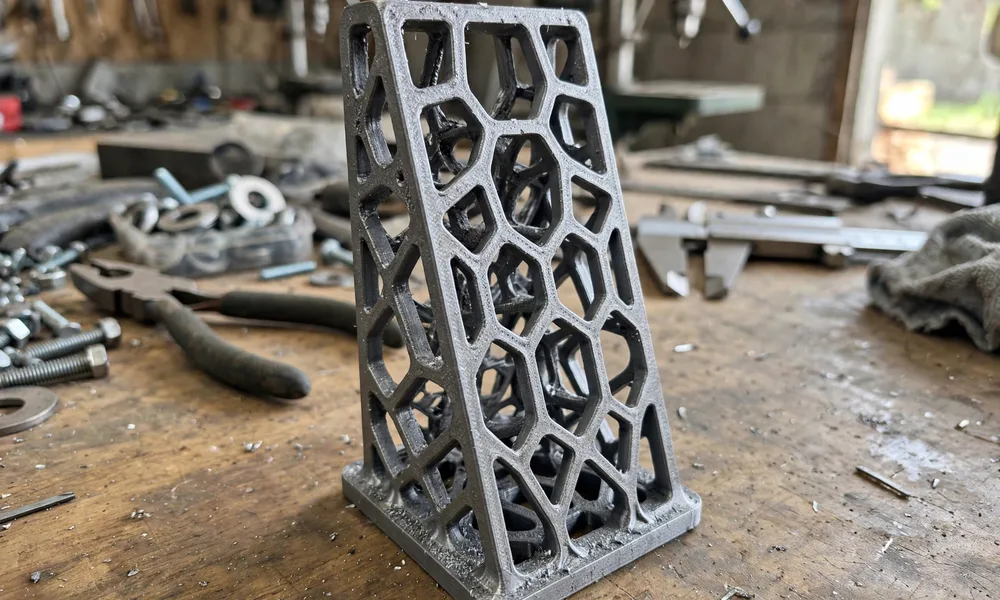
Metal 3D printing looks like magic, a machine turning dust into flight hardware. But the real story is the materials: titanium for strength, stainless steel for everyday work, nickel superalloys for fire, aluminium for lightness, copper for heat, and argon to protect them all. Get the powder right and the part is extraordinary. Get it wrong, and the printer will faithfully print a flaw, one layer at a time.


