Tungsten is the stubborn metal. It melts at 3,422 degrees Celsius, hotter than any other metal on Earth, and it keeps its strength long after steel has gone soft and sagging. Hold a small tungsten weight in your palm and it feels wrong, far heavier than its size suggests, because tungsten is nearly twice as dense as lead. That combination of heat resistance and density is why it ends up in the most punishing places engineers can imagine: rocket nozzles, radiation shielding, furnace parts, and the tiny filaments that once lit every home on the planet.
Pure tungsten, though, is brittle and hard to shape. The metal that industry actually uses is usually a tungsten alloy, most often tungsten heavy alloy, in which tungsten grains are held together by a binder of nickel and iron or nickel and copper. The result keeps most of tungsten’s density and heat resistance while gaining the toughness and machinability that pure tungsten lacks. A tungsten heavy alloy part can be drilled, milled and turned on ordinary machine tools, which pure tungsten resists with infuriating stubbornness.
Making that alloy is not like melting steel in a furnace and pouring it into a mould. Tungsten’s melting point is so high that conventional melting is impractical, so makers use powder metallurgy instead: fine powders are mixed, pressed into shape, and then heated until the particles fuse together without ever fully melting. It is a slow, patient process, and the furnaces run for hours at temperatures that would destroy most other metals. The reward is a material that behaves calmly in conditions that would melt, warp or vaporise almost anything else.

How It’s Made
Step 1: Making the tungsten powder
The journey begins with tungsten oxide, refined from ore, which is reduced to pure tungsten powder by heating it in hydrogen. The powder that emerges is extremely fine, with grains measured in micrometres, and its particle size sets the character of the final alloy. Finer powder sinters more completely and gives a denser, stronger part, but it is also harder to handle safely, so the powder is kept in sealed containers and moved with care.
Step 2: Mixing the alloy powders
The tungsten powder is blended with nickel and iron or nickel and copper powders in carefully weighed proportions. A typical heavy alloy contains around ninety to ninety-seven per cent tungsten, with the rest made up by the binder metals. The mixing must be perfectly even, because a pocket of binder-rich powder would become a weak spot in the finished part. Blending is done in sealed mixers over many hours until the powder is uniform.
Step 3: Pressing the shape
The mixed powder is poured into a steel die and pressed under enormous force, sometimes hundreds of tonnes, into a compacted shape called a green compact. The compact is fragile at this stage, like a sandcastle that holds together only through friction, yet it already has the rough shape of the final part. Larger or more complex shapes are pressed isostatically, with fluid pressure squeezing the powder evenly from all directions.

Step 4: Sintering in the furnace
The green compact goes into a furnace filled with hydrogen and is heated to around 1,400 to 1,500 degrees Celsius. At that temperature the nickel-iron binder melts and flows between the tungsten grains, pulling them together and filling the gaps, while the tungsten itself stays solid. This liquid-phase sintering shrinks the part by up to twenty per cent and turns the fragile compact into dense, solid metal. The furnace cycle can last many hours, and the cooling must be slow and controlled. The hydrogen atmosphere matters as much as the heat: it strips away any trace of oxide from the powder surfaces, so the grains bond cleanly, and it carries away impurities that would otherwise weaken the finished alloy.
Step 5: Heat treatment and densification
After sintering, the alloy is heat treated to relieve internal stresses and to tune its strength and ductility. Some parts are also hot isostatically pressed, a second squeeze at high temperature and pressure that closes any remaining microscopic pores. The result is a part with a density close to the theoretical maximum, which matters enormously in applications like radiation shielding and balancing weights, where every cubic centimetre must carry its full share of mass.
Step 6: Machining and finishing
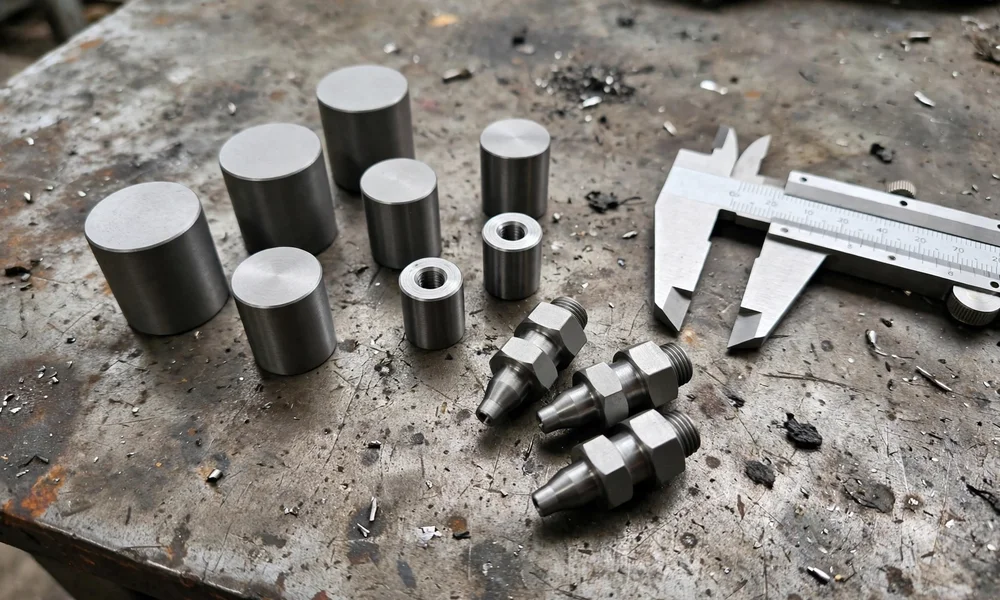
Finally, the sintered blank is machined to its finished dimensions. Tungsten heavy alloy cuts cleanly with carbide tooling, though it wears tools quickly because of its hardness and density. Parts are ground to tight tolerances, inspected for cracks and porosity, and sometimes plated with nickel or gold to protect them from corrosion. A finished tungsten alloy weight or nozzle is a dull grey object of surprising heft, and its plain appearance hides one of the most extreme materials in engineering. A final wipe and a last look under bright light catch any surface mark before the part is packed for shipping.
Specifications
The table below covers a typical tungsten heavy alloy of the kind used for counterweights, shielding and high-temperature parts. Exact figures vary with the tungsten content and the binder system.
| Property | Typical value |
|---|---|
| Tungsten content | 90 to 97 per cent by weight |
| Density | 17.0 to 18.5 g per cubic centimetre |
| Melting point | About 3,422 °C for pure tungsten |
| Tensile strength | 750 to 1,000 MPa |
| Hardness | 27 to 35 HRC |
| Binder system | Nickel-iron or nickel-copper |
| Sintering temperature | 1,400 to 1,500 °C |
What It Costs
Tungsten heavy alloy costs roughly $60 to $150 per kilogram as an estimate for standard grades in billet or bar form, with high-purity or precision-machined parts costing several times more. The price follows the tungsten market, which is dominated by a small number of producing countries, and it rises sharply for small, complex, tightly toleranced components. A single radiation-shielding block can cost thousands of dollars, while a simple counterweight may cost only a few hundred.
A Rare Fact
Tungsten is the only metal that can survive inside a working rocket nozzle throat, where exhaust gases roar past at thousands of degrees, and it is also the metal inside the tiny darts used in professional darts: tungsten darts can be made much slimmer than brass ones for the same weight, so players can pack them tighter on the board. The same density that steadies a dart also balances the crankshafts of Formula 1 engines and the rotors of racing yachts. Few materials move so easily between rocket science and the pub.
The story of tungsten alloy is a story of patience: powder, pressure and heat, repeated until a metal that refuses to melt is persuaded into shape. The materials behind tungsten alloy explain why engineers choose each binder and grade, and the specs of tungsten alloy translate its density and strength into numbers you can compare. If the price seems high, the reasons tungsten alloy costs so much trace the expensive powder, the long furnace cycles and the specialist machining behind every part.