The aeroplane cabin hums at a steady, low roar — engines, air conditioning, a hundred people breathing recycled air. You slide the headphones on, press the button, and the roar simply falls away. For the first time since boarding, you can hear the music instead of the machine. It feels like magic, but it is a set of numbers, engineered with extraordinary precision, working together in your ears.
Noise-cancelling headphones are one of the most quietly technical gadgets most people own. Beneath the soft ear cushions sit microphones, processors, drivers and batteries, each described on the box by figures that look impressive and mean almost nothing until somebody explains them. What does minus thirty decibels actually sound like? Why does a forty-millimetre driver matter?
This guide explains the numbers in plain English — cancellation depth, driver size, frequency response, battery life and the wireless codes that carry your music. The way noise-cancelling headphones work is clever, but the spec sheet is where the cleverness becomes something you can judge.
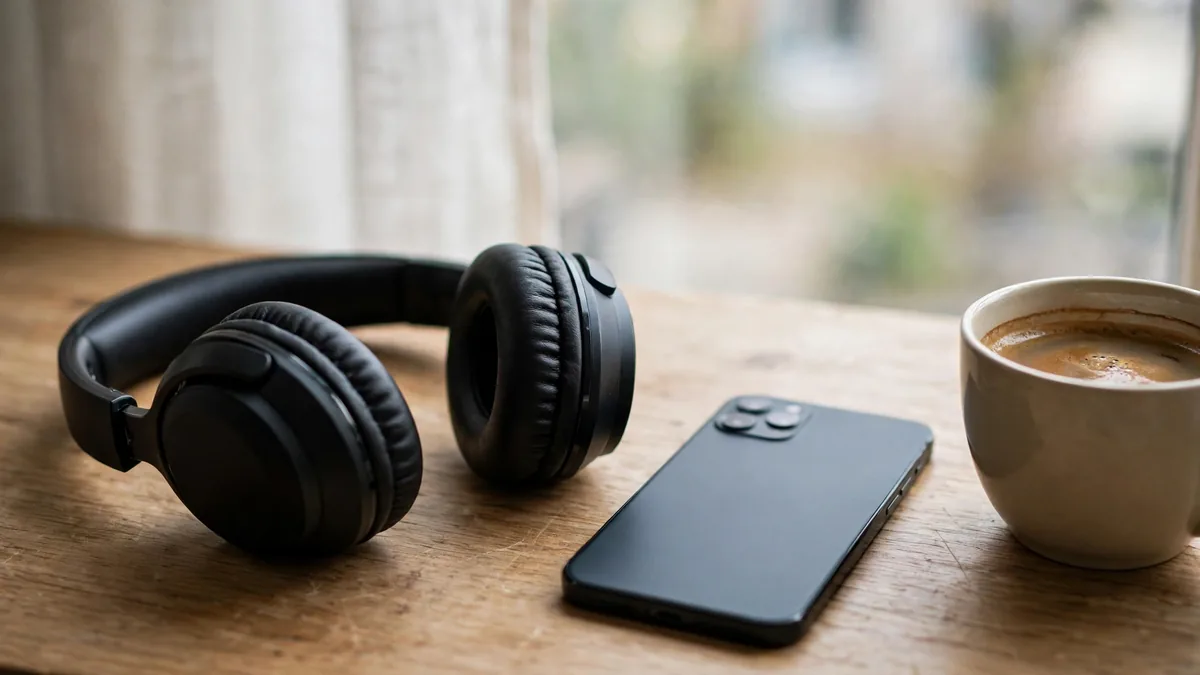
How Noise-Cancelling Headphones Work
Step 1: Listening to the noise
Tiny microphones on the outside of each earcup listen to the world around you, hundreds of times per second. They pick up steady, predictable sounds — engine drone, air conditioning, train rumble — and send that signal to a small processor inside the headphone. Sudden sounds, like a door slamming, are much harder to catch in time, which is why cancellation works best on constant noise.
Step 2: Making the opposite sound
The processor creates a mirror image of the incoming noise — a sound wave exactly opposite to it — and plays it through the driver at the same moment the real noise reaches your ear. When the two waves meet, they cancel each other out. This trick is called destructive interference, and it happens so fast your brain never registers the noise at all. The materials inside noise-cancelling headphones decide how well that trick holds up over hours of listening.
Step 3: Playing the music on top
Once the noise is cancelled, the driver plays your music through the same speaker, into the quiet the processor has created. Because the background is gone, you can listen at a lower volume and still hear every detail — kinder to your hearing on a long flight. The ear cushions add a second layer of defence, physically blocking higher-pitched sounds the electronics cannot catch.

Noise-Cancelling Headphones Specs
The spec sheet of a good pair of headphones is a short list of numbers, and each one answers a different question: how quiet, how big the sound, how long the battery lasts, and how the music gets there.
| Spec | Typical number | What it means | How it compares |
|---|---|---|---|
| Noise cancellation depth | 25 to 45 dB | How much outside noise is removed, in decibels | Budget pairs manage about 20 dB; flagship pairs reach 40 dB or more |
| Driver size | 40 mm | The diameter of the speaker inside each earcup | Smaller 30 mm drivers suit compact pairs; 50 mm drivers move more air for deeper bass |
| Frequency response | 4 Hz to 40 kHz | The range of sounds the headphones can reproduce | Human hearing spans roughly 20 Hz to 20 kHz; wider ranges suggest finer detail |
| Battery life (ANC on) | 30 to 60 hours | Playing time on one charge with cancellation switched on | Budget pairs offer about 20 hours; the best now pass 60 hours |
| Bluetooth version | 5.3 | The wireless standard linking headphones to your phone | Older 5.0 pairs work fine; 5.3 and 5.4 add range, stability and lower power use |
| Audio codecs | LDAC, aptX, AAC | How the music is compressed for wireless transmission | Basic SBC sounds flat; LDAC and aptX Adaptive carry far more detail |
| Weight | 240 to 260 g | How heavy the headphones feel on your head | Under 200 g feels feather-light; over 300 g can press on long journeys |
| Charging | 10 minutes for 5 hours | How much play time a quick top-up gives you | Fast charging is now standard; a full charge usually takes about two hours |
Cancellation depth is the headline number, and the easiest to misunderstand. Decibels work on a logarithmic scale, so a pair rated at 40 dB does not cancel twice as much noise as one rated at 20 dB — it cancels roughly a hundred times more sound energy. In practice, 20 dB takes the edge off a noisy office, 30 dB makes a train journey peaceful, and 40 dB turns an aeroplane cabin into a library.
Driver size tells you about the physical speaker, but bigger is not automatically better. A 40 mm driver is the sweet spot: large enough to produce deep, controlled bass without distorting, and small enough to keep the headphones light. A well-tuned 40 mm driver will beat a sloppy 50 mm one every time, because the magnet, the diaphragm material and the tuning of the enclosure matter just as much as the diameter. This is why two pairs with identical driver sizes can sound completely different.
Frequency response looks like a simple range, but the fine print matters. A pair claiming 4 Hz to 40 kHz can reproduce sounds far below and above human hearing, which sounds impressive but tells you little about how music actually sounds. What counts is how flat the response is within the range you can hear: a pair that reproduces bass, midrange and treble at similar levels will sound natural, while one with a huge bass boost will sound boomy and muddy.
Battery life is the most honest number on the sheet, and it has improved dramatically. A decade ago, twenty hours with cancellation on was excellent; today, thirty hours is ordinary and sixty hours is achievable. Check the figure with cancellation switched on, since some makers quote the longer figure with it switched off. Fast charging has become just as important: ten minutes on a charger for five hours of playback turns a forgotten charge into a non-problem.
The wireless codecs decide how much of your music survives the trip from phone to headphones. Basic SBC, the default codec, compresses music heavily and can sound thin on good headphones. AAC works well with Apple devices, while aptX and LDAC carry far more detail and suit Android phones and high-resolution streaming. Bluetooth 5.3 and later also bring multipoint, letting the headphones stay connected to a phone and a laptop at once, so a call can interrupt your music without any re-pairing.

What Do Noise-Cancelling Headphones Cost?
Good noise-cancelling headphones start at around $100 to $150 (estimate), with solid cancellation of about 20 to 25 dB and thirty hours of battery. The sweet spot sits at roughly $250 to $350 (estimate), with cancellation near 35 to 40 dB and high-resolution codecs. Flagship pairs cost about $350 to $450 (estimate) and add the last few decibels of cancellation and better microphones for calls. For comparison, wireless earbuds drivers pack similar technology into a far smaller space, which is why earbuds rarely match the cancellation depth or battery life of full-sized headphones.
A Rare Fact
Noise cancellation was invented by accident on an aeroplane. In 1978, Amar Bose was flying home from Europe and found the engine roar so loud he could not hear the music on his headphones. He began sketching the maths of cancelling sound with sound during the flight, and spent the next decade turning the idea into a working product. The first commercial noise-cancelling headphones, released for pilots in 1989, cost around $1,000.


