The door closes with a soft, heavy click, and the noise of the airport simply stops. Outside the small oval window, ground crew in high-visibility jackets are loading bags in the rain. Inside, the air smells faintly of new leather, the carpet is deep enough to swallow a footstep, and the only sound is the low hum of the air conditioning. It is built slowly, by hand, like a Swiss watch.
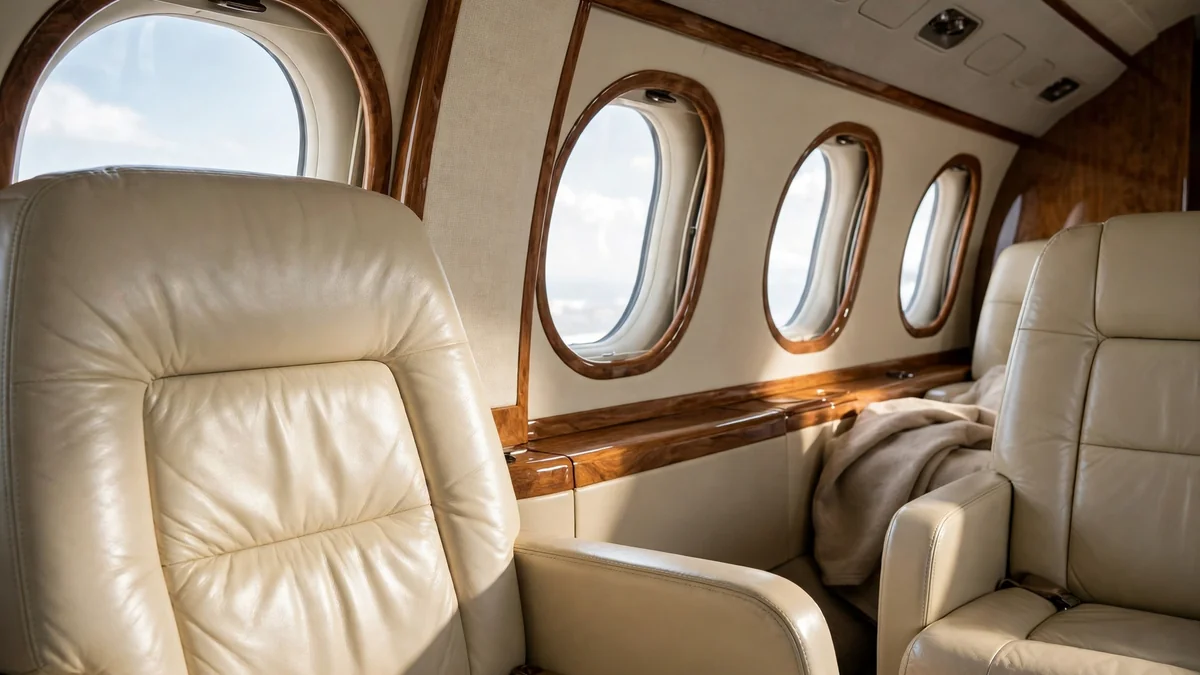
What makes a jet cabin so difficult to build is that it must be two things at once. It has to feel like a small luxury hotel, with soft seats, warm wood, and space to stand, yet it also has to be light enough to fly, safe enough to survive a crash, and tough enough to be pressurised and depressurised thousands of times without a single panel cracking. This is how a private jet cabin is made, from a bare metal shell to a room that flies.
How It’s Made
Step 1: The bare shell is stripped and measured
The cabin starts as the empty fuselage of the aircraft, a bare aluminium or composite tube with ribs, wiring, and insulation showing. Before anything decorative goes in, engineers scan the shell with lasers, mapping every curve and rivet line to a fraction of a millimetre, because no two fuselages are exactly alike. Insulation blankets are fitted to the walls to keep heat and cold out, and a vapour barrier is laid over them so condensation cannot reach the metal skin. At this stage the cabin is noisy, cold, and echoing.
Step 2: Honeycomb panels form the walls and floor
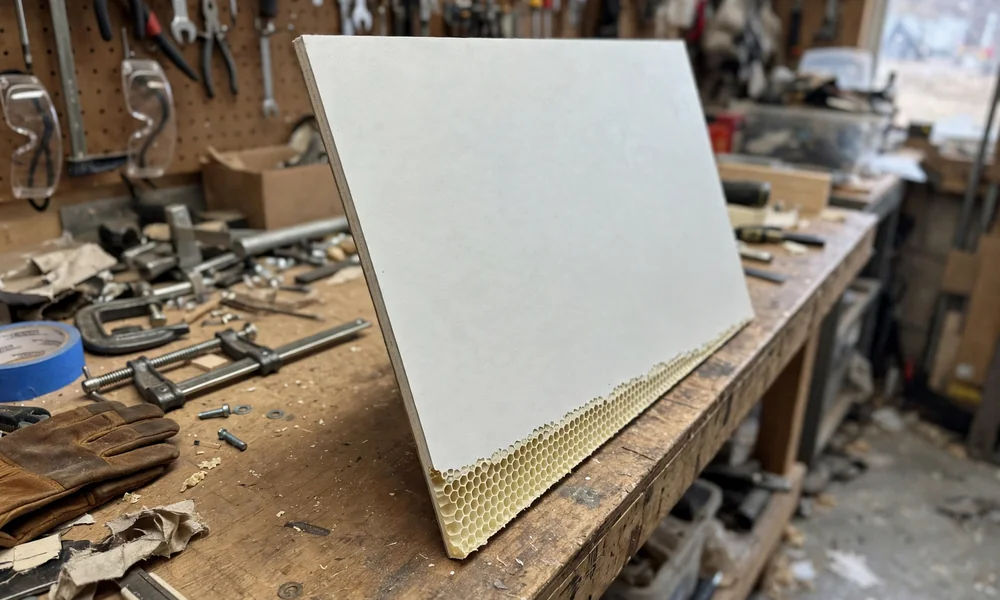
The walls, ceiling, and floor of a jet cabin are not solid boards. They are sandwich panels: two thin skins of fibreglass or carbon fibre bonded to a honeycomb core, a structure of tiny hexagonal cells that is astonishingly light and stiff for its weight. The panels are cut to shape on computer-controlled machines, then fitted into the shell and trimmed by hand where the fuselage curves. The panels are bonded in a press, then cured until the skins and core become one piece. The same honeycomb idea holds up aircraft floors and many other lightweight structures, as explained in how the honeycomb core works, and in a jet it does the quiet work of carrying seats, cabinets, and passengers while adding almost nothing to the weight. The floor panels are made thicker and stronger to carry the seat rails.
Step 3: Seats are built, tested, and upholstered
The seats are the heart of the cabin, and they are engineered long before they are comfortable. Each seat frame is a mix of aluminium, steel, and composite, built to survive a crash load many times the weight of its passenger, and every seat is tested on a rig that slams it forward to prove the frame and the seatbelt anchor hold. Hides are chosen one by one, since a single small mark can reject a whole skin, and the leather is cut, stitched, and stretched over the foam by hand. The foam is layered, firm at the base and soft at the surface, so a crash-tested seat still feels like an armchair after six hours.
Step 4: Wood, stone, and metal are fitted by hand
The warm look of a jet cabin comes from veneer, real wood sliced thin and laid over the honeycomb panels. Craftspeople match the grain from panel to panel so a table, a cabinet door, and a sidewall look as though they were cut from a single tree, and the veneer is polished until it feels like glass. Stone is used sparingly, usually a thin slice of marble or granite on a galley counter, chosen because it is beautiful and because it can be sealed against spills. The joinery skills here are close cousins to the cabinetry on a superyacht, as described in the materials behind superyacht interior joinery, where the same obsession with grain, fit, and finish rules the workshop.
Step 5: Systems, lighting, and the final inspection
Last come the systems that make the cabin work: the air conditioning that keeps the air fresh at altitude, the lighting that can shift from bright white for working to warm amber for sleeping, and the screens, chargers, and controls built into every seat. Electricians route kilometres of wiring behind the panels, and each circuit is tested before the panels are closed for good. Then the inspectors run a hand over every seam and check that every stitch is straight and every veneer joint is invisible. The obsession with lightness and precision is the same force that makes a two-million-pound car what it is, as explored in why the Aston Martin Valkyrie is so expensive. Only when the cabin passes does the aircraft roll out for its first flight with passengers aboard.

Private Jet Cabin Specifications
| Specification | Typical figure |
|---|---|
| Cabin length | About 5 to 13 metres, depending on the jet |
| Cabin width | About 1.8 to 2.4 metres |
| Standing height | About 1.75 to 1.9 metres |
| Wall and floor panels | Honeycomb sandwich, fibreglass or carbon skins |
| Seat weight | Roughly 25 to 45 kilograms each |
| Cabin noise level | About 50 to 55 decibels at cruise |
| Cabin build time | Several months of hand fitting |
How Much Does a Private Jet Cabin Cost?
A cabin is a large share of what a private jet costs, because almost everything in it is custom-made and fitted by hand. Industry estimates put a full bespoke cabin interior at roughly $2 million to $15 million (estimate), depending on the size of the aircraft and the materials chosen, while a complete new light jet typically sells for $5 million to $10 million (estimate) and a large-cabin jet for $40 million to $75 million (estimate). A refurbishment often costs $1 million to $3 million (estimate) for new seats, panels, and carpets. Owners pay it because the cabin is the whole point: nobody buys a jet for the engines.
A Rare Fact About Private Jet Cabins
Here is something few passengers realise: the carpet in a private jet is often the heaviest single soft furnishing in the cabin, and designers fight over every gram of it. A thick wool carpet can weigh tens of kilograms across a large cabin, so centres test lighter weaves that still feel deep underfoot, and some owners choose one simply to fly slightly further. It is a small, invisible trade-off that sums up the whole job: luxury you can feel, engineered down to the weight of the floor you walk on.
So the next time you step into a jet and the world outside goes quiet, remember what is behind that silence: a laser-scanned shell, honeycomb panels lighter than the luggage they carry, crash-tested seats stitched like a suit, and veneer matched grain by grain. The private jet cabin is a hotel room and a crash-tested machine at once, and it is the quietest room in the sky because somebody made it that way.