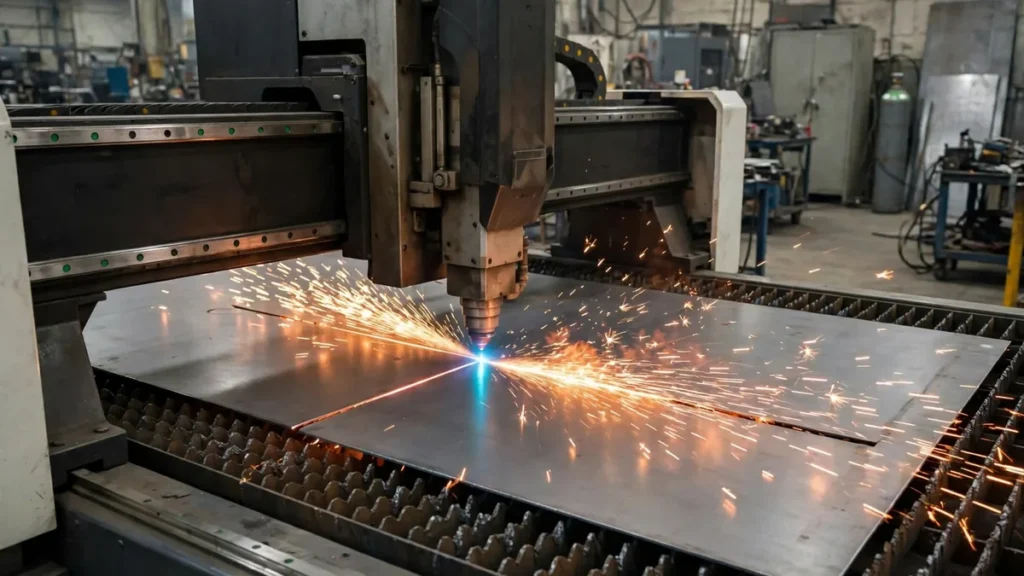
A human hair is about seventy microns thick. A precision CNC machine cuts metal to a tolerance of a few microns — a tenth of a hair — and does it again and again, all day, without getting tired or bored. The machine reads its own position a thousand times a second, and corrects itself before an error becomes a scrap part.
It is materials: the cast iron that holds the machine still, the carbide that does the cutting, and the steel that carries the motion. This is the story of the materials inside precision CNC machining, and of what happens when each one is pushed too far.

The Materials Behind Precision CNC Machining
A CNC machine is a contradiction: it must be heavy enough not to move, and fast enough to move constantly. Its base is cast iron, its guides are hardened steel, its screws are ground to a mirror finish, and its cutting tools are made of a material harder than almost anything they cut. The precision CNC machining process starts with a block of metal clamped to the table, and every material in the machine is chosen to make sure that block ends up exactly the shape the drawing asked for.
Step 1: The cast iron base and frame
The machine’s body is cast iron, and it is chosen for two reasons that no other material offers together: it is heavy, and it absorbs vibration. A tonne of iron does not flinch when a cutter bites into steel, and the graphite flakes inside cast iron turn vibration into heat, damping the shudders that would leave ripples on the part’s surface. If the base is too light, or the casting was rushed, the machine chatters: the cutter bounces, the surface comes out wavy, and no amount of clever programming can fix it. A good CNC machine starts with good iron, left alone long enough to settle.
Step 2: The hardened steel guides and ball screws
Motion in a CNC machine travels along linear guides — hardened steel rails with recirculating ball bearings — driven by ball screws, which are steel screws with balls rolling in the thread instead of sliding. The rails are ground to a straightness measured in microns over a metre, and the screws are ground too, then preloaded so there is no backlash, no tiny gap where the direction changes. Steel is chosen because it can be hardened to resist wear while keeping a tough core that does not snap. The screws are often hollow, with coolant running through the middle, so that they stay the same length no matter how hard they work.

Step 3: The carbide cutting tools
The cutting is done by carbide — tungsten carbide, a powder of tungsten and carbon sintered with cobalt into a grey, heavy, brutally hard material. A carbide cutter can run ten times faster than a steel one, and it keeps its edge at temperatures where steel would go soft. Carbide is chosen because it is hard, but hardness has a price: it is brittle. Hit a carbide cutter against a clamp, or feed it too fast into the metal, and it does not bend — it shatters, throwing fragments across the machine. A worn cutter is worse than a broken one, because it still cuts, just badly, leaving a rough surface and the wrong size.
Step 4: The spindle and its bearings
The cutter spins in the spindle, a steel shaft running in ceramic or steel ball bearings at speeds up to twenty thousand revolutions a minute. The bearings are the most precise part of the machine: ceramic balls are lighter than steel, so they throw less heat at high speed, and they do not need as much lubrication. If a bearing fails, the spindle starts to run out, wobbling by a few microns, and the parts come out with a pattern of tiny waves.
Step 5: The coolant and the chips
Cutting metal makes heat, and heat is the enemy of accuracy, so a flood of coolant — water mixed with oil and additives — pours over the cut, carrying the heat away and washing the chips out of the way. The coolant is chosen to cool, to lubricate, and to stop the freshly cut metal from rusting before the part is finished. The machine’s chip conveyor carries them away, and the coolant is filtered and reused. The inside a precision CNC workshop shows the coolant tanks and conveyors that keep the cutting clean, and they are maintained like any other part of the machine.
Step 6: The workholding and the measuring
The part must be held still while it is cut, and the workholding — the vice, the clamps, the fixture — is made of hardened steel and cast iron, machined flat and ground square. A part clamped too loosely moves, and the cutter takes a bite out of the wrong place. The titanium forging materials show the other end of the story — the forged blanks that arrive at the machine shop, already strong, waiting to be cut to their final shape. If the measuring fails, the machine cuts blind, and the first sign of trouble is a batch of parts that do not fit anything.

Materials at a Glance
| Material | Why it is chosen | How it is shaped | When it fails |
|---|---|---|---|
| Cast iron | Heavy and vibration-absorbing; holds the machine still | Cast, aged, then hand-scraped flat | A rushed casting chatters and leaves wavy surfaces |
| Hardened steel guides | Wear-resistant rails and screws for exact motion | Ground to micron straightness, preloaded | A chip dents a rail; dry balls skid and grow hot |
| Tungsten carbide | Harder than the metal it cuts; keeps its edge hot | Sintered powder, ground, coated with nitride | Brittle — it shatters instead of bending |
| Ceramic bearings | Light and cool at twenty thousand rpm | Precision balls in a balanced steel spindle | A worn bearing wobbles and waves the surface |
| Coolant | Carries heat away; stops rust; clears chips | Water, oil and additives, filtered and reused | Weak coolant overheats the cut; old coolant breeds bacteria |
| Steel workholding | Grips the part without bending it | Hardened vices and fixtures, ground square | Too tight bends the part; too loose lets it move |
Precision CNC Machining at a Glance
| Specification | Detail |
|---|---|
| Typical tolerance | A few microns — a tenth of a human hair |
| Base material | Cast iron, aged and stress-relieved |
| Cutting tool | Tungsten carbide, often coated |
| Spindle speed | Up to around 20,000 rpm |
| Motion | Hardened steel guides and ball screws |
| Cooling | Water-based coolant, filtered and reused |
| Main enemy | Heat, vibration and a worn cutter |
A Rare Fact
The most accurate CNC machines in the world are kept in rooms held at exactly twenty degrees Celsius, because the machine itself grows with heat. A steel ball screw a metre long grows by about twelve microns for every degree it warms up — four times the tolerance of the parts it is cutting. It is the air conditioning. Some shops keep the whole room sealed and filtered, because a speck of dust on a glass scale can throw a measurement off by more than the tolerance.