A steel plate goes into the machine flat, dull and ordinary. Ninety seconds later it comes out as a gear, a bracket, or the side panel of a machine that did not exist that morning — its edges so clean you could run a finger along them without finding a burr. The only thing that touches it is light, focused down to a point finer than a human hair, and hot enough to turn steel into vapour.
That is the strange, almost science-fiction heart of laser cutting. A beam of light does the work of a hundred blades, guided by a computer, moving at speeds a human hand could never match. This is how that beam is made, how it is aimed, and why a factory that owns a good laser cutter can do in an afternoon what once took a whole workshop a week.

How Laser Cutting Works
At its simplest, laser cutting is melting with extraordinary precision. A powerful laser beam is focused through a lens onto a tiny spot on the metal. The spot gets so hot — thousands of degrees — that the metal melts, and in many cases boils away as vapour. A jet of gas blows the molten metal out of the cut, leaving a narrow slot called the kerf. A computer moves the beam, or the sheet, along a programmed path, and the shape emerges. The laser cutting process sounds simple, but every part of it has to work in perfect balance, or the cut fails.
Step 1: Generating the beam
Everything starts inside the laser source, and modern factories mostly use fibre lasers. Inside a spool of specially doped optical fibre, light bounces back and forth, gaining energy with every pass, until it emerges as a beam of a single wavelength, perfectly straight and tightly packed. A fibre laser can turn a large share of its electricity into light, which is why it has largely replaced the older carbon dioxide lasers in metal cutting. The beam leaves the source through a fibre-optic cable, like light travelling down a glass thread, and arrives at the cutting head ready to be focused.
Step 2: Focusing the beam to a point
The cutting head holds a lens that squeezes the beam down to a spot roughly 0.1 to 0.3 millimetres across — about the width of two or three human hairs. This focus point is the whole secret of the process. The smaller the spot, the more intense the heat, and the narrower the cut. Operators set the focus carefully: too high above the surface and the beam spreads and loses power; too low and it cuts a ragged edge.

Step 3: Melting the metal
When the focused spot touches the metal, the temperature at that point climbs past the melting point in a fraction of a second. Steel melts at around 1,500 degrees Celsius, and the beam can push the spot far beyond that. The metal directly under the beam turns liquid, and a small amount vaporises, forming a tiny pool of molten metal no wider than the beam itself. The key is speed: the beam moves on before the heat can spread far into the surrounding metal, so the heat-affected zone — the band of metal weakened by heat — stays very narrow.
Step 4: Blowing the cut clear with assist gas
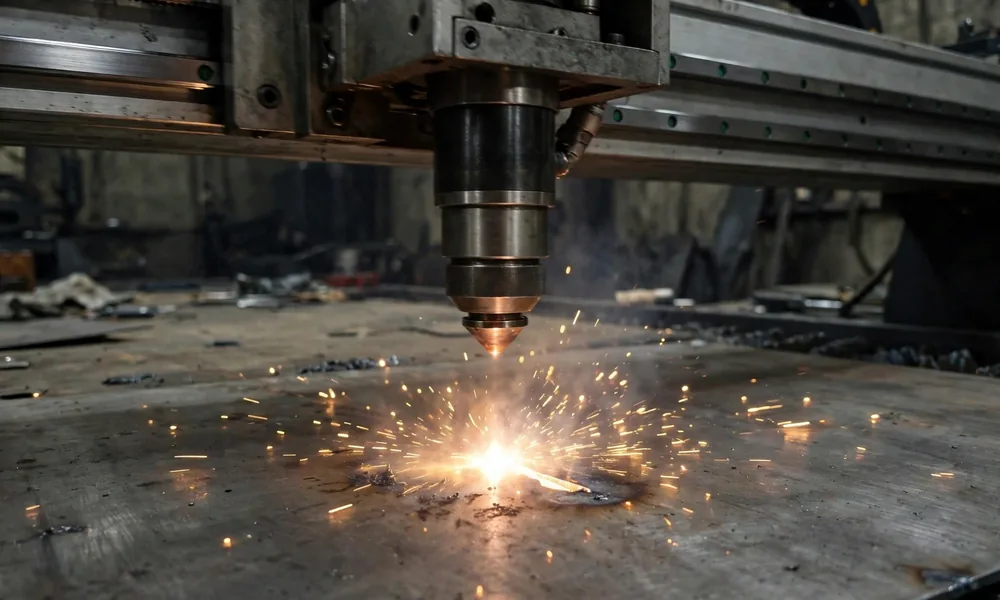
Melting the metal is only half the job. The molten metal has to go somewhere, or it would simply freeze back into the cut. That is the job of the assist gas, fired through the nozzle at high pressure alongside the beam. For mild steel, the gas is usually oxygen, which reacts with the hot iron and adds its own heat to the cut, speeding things up. For stainless steel and aluminium, operators use nitrogen, which does not react and leaves a clean, oxide-free edge. The gas jet blows the liquid metal down and out of the kerf in a spray of sparks — the bright fountain you see in every photo of a laser cutter.
Step 5: Following the programmed path
The cutting head does not wander. It follows a path drawn in computer-aided design software and translated into machine code, moving on rails with a precision measured in hundredths of a millimetre. The machine can cut curves, sharp corners, tiny holes and intricate patterns that no saw could follow, and it can repeat the same part a thousand times without drifting. Compared with additive manufacturing, which builds parts up layer by layer, laser cutting is subtractive and far faster for flat shapes.
Step 6: Cooling, inspection and finishing
As soon as the beam passes, the metal around the cut cools quickly, freezing the edge in place. Workers lift the cut parts out of the sheet skeleton — the leftover frame of metal — and check the edges by eye and with gauges. A good laser cut needs almost no finishing: the edge is smooth, square and ready for bending, welding or powder coating. When everything is right, the parts stack up like they were stamped, except no die was ever made and no tool ever wore out.
Laser Cutting at a Glance
| Specification | Typical value |
|---|---|
| Laser type | Fibre laser, 3–12 kW |
| Cutting speed | Up to 30 m per minute on thin sheet |
| Maximum steel thickness | Around 25 mm |
| Kerf width | 0.1–0.3 mm |
| Positioning accuracy | About 0.05 mm |
| Assist gas | Oxygen for mild steel, nitrogen for stainless and aluminium |
| Best for | Flat sheet, brackets, panels, intricate profiles |
What Laser Cutting Costs
A small job-shop laser cutter can cost roughly $150,000 to $500,000 as an estimate, while a large industrial fibre laser system with automated loading can pass $1 million. The running cost is what matters day to day: electricity, assist gas and the occasional lens or nozzle, usually adding up to a few dollars per minute of cutting time. The real saving is time: a part that took a machinist hours to cut and file can be laser cut in minutes, and the machine works through the night without a break.
A Rare Fact
The first laser cutter for metal was built in the 1960s, and it was used to drill holes in diamond dies — the tiny, brutally hard tools that draw wire. Engineers quickly realised the same beam could cut metal, but early machines were so slow and expensive that only aerospace firms could afford them.
Where Laser Cutting Shows Up
Laser cutting is now so common that its results are easy to miss. The chassis of a car, the case of a phone, the ventilation grille in a kitchen, the decorative screen on a building facade — all of them may have been cut by a beam of light. Jewellers use small lasers for delicate patterns in gold, and aerospace workshops use them for parts that must fit perfectly the first time. Anywhere a flat sheet of metal needs to become a precise shape quickly, the laser cutter is usually the machine doing the work.
Next time you see a machine with a panel full of perfectly round holes and curves no drill could make, look at the edges. The precision machining world still has its place for parts that need a machined finish, but for flat metal, light is now the sharpest tool in the factory.