Every time an electric car slows for a corner, something remarkable happens: instead of throwing its speed away as heat, it catches it. The motor runs backwards, the wheels turn a generator, and the energy of motion flows back into the battery as electricity. It is called regenerative braking, and on a winding downhill road it can put real miles back into the car’s range. The trick is not magic. It is materials — copper, magnets, silicon carbide and lithium — arranged so that the same hardware that drives the car can also harvest its speed.
A regenerative braking system is really two systems sharing one set of parts. The electric motor that pushes the car forward becomes a generator when the driver lifts off. The inverter that feeds power to the motor reverses the flow and tidies it into a form the battery can accept. And the ordinary friction brakes stand by for the moments when electricity alone cannot stop the car.
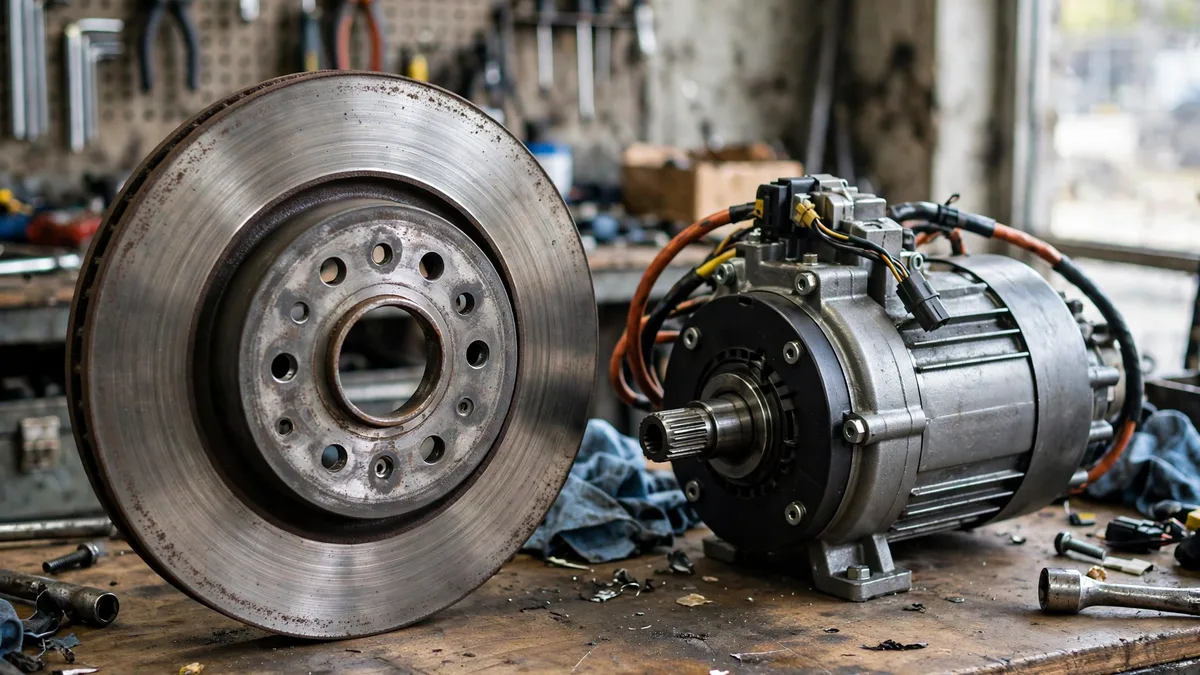
The Materials Behind the Regenerative Braking System
At the heart of the system is the motor itself, built from copper windings, laminated steel and powerful permanent magnets made from neodymium. Around it sits the inverter, whose silicon carbide switches control the flow of electricity in both directions. The battery, usually lithium-ion, must accept sudden bursts of charge without damage, and the friction brakes — cast iron discs and sintered pads — handle whatever the motor cannot. Sensors and software tie it all together, blending electric and friction braking so smoothly the driver never notices the handover.
Step 1: The motor that becomes a generator
An electric car’s motor is a reversible machine. When power flows in, it spins and drives the wheels; when the wheels drive it, it generates electricity. The key materials are the copper windings in the stator, which carry the current, and the permanent magnets in the rotor, made from neodymium-iron-boron — the strongest magnets available, and the reason modern EV motors are so compact. A well-designed motor can recover a large share of the energy it spent accelerating the car.
Step 2: The inverter’s silicon carbide switches
Between the motor and the battery sits the inverter, and its most important material is silicon carbide. Traditional inverters used silicon switches, which waste energy as heat every time they switch on and off — thousands of times a second. Silicon carbide switches run hotter, switch faster and waste far less, which matters twice over in regenerative braking: less energy is lost on the way into the battery, and less heat has to be cooled away. It is the traffic controller of the whole system.
Step 3: The battery that takes the charge back
Recovered energy is useless if the battery cannot accept it. Lithium-ion cells, the kind used in most electric cars, can take a fast burst of charge when braking — but only within limits. Push too hard and the lithium plates onto the anode instead of slipping inside it, permanently damaging the cell. The battery management system watches every cell’s voltage and temperature, and throttles the regeneration the moment a cell complains. Understanding how a regenerative braking system works starts here, with a battery that must be both a fuel tank and a sponge.

Step 4: The friction brakes that stand by
Regenerative braking cannot do everything. At very low speeds the motor generates too little power to stop the car, and in a hard emergency stop the driver needs far more braking force than the motor can provide. That is when the friction brakes take over: cast iron discs and pads, much like those on a petrol car, though they work far less hard and last far longer — some EV owners never replace their pads at all. The two systems share the pedal, and the car decides, moment by moment, how much work each one does.
Step 5: Blending the two brakes
The hardest part of regenerative braking is not the hardware but the handover. The driver presses one pedal and expects one smooth response, yet behind it two very different systems are trading the workload. Sensors measure pedal travel, wheel speed and battery state, and a controller blends electric and friction braking in real time, adjusting dozens of times a second. The best systems are invisible: the car simply slows, and only the range display betrays that energy is flowing back into the battery. The full picture is laid out in the regenerative braking system specifications, where the blend is tuned to the gram.
Step 6: Cooling what the system cannot use
Not all braking energy can be recovered. When the battery is full, or too cold, or too hot, it cannot accept charge — and the energy has to go somewhere. That somewhere is heat, shed through the friction brakes and through the motor and inverter cooling circuits. The EV inverter is the hardest-working part of this loop, switching thousands of times a second while its cooling system keeps it alive.
Step 7: Testing, tuning and the downhill proof
A regenerative braking system is tuned on test tracks and mountain roads, where engineers can measure exactly how much energy comes back. The final test is the one every owner does without thinking: a long descent in the mountains, watching the range display climb instead of fall. A good system can recover a large share of the energy spent climbing the other side — the car, in effect, reuses its own speed.

Regenerative Braking System at a Glance
| Specification | Detail |
|---|---|
| Motor windings | Copper, in a laminated steel stator |
| Rotor magnets | Neodymium-iron-boron permanent magnets |
| Inverter switches | Silicon carbide (SiC) |
| Battery type | Lithium-ion, often lithium iron phosphate |
| Friction brakes | Ventilated cast iron discs, sintered pads |
| Energy recovery | A large share of braking energy in city driving |
| Cooling | Liquid-cooled motor, inverter and battery |
What Does It Cost?
Regenerative braking comes built into every electric car, so there is no separate price tag — but the hardware behind it is a major part of the car’s cost. A replacement inverter typically costs one to several thousand dollars (estimate), and a drive motor costs several thousand dollars (estimate), with the battery dwarfing both. The good news for owners is that the system saves money every day: friction brake pads on an electric car can last twice as long as on a petrol car (estimate), because the motor does most of the braking, and the recovered energy is free range.
A Rare Fact
Regenerative braking is far older than the electric car boom. More than a century ago, early electric cars and trams were already using their motors as generators to slow down, and the Baker Electric cars of the early 1900s recovered energy on downhill runs. The idea then faded as cheap petrol took over, and it took a hundred years — and the return of the electric motor — for it to come back. Today, Formula 1 cars recover braking energy with a system so powerful it adds hundreds of horsepower on acceleration, and the humble city EV uses the same idea to stretch its range through traffic. The oldest trick in electric driving turned out to be the one that mattered most.


