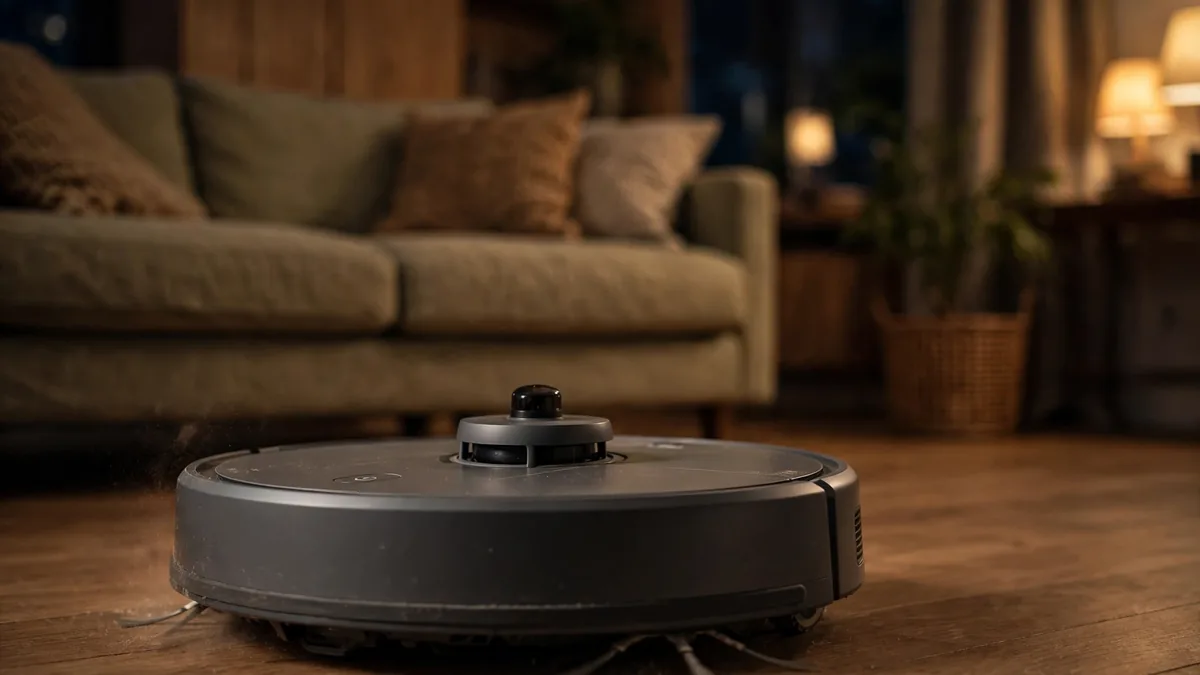
At two in the morning, a small disc wakes up in a dark living room, spins a tiny mirror ten times a second, and fires invisible laser pulses at the walls. In less than a minute it has measured every room in the house, drawn a map accurate to a centimetre, and set off to clean the floors without bumping into a single chair leg. The machine doing the measuring is a LiDAR sensor, and it lives inside a robot vacuum no bigger than a dinner plate.
The LiDAR vacuum sees the house as a cloud of millions of distance measurements, rebuilt into a map it remembers between cleans. The sensor that makes it possible is a marvel of materials engineering: a laser, a spinning mirror and a light detector, all packed into a turret the size of a coin stack, built to spin for thousands of hours without wearing out.
The Materials Behind the LiDAR
A robot vacuum LiDAR is built from a small set of materials, each chosen for a single demanding job. A gallium arsenide laser diode fires the infrared pulses that measure distance. A silicon photodetector, called an avalanche photodiode, catches the faint reflections that return. A beryllium copper spring and a miniature brushless motor spin the mirror that sweeps the beam around the room. The mirror itself is glass coated with a thin film of gold or aluminium, chosen because it reflects infrared light almost perfectly. Around it all sits a housing of polycarbonate and aluminium, protecting the optics from dust while letting the laser pass through a clear window.
Step 1: Making the gallium arsenide laser diode
Everything starts with a wafer of gallium arsenide, a semiconductor that turns electricity into infrared light far more efficiently than silicon ever could. Layers of the crystal are grown by deposition, then etched into a tiny diode that emits a beam at 905 nanometres, a wavelength invisible to the human eye and safe at the low powers used. Gallium arsenide was chosen because it lases brightly at room temperature from a chip smaller than a grain of sand.
Step 2: Coating the spinning mirror
The laser beam is bounced off a small mirror that spins inside the turret, sweeping the beam around the room in a full circle. The mirror is made from glass, polished flat to within a fraction of a wavelength, then coated with a film of gold only a few hundred atoms thick. Gold was chosen because it reflects more than ninety-eight percent of infrared light and never tarnishes, so the mirror stays bright for the life of the vacuum.
Step 3: Building the avalanche photodiode receiver
The returning laser pulse is far too faint for an ordinary sensor to see, so the receiver is an avalanche photodiode made from silicon, with a dash of indium gallium arsenide in the most sensitive designs. When a photon strikes it, the diode multiplies the signal in an avalanche of electrons, amplifying a whisper of light into a measurable pulse. Silicon was chosen because it is cheap, reliable and sensitive at 905 nanometres, and because it can be made on the same production lines as computer chips.
Step 4: Spinning the turret on a brushless motor
The mirror, laser and detector all ride on a turret spun by a miniature brushless motor, its coils wound from copper wire and its rotor fitted with neodymium magnets. Brushless was chosen because there are no carbon brushes to wear out: the turret must spin at around ten revolutions a second, hour after hour, year after year, and a brushed motor would die within months. The same motor logic appears in the spinning motors of a camera drone, where a worn bearing would mean a crash instead of a missed spot on the carpet.
Step 5: Timing the pulses to measure distance
The LiDAR measures distance by time of flight: it fires a pulse, starts a clock, and stops it when the reflection returns. Light travels about thirty centimetres in a nanosecond, so the timing circuit must resolve billionths of a second to measure a wall to within a centimetre. Thousands of pulses a second build a point cloud, and software turns that cloud into a map the vacuum can navigate, much as a larger LiDAR sensor maps the road ahead for a self-driving car.
Step 6: Sealing the optics against dust
A vacuum cleaner lives in the dustiest place in the house, so the turret is sealed behind a polycarbonate window that the laser passes through. Polycarbonate was chosen because it is tough and transparent to infrared light, and because it can be moulded into the curved shape the turret needs.

Why These Materials Win
Gallium arsenide was chosen because it makes the brightest infrared laser from the smallest chip. Gold was chosen for the mirror because it reflects infrared almost perfectly and never tarnishes. Silicon was chosen for the detector because it is sensitive, cheap and proven. Ceramic bearings were chosen because they spin for years without grease, and brushless motors because they have nothing to wear out.
The trade-off is sensitivity to dirt and cost. A gold mirror and a gallium arsenide laser are expensive for a household appliance, and the whole sensor fails if its window gets dirty. Cheaper vacuums skip LiDAR entirely and use cameras or random bouncing, and they clean worse for it, a reminder that even the smallest sensor in the home now borrows technology from far more demanding machines.
Specifications
| Specification | Detail |
|---|---|
| Laser material | Gallium arsenide diode, 905 nanometres |
| Detector | Silicon avalanche photodiode |
| Mirror coating | Gold film on polished glass |
| Motor | Miniature brushless, neodymium rotor |
| Bearings | Ceramic, grease-free |
| Turret speed | About 10 revolutions per second |
| Measurement range | Up to about 8 metres indoors |
| Accuracy | About 1 centimetre at typical room distances |
| Pulses per second | Several thousand |
| Window material | Infrared-transparent polycarbonate |
Price
A LiDAR robot vacuum such as the Roborock S8 sells for around 750 dollars (estimate), and the LiDAR turret is one of its most expensive parts, costing roughly 50 to 100 dollars as a replacement module (estimate). Budget vacuums without LiDAR sell for 200 to 300 dollars (estimate), which shows what the sensor adds to the price.
Rare Fact
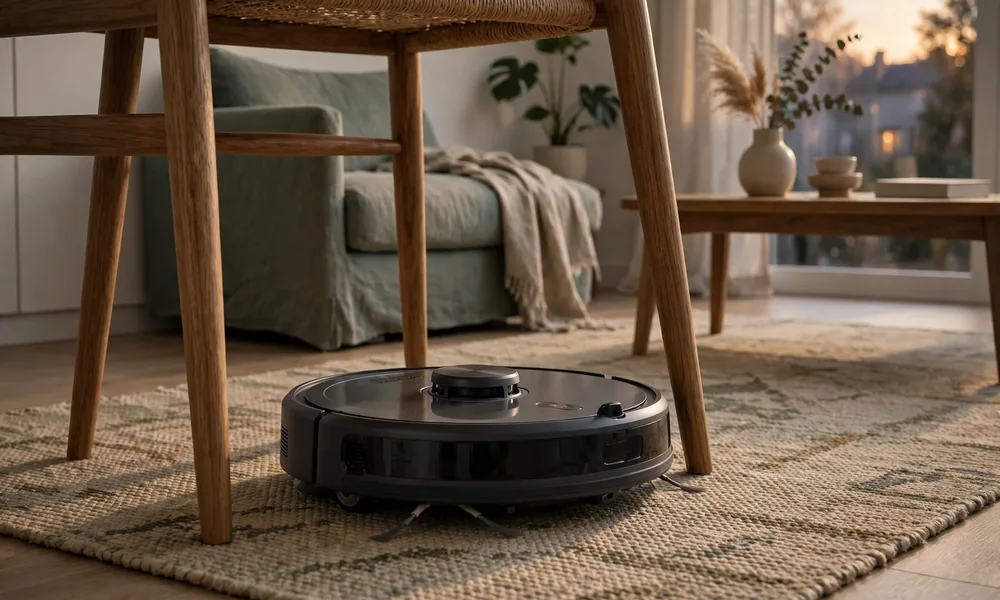
The laser inside a robot vacuum fires thousands of pulses every second, yet the total light it emits is less than a milliwatt — dimmer than a laser pointer — and each pulse lasts only a few billionths of a second. In that brief flash the sensor measures the time it takes light to travel to the wall and back, a journey of a few billionths of a second, and from that it draws a map of your home accurate to a centimetre. Your vacuum knows the shape of your living room better than you do, and it learned it in the dark.
That is the quiet marvel of the robot vacuum LiDAR: a gold mirror spinning on ceramic bearings, a gallium arsenide laser flashing invisibly, and a silicon ear listening for the echo. The materials are the same ones found in military rangefinders and space telescopes, shrunk into a turret the size of a coin stack, and the result is a machine that never gets lost in your own home.


