There is a particular kind of seasickness that has nothing to do with waves and everything to do with roll — the slow, sideways sway that turns a calm crossing into a miserable one. For a century, yacht builders fought roll with weight. Then engineers realised the answer was a wing, not mass. A stabilizer fin is a small, curved blade that sticks out of the hull below the waterline, and when the yacht starts to roll, the fin angles itself to push back. The result is a yacht that stays level in seas that would have had guests reaching for the rail.
Building a stabilizer fin is a strange mix of disciplines. The fin itself is a hydrodynamic sculpture, machined to a smooth foil shape; the mechanism inside the hull is a piece of heavy machinery, with hydraulic rams, bearings and sensors that must work flawlessly in salt water for decades. The factory that makes them is part shipyard, part precision machine shop, and the people who work there think in two worlds at once: the clean geometry of a wing, and the brutal reality of the ocean.
How Yacht Stabilizer Fins Are Made
Step 1: Designing the foil
Every fin starts as a hydrodynamic design. Naval architects model the yacht’s hull, its speed and its expected sea states, then shape the fin like an aircraft wing — a curved foil that generates lift as water flows over it. The fin must be large enough to counteract the roll, but small enough not to add drag — and on some yachts it retracts for shallow harbours. The design is tested in towing tanks and in software, where engineers watch how the fin behaves at different speeds and angles. A good fin can cut roll by 70 to 90 percent.
Step 2: Forging and casting the fin
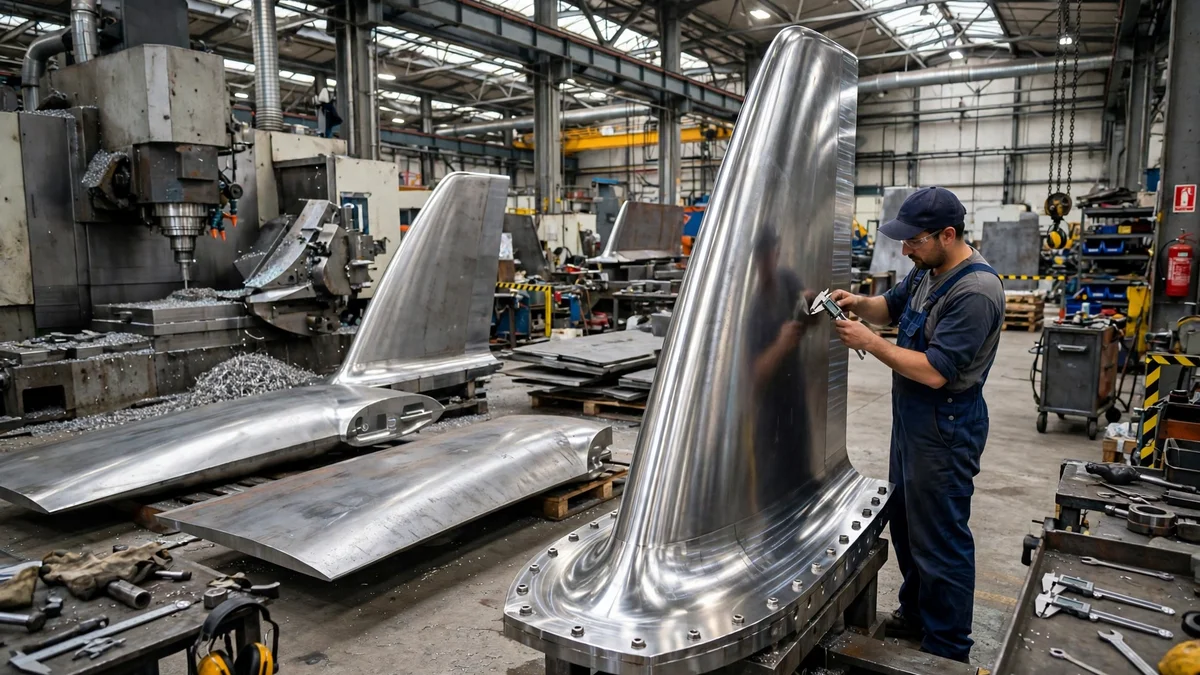
The fin itself is usually cast or forged from stainless steel or a nickel-aluminium bronze alloy, chosen for strength and resistance to corrosion in salt water. Molten metal is poured into a mould shaped like the foil, and the casting cools slowly to avoid internal stresses. The rough fin that comes out of the mould is heavy and dull — the hydrodynamic magic happens in the machining that follows. The metallurgy matters enormously, and the same care over marine alloys that shapes superyacht steel hulls applies to every fin.
Step 3: Machining the foil shape
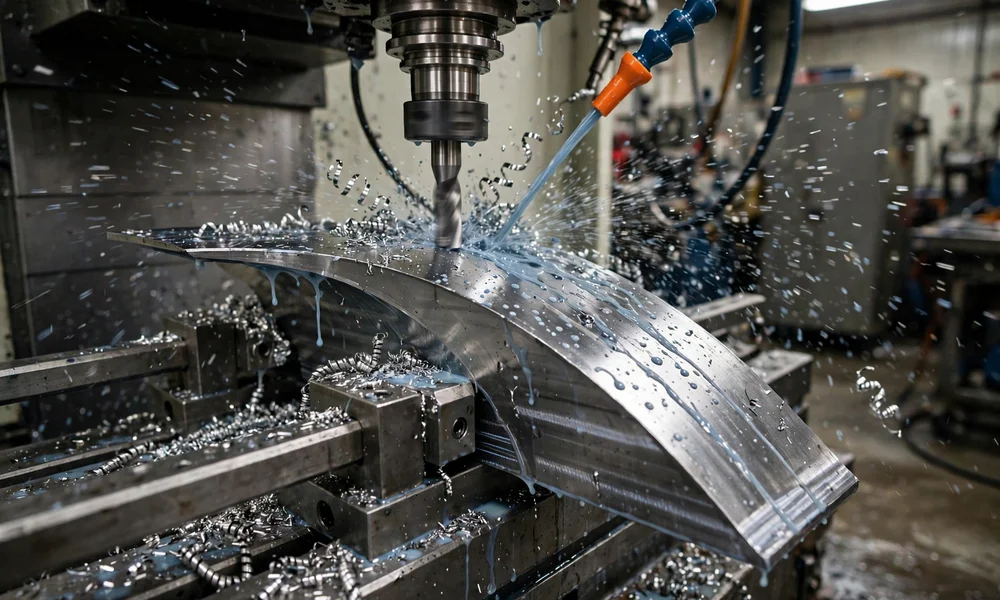
The rough casting goes onto a large five-axis CNC machine, which mills the fin to its final foil profile. The machine works for hours, sometimes days, removing metal in thin passes until the surface is smooth and the shape matches the digital model to within a fraction of a millimetre. The leading edge is shaped to cut the water cleanly, the trailing edge is kept sharp, and the surface is polished to reduce drag — a rough fin is a slow fin, and a slow fin is a fin that wastes fuel. After machining, the fin is measured and balanced — a vibrating fin wears out bearings fast.
Step 4: Building the actuation system
Inside the hull, the fin is driven by a hydraulic or electric actuator — a powerful ram that can swing the fin through its full range in a fraction of a second. The actuator, its bearings and its seals are assembled in a clean workshop, because the mechanism must be watertight where the fin shaft passes through the hull. The shaft seal must keep the sea out while the shaft rotates under load, for years, without maintenance. The bearings carry tonnes of lift, delivered sideways again and again.
Step 5: Sensors and control electronics
A stabilizer fin is useless without a brain. Gyroscopes and accelerometers sense the yacht’s roll, and a control unit calculates the exact fin angle needed to counteract it, updating the command many times per second. The system must react faster than the wave — a fin that moves too late adds to the roll instead of cancelling it. The electronics are calibrated with the actual fin and actuator. It is the same sensor-and-response discipline that makes gyroscopic stabilizers work, and the two systems are often fitted together on the same yacht.
Step 6: Testing in the tank and at sea
Before a fin system is fitted to a yacht, it is tested. The actuator is cycled thousands of times on a test rig, the seals are pressure-tested, and the control system is run through simulated sea states. Then comes the real test: the yacht goes to sea, and the engineers watch the roll. A good system shows an immediate, dramatic difference — the yacht that rolled 10 degrees in a beam sea now rolls two or three. The sea trial also checks for noise and vibration, felt in every cabin. Only when the sea trial data is clean does the system get signed off.
Step 7: Fitting to the hull
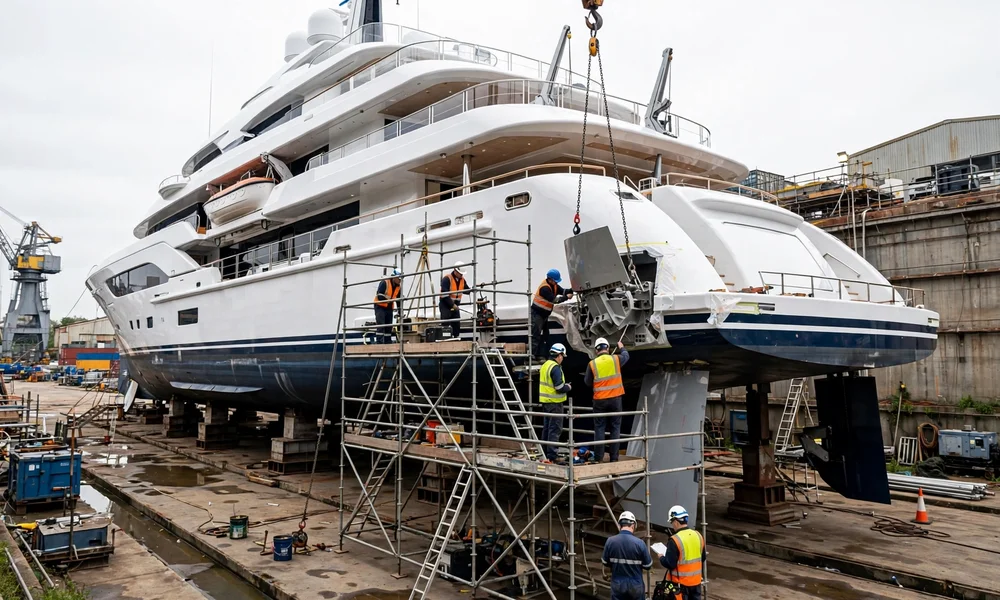
The final step happens in the shipyard, not the factory. The fin is bolted to its shaft, the shaft is fitted through the hull with its seals, and the actuator is mounted inside. The fin is coated with antifouling paint, and the system is commissioned with the yacht’s other stabilisation equipment. From the outside, all you see is a small blade under the waterline — and the reason the champagne stays in its glass. The same shipyard craft that fits the fin also shapes the yacht’s running gear, including the yacht propeller that shares the water below the hull.
Yacht Stabilizer Fins at a Glance
| Specification | Typical Value |
|---|---|
| Fin material | Stainless steel or nickel-aluminium bronze |
| Roll reduction | 70–90% at cruising speed |
| Fin size | About 1–3 square metres per fin on a superyacht |
| Actuation | Hydraulic or electric, full range in under a second |
| Control | Gyroscopes and accelerometers, updated many times per second |
| Working life | Decades, with seal and bearing service intervals |
| Key advantage | Comfort at sea without adding ballast or beam |
What Does It Cost?
A stabilizer fin system is a serious investment. A pair of fins with actuators, sensors and controls for a superyacht typically costs $200,000–$800,000 installed (estimates), depending on yacht size and whether the fins retract. Smaller yachts can be fitted with compact systems from around $50,000 (estimates). The cost is driven by the machining, the hydraulic hardware and the control electronics, not by the steel itself. For an owner who crosses oceans, the price is easy to justify: a yacht that does not roll gets used more.
A Rare Fact
The idea of stabilizer fins is older than most people think — the first working systems appeared on ocean liners in the 1930s — but the modern fin is a different animal. Some superyachts use them even at anchor, swinging gently to cancel the swell — a mode called zero-speed stabilisation. A yacht at rest, in a rolling anchorage, can sit almost perfectly still while the boats around it pitch and roll.


