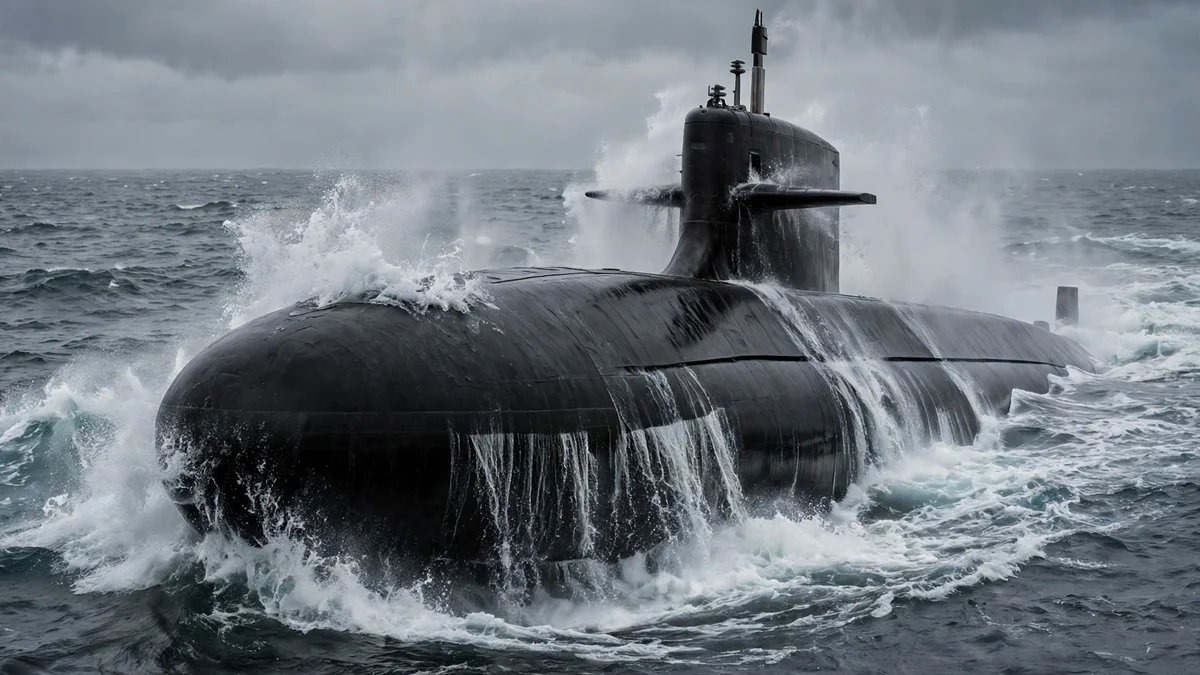
The submarine hangs motionless in the water, neither rising nor sinking, and then the captain gives an order in a voice barely above a murmur. Valves open. Seawater rushes into steel tanks with a sound like a river filling a cave, and the boat begins to sink — not falling, but settling, deliberately, tonne by tonne, until the sea closes over the sail and the submarine is gone. Hours later the order reverses, high-pressure air blasts the water out, and tonnes of steel rise back to the surface like a whale taking a breath. The ballast tanks are the submarine’s lungs — the oldest and simplest idea in the boat, and one of the hardest to build well.
A ballast tank is, at heart, a steel container that can be flooded with seawater or blown dry with compressed air. But the simplicity is deceptive. The tanks sit outside the pressure hull, exposed to the full crushing pressure of the deep ocean, and must survive it thousands of times without cracking, corroding or leaking. Their valves must work perfectly at depth and in freezing water, their steel must resist salt water for decades, and their vents must let air escape in seconds when the boat needs to dive in a hurry.
The Materials Behind Submarine Ballast Tanks
The tanks are built from high-strength steel — typically HY-80 or HY-100, the same steels used for the pressure hull, chosen because they are tough, weldable and proven at depth. Where weight matters most, some designs use glass-reinforced plastic or titanium for free-flooding structures around the tanks. The Kingston valves and vents are made from corrosion-resistant alloys: nickel-aluminium bronze, stainless steel and, in the most demanding spots, titanium. Inside, the steel is protected by epoxy coatings and sacrificial anodes of zinc or aluminium, which corrode in place of the hull. The high-pressure air that blows the tanks is stored in steel or composite flasks at around 200 to 300 bar.
Step 1: Shaping the tank steel
Ballast tanks are usually built into the space between the pressure hull and the outer casing, so their shape is dictated by the submarine’s hull form — curved, tapered, fitted around everything else the boat carries. Steel plates are rolled to the required curvature, cut to shape and welded into tanks, with internal stiffeners that stop the thin walls buckling when the sea presses on them. The welding is done to the same standard as the pressure hull itself, because a ballast tank that cracks can flood a compartment or trap air and upset the boat’s trim.
Step 2: Welding and testing the tanks
Every weld is inspected — X-rayed or ultrasonically tested — and every tank is pressure-tested before it is closed up, because once the outer casing goes on, a ballast tank is almost impossible to reach. The tanks are filled with water and pressurised to prove they hold, then drained and dried. It is slow, exacting work, done in the same dry dock where the whole boat takes shape, much like modular ship construction.
Step 3: Coating against the sea
Before the tanks are sealed, their insides are coated with epoxy paint, layer upon layer, because seawater inside a steel tank is a recipe for corrosion. Then sacrificial anodes are bolted inside: blocks of zinc or aluminium that corrode first, protecting the steel by giving the salt water something easier to attack. The anodes are replaced in refits, like the brake pads of a car. Outside, the tanks are coated again and, on many boats, covered by the outer casing and its anechoic tiles, the rubber-like coating that absorbs sonar.

Step 4: Fitting the Kingston valves and vents
At the bottom of each main ballast tank sits a Kingston valve — a large flood valve, operated hydraulically from inside the boat, that lets seawater in when the submarine needs to dive. At the top sits a vent valve that lets air out as the water comes in. The Kingston valves are made from nickel-aluminium bronze, an alloy that resists seawater corrosion and will not seize after months shut. They must open fully in seconds and seal perfectly when closed, because a valve that leaks slowly will change the boat’s buoyancy without anyone noticing.
Step 5: Installing the high-pressure air system
To surface, the submarine blows its ballast tanks dry with compressed air stored in flasks at 200 to 300 bar — pressures high enough to push water out against the sea pressing in at depth. The air flasks are made from high-strength steel or, in newer boats, composite-wrapped steel, and the air lines to each tank are stainless steel or copper-nickel pipe. The blow valves are among the most critical fittings on the boat: they must open instantly, deliver an enormous volume of air in seconds, and never leak, because the air in those flasks is the boat’s only way back to the surface. Crews test them constantly, in harbour and at sea.
Step 6: Trim and auxiliary tanks
Alongside the main ballast tanks, a submarine carries trim tanks, usually inside the pressure hull, that fine-tune its balance. Water is pumped between forward and aft trim tanks to level the boat, and between trim and auxiliary tanks to adjust its overall weight as stores are consumed and torpedoes fired. These tanks use the same steels and coatings, but their valves and pumps are precision instruments, where the main tanks are built like floodgates.
Step 7: The dive test
When the boat is complete, it is taken to sea for its first dive. The crew floods the tanks, watches the trim, blows the tanks, and does it again — dozens of times, at increasing depths, while engineers listen for anything wrong: a valve that hesitates, a tank that drains unevenly, a list that will not correct. The ballast system is tested until the crew can dive and surface the boat in their sleep.

Submarine Ballast Tanks at a Glance
| Specification | Detail |
|---|---|
| Main material | HY-80 / HY-100 high-strength steel |
| Valve material | Nickel-aluminium bronze, stainless steel, titanium |
| Corrosion protection | Epoxy coatings + zinc/aluminium anodes |
| Blow air pressure | ~200–300 bar in steel or composite flasks |
| Key valves | Kingston flood valves (bottom), vent valves (top) |
| Location | Between pressure hull and outer casing |
| Main enemy | Corrosion, pressure cycling, valve failure |
What Does It Cost?
Ballast tanks are not sold separately, and no navy publishes a price for them. But their cost is buried inside the price of the submarine itself: a modern diesel-electric submarine costs on the order of $500 million to $1 billion (verifiable published estimates vary widely by class and country), and a nuclear attack submarine several billion dollars. The ballast system — steel, bronze valves, air flasks, coating and testing — is a small fraction of that total. The valves alone, built to standards no commercial valve ever meets, cost many thousands of dollars each (estimate). It is expensive, and it has to be: the system that takes a submarine down must always be able to bring it back up.
A Rare Fact
A submarine can dive with its ballast tanks only partly flooded, and in an emergency it can blow them in a fraction of the normal time — an “emergency blow” that sends the boat rocketing to the surface in a tower of white water. The air that does it is stored at such pressure that a single flask contains enough energy to be dangerous in its own right, and submariners treat the high-pressure air system with the same respect they give the reactor or the torpedoes.


