Three hundred metres down, the ocean presses on a submarine with a force that would crush a car flat, and the only thing between the crew and that pressure is a steel tube a few centimetres thick. The pressure hull is the most demanding piece of steel engineering ever put to sea, and the materials it is made from are chosen for one quality above all others: the ability to bend without breaking when the ocean tries to squeeze the boat into a smaller shape.
A submarine hull is not simply thick steel. Thickness alone would make the boat too heavy to dive, too slow to manoeuvre and too expensive to build. Instead, designers use special high-strength steels, shape them into perfect cylinders and spheres, and reinforce them with rings and frames that share the load. The materials behind it are a compromise between strength, toughness and weldability — and getting that compromise wrong has sunk boats before.
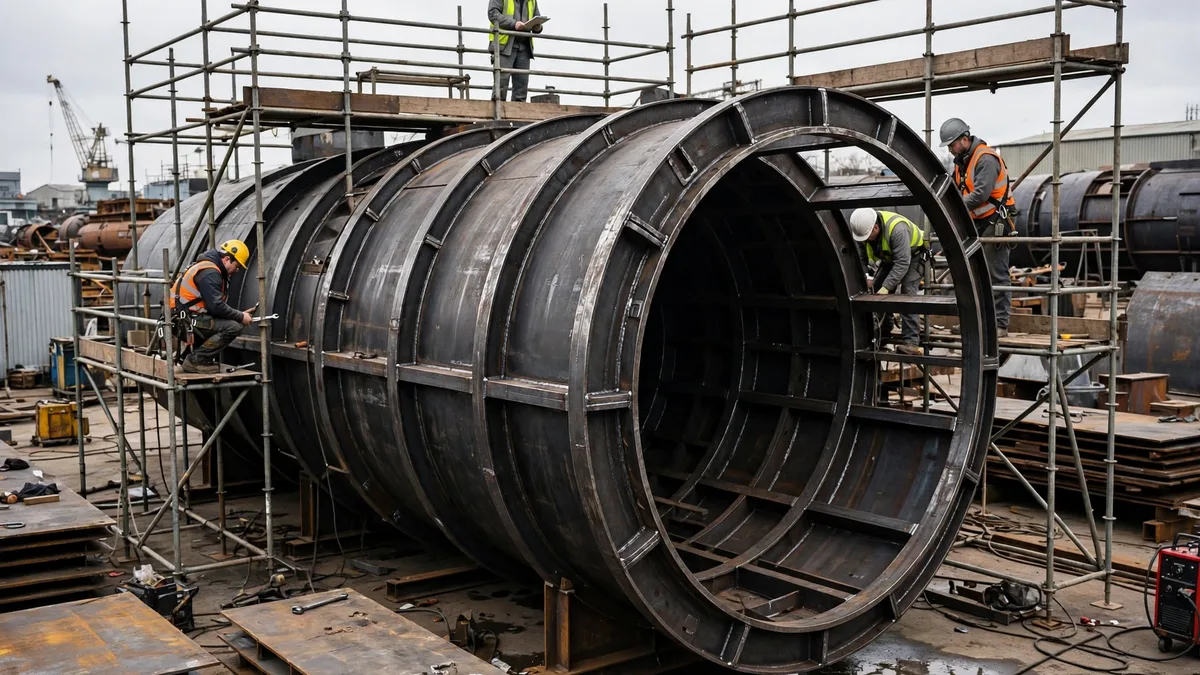
The Materials Behind the Submarine Pressure Hull
The pressure hull of a modern military submarine is usually built from HY-80 or HY-100 steel, alloys with a yield strength of around 80,000 or 100,000 pounds per square inch — roughly twice that of ordinary ship steel. These steels are quenched and tempered, heated and cooled in a controlled way that gives them their strength without making them brittle. Around the steel sit other materials with supporting roles: titanium in a few specialised boats, high-strength alloys for hatches and penetrations, and acoustic coatings outside that keep the hull quiet. The steel is the star, but the hull only works as a system.
Step 1: Choosing a steel that bends before it breaks
The first choice is the steel itself, and it is a harder decision than it looks. The hull must be strong enough to resist crushing, but strength alone is dangerous: a very strong steel can be brittle, and a brittle hull fails suddenly, without warning. HY-80 and HY-100 are chosen because they combine high yield strength with toughness — the ability to absorb energy and deform before fracturing, especially in cold deep water.
Step 2: Rolling plates into a near-perfect cylinder
A pressure hull works because it is round. A cylinder spreads external pressure evenly around its circumference, so no single point carries more than its share. That only works if the cylinder is truly round: even a small flat spot or dent concentrates stress and can start a collapse. Plates are therefore rolled to exact curvature and the hull is measured obsessively as it is assembled, with tolerances of a few millimetres over a diameter of ten metres.
Step 3: Ring stiffeners that share the crushing load
Between the plates, the hull is reinforced with ring stiffeners — heavy steel rings welded around the inside of the cylinder at regular intervals. These rings are what stop the hull from buckling inward like a crushed drinks can. They carry a large share of the pressure load and keep the shell round even as the boat dives. The pressure hull is therefore not a simple tube, but a tube stiffened by dozens of internal rings working together.

Step 4: Welding steel that must never crack
Welding HY steel is a craft of its own. The steel is sensitive to hydrogen, and a weld contaminated with even a little moisture can develop cracks hours after it cools — cracks that would be catastrophic at depth. Welders preheat the steel, use low-hydrogen electrodes kept bone dry, and work to strict procedures that are qualified and re-qualified constantly. Every structural weld is inspected with ultrasound and X-rays, and any defect is cut out and redone. There is no acceptable level of flaw in a pressure hull weld, and the boats are built on that principle.
Step 5: Titanium where steel reaches its limits
A few submarines — most famously some Soviet designs — were built with titanium pressure hulls instead of steel. Titanium is lighter for the same strength and never rusts, which lets a boat dive deeper and stay quieter, since it is non-magnetic. The price is enormous: titanium is difficult to weld, it must be shielded from air while hot, and the metal itself costs many times more than steel. The experiment proved the material works brilliantly and costs too much for most navies, so modern boats use titanium only for selected parts. The titanium hull remains the deep-diving benchmark that steel boats are measured against.
Step 6: Hatches, penetrations and the weakest points
Every hole in a pressure hull is a weakness: hatches, torpedo tubes, periscope and mast penetrations, and the pipes and cables that pass through. Each one is reinforced with a heavy forged ring, and the fittings themselves are made from high-strength forgings that can take the same pressure as the shell. The hatch mechanisms use special steels and seals that must close perfectly every time, because a hatch that leaks at depth floods the boat in seconds.
Step 7: Coatings that silence the hull
Outside the steel, a submarine wears a skin of anechoic tiles — rubber-like panels that absorb sonar instead of reflecting it. The tiles are bonded to the hull with adhesives that must survive pressure, cold and years underwater without peeling, and they add weight and maintenance the designers would rather avoid. The ballast tanks that flood and empty to control the dive surround the pressure hull, and their steel must survive the same corrosive sea while cycling between wet and dry hundreds of times a year.

Submarine Pressure Hull at a Glance
| Specification | Detail |
|---|---|
| Main hull steel | HY-80 or HY-100 high-strength quenched and tempered steel |
| Yield strength | Around 80,000–100,000 psi, about twice ordinary ship steel |
| Hull shape | Cylinder with spherical or conical end caps, ring-stiffened |
| Typical plate thickness | Around 25–50 mm, thicker at frames and penetrations |
| Alternative material | Titanium, used in a few deep-diving designs |
| Welding | Low-hydrogen, preheated, fully inspected by ultrasound and X-ray |
| Outer coating | Anechoic rubber tiles bonded to the steel |
What Does It Cost?
There is no civilian price for a submarine pressure hull, but the material gives a sense of the scale: HY-80 and HY-100 plate cost several times more per tonne than ordinary ship steel (estimate), and the machining, welding and inspection multiply that many times over. A single hull section can take a shipyard a year to build, and the finished hull represents hundreds of millions of dollars (estimate) of a submarine’s total cost. Navies pay it because there is no cheaper way to put people hundreds of metres underwater and bring them home.
A Rare Fact
The most famous pressure hull failure in history was not caused by enemy action at all. The American submarine USS Thresher was lost in 1963 during a deep test dive, and the investigation pointed to a piping failure that flooded the boat faster than it could blow its ballast — a failure in the systems that pass through the hull, not the hull steel itself. The lesson reshaped submarine construction worldwide: after Thresher, navies introduced far stricter rules for every pipe, valve and weld that penetrates a pressure hull. The steel was never the weak point. The holes in it were.


