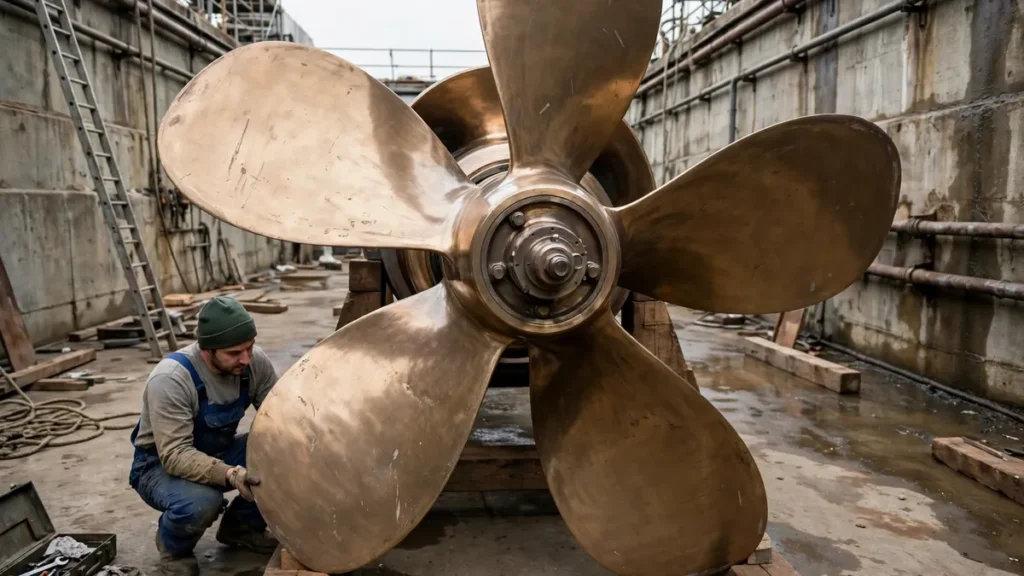
There is a moment, just before a submarine slips beneath the surface, when the whole boat seems to hold its breath. The propeller is the one part of a submarine that does its work entirely out of sight, in the dark, under crushing pressure — and it is also the part that can give the whole boat away.
A submarine lives or dies by how quietly it moves. So the propeller on a modern submarine is not a simple fan. It is a precision instrument, machined to tolerances measured in fractions of a millimetre, shaped to push tonnes of steel through the sea without leaving a trace of bubbles behind it.
Everything about the design is a compromise between thrust, silence, strength and speed. A bigger diameter means more bite on the water, but it also means a propeller that sticks out below the hull and risks damage. The numbers that describe it — diameter, pitch, blade count, skew, tip speed — are the numbers that decide how fast a submarine can go, and how quietly it can get there. Its closest cousins in engineering are the submarine pressure hull that protects the crew and the submarine sonar array that listens for the enemy. Here is what the specifications mean.
Diameter: How Big the Disc Is
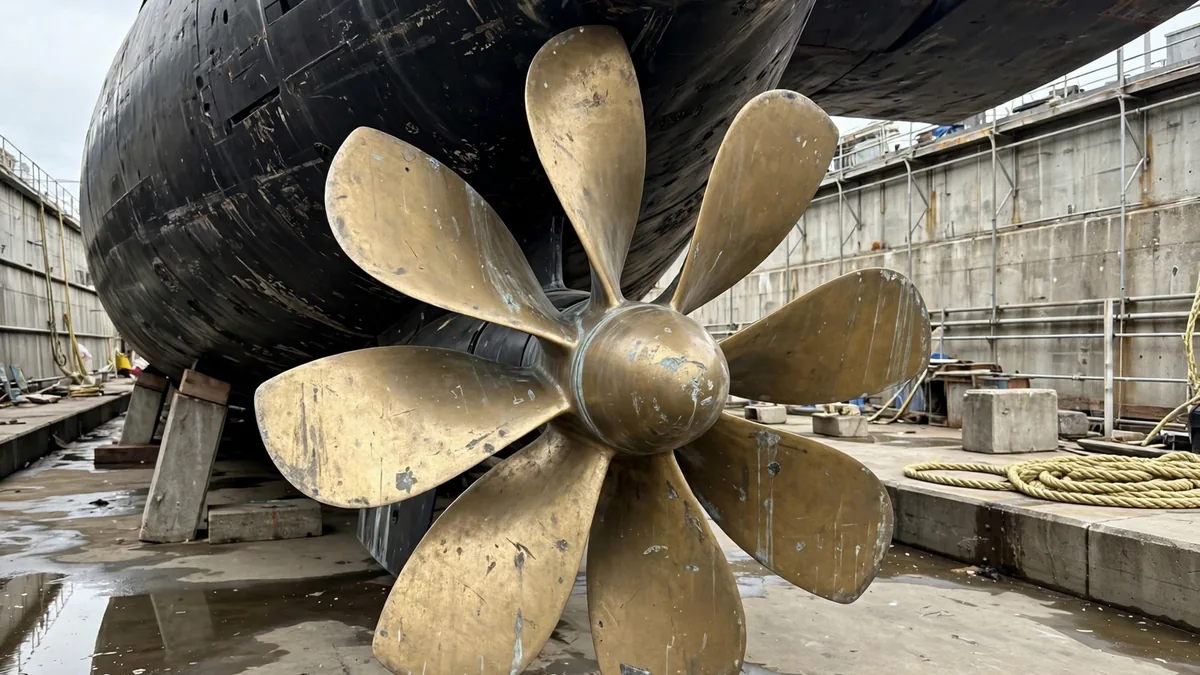
The diameter of a submarine propeller is the width of the circle its blades sweep through the water, and it is usually the single most important number in the whole specification. On a large nuclear submarine the propeller can be six to seven metres across — taller than a two-storey house. That is why submarine propellers are as large as the hull allows, often reaching almost to the keel line and nearly to the waterline at the top. The limit is the shape of the stern itself: the blades must clear the hull, the rudder and the seabed when the boat is in shallow water, so designers work in centimetres, not metres, to squeeze every last bit of diameter in.
Skew: The Curve That Kills Noise
Look at a submarine propeller from the side and the blades do not stand straight out from the hub — they sweep backwards like the blades of a scythe. This is called skew, and it is the propeller’s main defence against cavitation. As a blade turns, it meets water that has just been disturbed by the hull above it, a patchy, uneven flow. A skewed blade enters the uneven flow gradually, tip first and then the rest, spreading the load along its length. Highly skewed blades can look almost bent, but that bend is what lets a submarine run at speed without announcing itself.
Pitch: How Far Each Turn Carries the Boat
Pitch is the distance the propeller would travel forward in one full turn if it were screwing through a solid material, and it is usually measured in metres. A submarine propeller might have a pitch of around five to six metres, meaning each revolution would carry it that far through undisturbed water. Pitch is matched carefully to the engine and the gearbox: too much pitch and the motor strains at low speed, too little and the boat can never reach its top speed. On many submarines the pitch is fixed, machined into the bronze forever, because a variable-pitch hub would add moving parts, noise and a point of failure in the worst possible place.
Material: Nickel-Aluminium Bronze
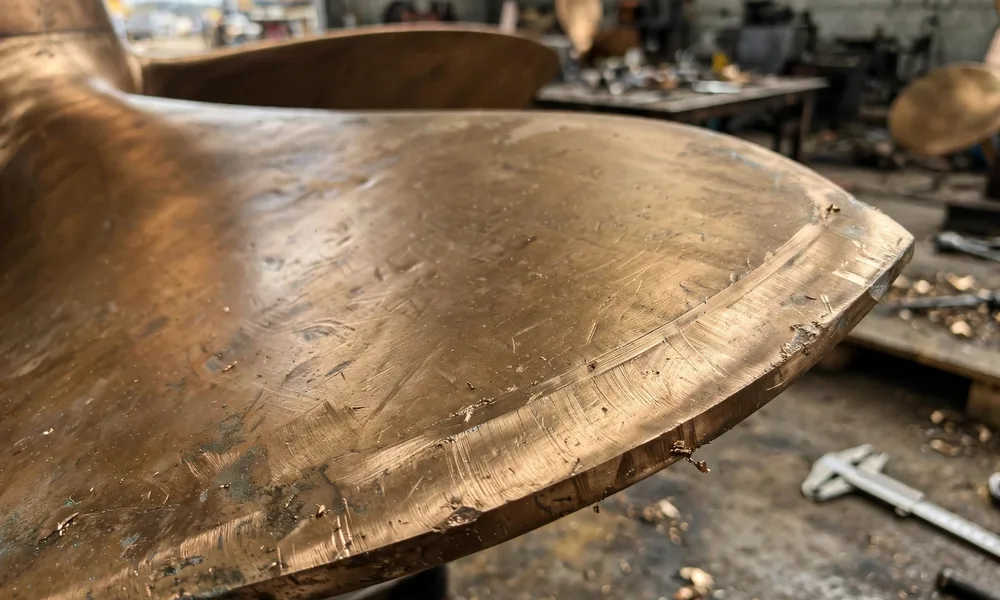
Submarine propellers are cast from nickel-aluminium bronze, an alloy of copper with aluminium, nickel and iron that is strong, tough and almost immune to corrosion in seawater. A single propeller casting can weigh thirty to forty tonnes, poured in one piece and then machined for months. The surface is polished to a mirror finish, because even a rough patch or a dent can seed cavitation bubbles. When a propeller is damaged — by debris, by grounding, or by ice — the whole boat goes into dry dock, because there is no way to fix a thirty-tonne bronze screw while it is underwater.
Tip Speed and Cavitation
The fastest-moving part of any propeller is the tip of its blades, and tip speed is the number that decides when cavitation begins. As the tip spins faster, the pressure on the back of the blade falls, and once it falls below the vapour pressure of seawater, tiny bubbles form and then collapse violently against the metal. Designers keep tip speeds well below the cavitation limit at patrol speed, typically under about twenty-five metres per second, and accept that at full speed the propeller will cavitate — which is why a submarine running flat out is anything but silent. The relationship between tip speed and noise is the reason deep-sea submersibles use small, slow-turning thrusters instead of one big screw.
Submarine Propeller Specs
| Specification | Typical range |
|---|---|
| Diameter | About 5 to 7 metres on a large nuclear submarine |
| Blade count | Usually 5, 7 or 9 blades |
| Pitch | About 5 to 6 metres per revolution |
| Material | Nickel-aluminium bronze (copper, aluminium, nickel, iron) |
| Weight | About 20 to 40 tonnes for a single casting |
| Tip speed at patrol | Below about 25 metres per second to avoid cavitation |
| Shaft speed | About 100 to 200 rpm at patrol speed |
| Skew angle | Highly skewed, often 30 to 45 degrees at the tip |
| Top speed contribution | Designed for about 25 to 35 knots submerged |
| Service life | About 10 to 20 years between major overhauls |
What Does a Submarine Propeller Cost?
A single submarine propeller is estimated to cost roughly $2 million to $10 million, depending on size, blade count and how much machining it needs — and that is before the cost of the shaft, the seal and the dry-dock time to fit it. Replacement is rare: propellers are repaired and re-polished in dry dock, and a boat may keep the same screw for most of its life. Prices are estimates only — the real figures are classified, and no navy publishes what it pays for its quietest hardware.
A Rare Fact
In the 1980s, the Soviet Union secretly bought advanced computer-controlled milling machines from Japan’s Toshiba and Norway’s Kongsberg, and used them to machine submarine propellers so smooth and so precisely skewed that their boats suddenly became far harder to hear. American sonar operators noticed the difference almost at once: Soviet submarines that had once been easy to track began to vanish. It remains the clearest proof that a propeller is not just a piece of hardware, but a strategic secret.

Next time you picture a submarine, do not picture the tower or the torpedo tubes. Picture the screw at the stern, turning slowly in the dark, pushing thousands of tonnes of steel through the sea without making a sound. That silence is not an accident. It is machined, polished and measured into every curve of the blades — and it is what keeps the boat, and its crew, alive.