Stand on the dock at first light and look up. The mast of a sailing superyacht does not rise like a pole; it climbs like a tower, black and tapered, vanishing into the pale morning sky until your neck aches and you still cannot quite see the top. From the waterline to the masthead is further than the length of most city streets, and every centimetre of that height is doing work — catching wind, carrying sail, and holding a hundred tonnes of yacht upright against it.
It is easy to think of a mast as a simple stick that holds the sails up. On a superyacht it is nothing of the sort. It is a precision-engineered structure, built from carbon fibre in an autoclave the size of a small house, shaped by wind-tunnel data and computer models, and tuned like an instrument by the crew. A mast on a large sailing superyacht can weigh as much as a car yet flex in a controlled curve under load, bending to spill wind in a gust and springing back when the pressure eases.
The numbers behind a superyacht mast look absurd until you understand what they are for: heights in tens of metres, sail areas bigger than tennis courts, loads counted in tonnes. This guide explains those numbers in plain English — what a superyacht mast is made of, how its parts work together, and what the specifications actually mean.
How It Works
Step 1: The carbon spar carries the load
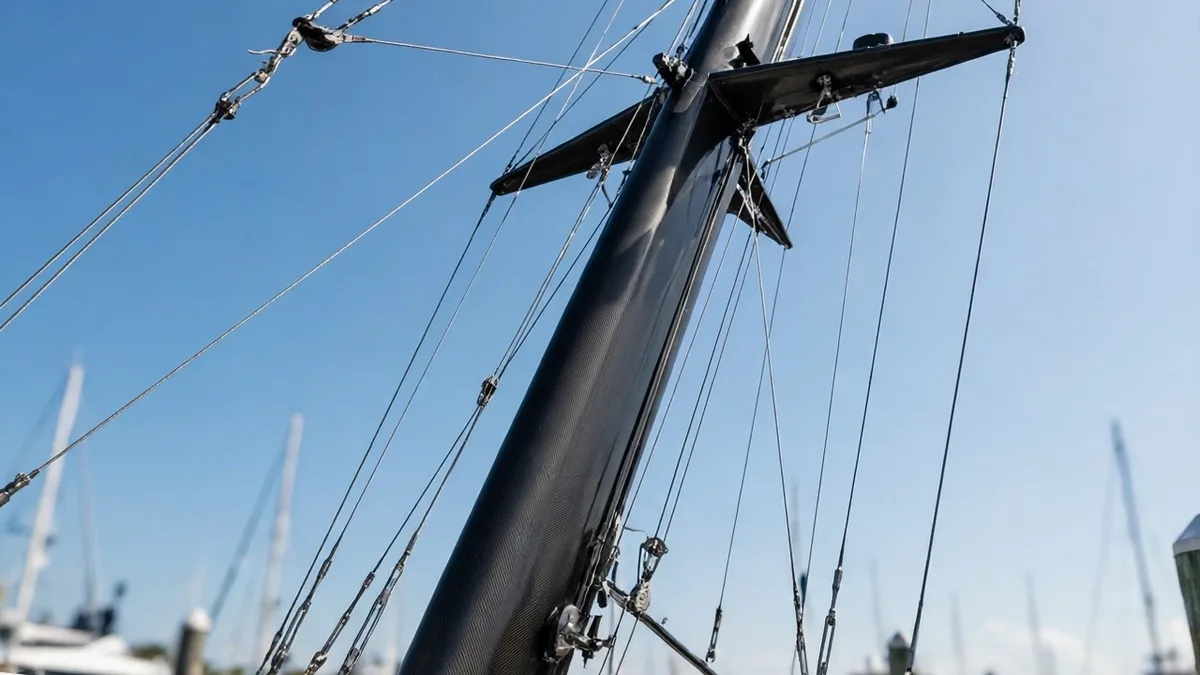
The mast itself is called a spar, and on a modern superyacht it is almost always carbon fibre. Layers of carbon cloth are laid over a mandrel, infused with resin, and cured in a giant autoclave until they become a single rigid tube. Carbon is far lighter and stiffer than aluminium, which matters because weight at the top of a mast acts like a lever, trying to tip the boat over. The spar is tapered — fat at the base, slim at the top — because the bending loads are greatest near the deck.
Step 2: Spreaders hold the rigging out wide
Sticking out sideways from the spar are the spreaders — the horizontal arms you can see in photographs, usually in pairs. Their job is geometry. The wires that support the mast, the shrouds, run from the masthead down to the sides of the hull. Without spreaders, those wires would meet the mast at a shallow angle and give it almost no sideways support. Spreaders push the shrouds outward so they meet the mast at a wide, strong angle. A large superyacht mast may carry three, four, or even five sets of spreaders.
Step 3: Standing rigging holds it all upright
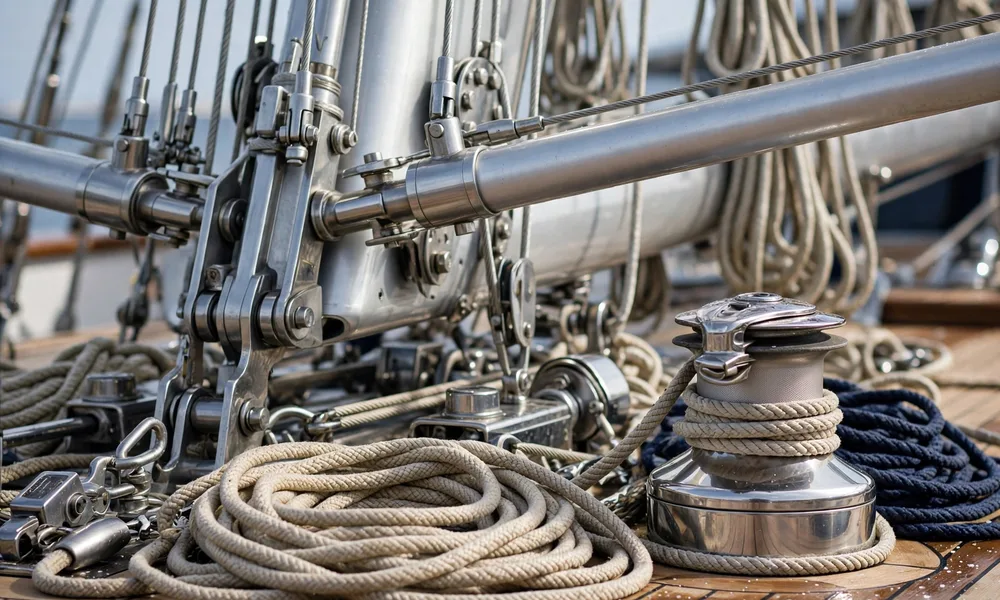
The standing rigging is the network of fixed wires and rods that keeps the mast standing. The forestay runs forward to the bow, the backstay runs aft, and the shrouds run to either side. On a superyacht this rigging is often made of carbon fibre rod or high-modulus synthetic fibre rather than steel wire, because it is lighter and stretches less. Each stay is tensioned to a precise load, and the whole system works in balance. The hull itself has to be built to take these loads, which is why the structure of a superyacht hull is engineered around the mast step and the chainplates where the rigging attaches.
Step 4: Sail loads push and pull on the mast
When the sails fill, the wind does not just push the boat forward — it pushes sideways, and that sideways force travels straight into the mast. A mainsail and headsail on a large superyacht can together cover more than 2,000 square metres, and in a strong breeze the total load on the rig can exceed a hundred tonnes. The mast has to transfer that force down into the hull without buckling.
Step 5: Mast bend and tuning shape the sails
A superyacht mast is not meant to be perfectly straight. It is designed to bend, and the crew use that bend to control the shape of the sails. Tightening the backstay pulls the top of the mast aft, flattening the mainsail — just what you want in strong wind. Easing it lets the mast spring forward, making the sail fuller and more powerful in light airs.
Step 6: Lightning and instruments live aloft
The top of the mast is a busy place. A masthead carries a wind sensor, navigation lights, antennas, and often a lightning conductor bonded down to the keel. Lightning is a real hazard: a mast is the tallest thing for miles around at sea, and a strike can blow out every electronic system on board. The conductor gives the strike a safe path to the water. The wind sensor at the masthead tells the crew exactly what the wind is doing, and on a yacht this size the wind at the top can be measurably stronger than at deck level. A steady platform matters too, which is why the rig works best alongside gyroscopic stabilizers that keep the yacht calm even when the sea is not.
Superyacht Mast Specs
| Specification | Typical range |
|---|---|
| Height above water | About 45 to 90 metres |
| Material | Carbon fibre composite, usually autoclave-cured |
| Weight | About 8 to 25 tonnes |
| Wall thickness | About 15 to 60 millimetres, thickest at the base |
| Rigging type | Carbon rod or high-modulus synthetic fibre standing rigging |
| Sail area carried | About 1,000 to 2,500 square metres |
| Righting load | About 40 to 150 tonnes of compression at the mast step |
| Number of spreaders | Three to five sets, swept aft |
What Does a Superyacht Mast Cost?
A superyacht mast is one of the most expensive single components on the boat. A carbon fibre mast for a large sailing superyacht is estimated to cost roughly $2 million to $8 million, with the standing rigging, spreaders, winches, and furling systems estimated to add another $1 million to $3 million on top. Taller masts cost far more: more carbon, heavier rigging, more engineering time. Prices are estimates only and vary widely by size, builder, and specification.
A Rare Fact
The tallest masts ever put on a sailing yacht belong to the 143-metre Sailing Yacht A, launched in 2015. Its three freestanding carbon masts rise nearly 100 metres above the water — taller than the Statue of Liberty from base to torch. Because the masts are freestanding, with no standing rigging at all, they had to be built strong enough to carry the full sail load alone.
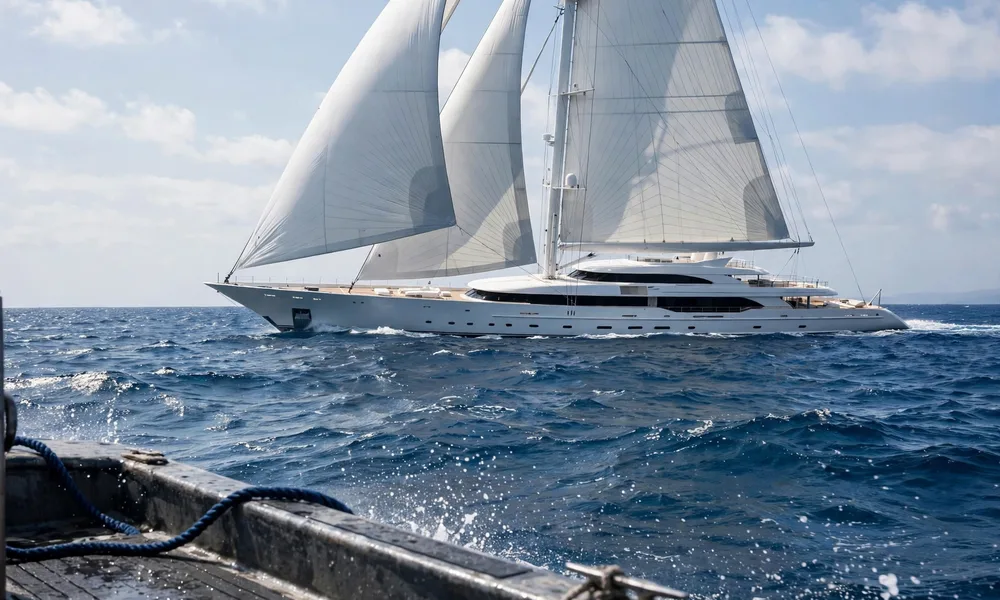
A superyacht mast looks like a simple tower, but it is really a system: a carbon spar, a spreader geometry, a web of rigging, and a crew who tune it like an instrument. Its specifications are not vanity numbers; they are the engineering answers to a single question — how do you hold up a sail the size of a tennis court, a hundred metres in the air, and keep a floating palace upright while you do it? Shipbuilders plan for the same challenge before a hull leaves the yard, in the same way they plan the modular construction of large ships. Next time you see one of these masts against the sky, you will know what you are looking at — not a pole, but one of the most demanding structures ever built to go to sea.


