It is two in the morning, the yacht is at anchor in a dark bay, and the sky above the water is something most people never see: the Milky Way arched from horizon to horizon, unwashed by city light. The owner climbs a short staircase from the main saloon, pushes open a door, and steps into a round room of glass. There is a telescope in the middle, a ring of low chairs, and nothing between the guests and the stars but a curved dome. This is the superyacht observatory — a room built for the simple pleasure of looking up.
An observatory on a superyacht is a glass-domed room, usually on the highest deck, designed for stargazing and for watching the sea and sky. Either way, the room exists because a yacht at sea has something no house can buy — a dark sky, a 360-degree horizon, and no neighbours.
This guide explains superyacht observatory specs in plain English — dome size, glass thickness, height above the water, and what a room like this actually costs to build.

The Superyacht Observatory Specs, Explained
Observatories vary enormously between yachts, so the figures below are typical for a 50- to 80-metre superyacht. Where a figure depends on the yard and the design, the range is given.
| Spec | Typical figure | What it means | How it compares |
|---|---|---|---|
| Dome diameter | About 2–4 m | The width of the glass dome over the room | About the size of a small bedroom; larger than most home observatory domes |
| Glass thickness | About 20–40 mm laminated | Several layers of glass bonded together for strength | Far thicker than a house window (4–6 mm); closer to an aquarium panel |
| Height above water | About 12–20 m | How high the observatory sits, on the top deck | High enough to clear the horizon haze and most spray |
| Telescope aperture | About 200–400 mm | The diameter of the main telescope mirror or lens, where fitted | A 300 mm telescope shows Saturn’s rings and Jupiter’s moons clearly |
| Roof type | Fixed dome or retractable panels | Whether the dome opens to the sky or stays closed | Retractable roofs cost more but give an unobstructed view |
| Climate control | Dedicated HVAC, about 5–10 kW | Heating and cooling sized for a glass room in sun and cold | Similar to cooling a small conservatory on a hot day |
| Estimated cost | About $500,000–$2,000,000 (estimate) | Dome, glass, telescope, seating and climate systems fitted | More than many whole yachts cost; a fraction of the superyacht’s total price |
How a Superyacht Observatory Works
Step 1: The dome
The dome is the room’s defining feature and its hardest engineering problem. Curved glass panels, each laminated from several layers, are set into a steel or aluminium frame and sealed against wind and waves. The glass must be strong enough to take a breaking wave over the bow in bad weather, clear enough not to dim the stars, and tough enough to survive a dropped winch handle. Low-iron glass is used because ordinary glass has a green tint from its iron content — fine for a window, ruinous for astronomy. The paint system that protects the rest of the yacht’s exterior is explained in our guide to superyacht paint system specs.
Step 2: The telescope
Where a real telescope is fitted, it sits on a mount that does two jobs at once: it tracks the stars as the Earth turns, and it compensates for the yacht’s motion. At anchor a yacht still rolls gently, and even a small movement throws a planet out of a telescope’s narrow field of view. Gyroscopic stabilisation and a computerised drive keep the telescope pointed at its target. The telescope itself is usually a Schmidt-Cassegrain or Ritchey-Chrétien design — compact for its aperture, which matters in a room only a few metres wide.
Step 3: The room below the glass
Below the dome, the observatory is a lounge. Low chairs or a circular sofa face outward and upward, the floor is often dark carpet or teak to cut reflections, and the lighting is red — red light preserves night vision, so guests’ eyes stay adapted to the dark. The room is sound-insulated from the deck below, because the point of the space is quiet. The observatory’s working principles are covered in our guide to how a superyacht observatory works.

Step 4: Keeping the view clear
A glass room at sea fogs, salts and ices. The observatory’s climate system runs constantly: dehumidified air is blown across the inside of the glass, heated strips in the frame keep the edges above the dew point, and the crew wash the outside of the dome with fresh water after every passage, because dried salt spray scatters starlight. On some yachts the dome panels can be retracted or slid aside entirely, opening the room to the open sky — the best view of all, and the reason the retractable option costs so much more. When the weather turns, the dome closes in under a minute.
Step 5: Using it at sea
An observatory is at its best at anchor, on a dark night, far from shore lights. Under way, the yacht’s own navigation lights and the motion of the hull make serious astronomy impractical, so the room becomes a lookout lounge instead — a place to watch a storm on the horizon or a sunrise over an empty sea. Crew plan observatory evenings around the moon: a new moon gives the darkest sky, and a clear forecast matters more than anything else. How the room is built is explained in our guide to how a superyacht observatory is made.
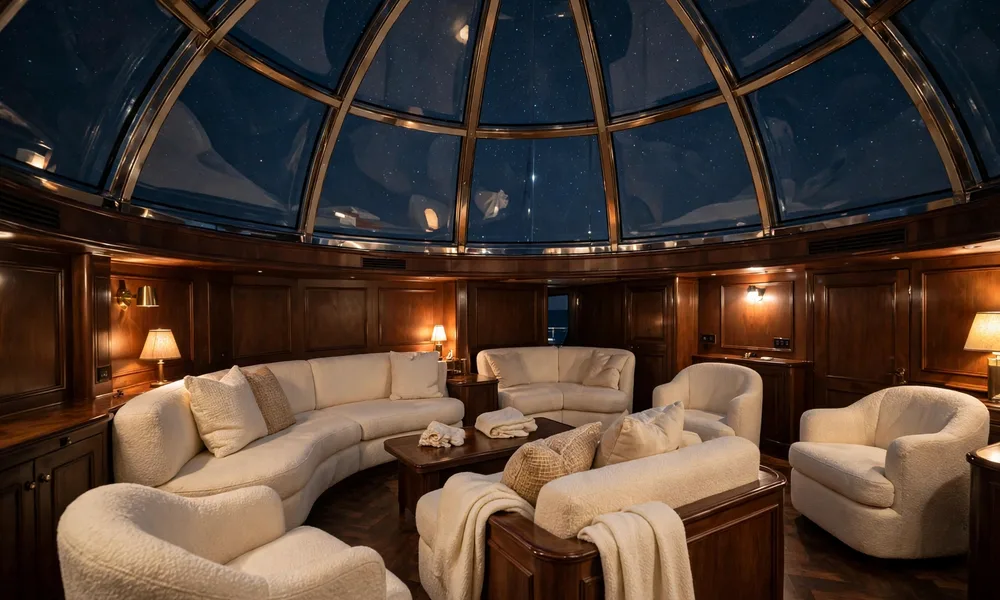
How an Observatory Is Made
Building one starts with the naval architect, because a glass room on the top deck changes the yacht’s weight, stability and windage. The dome frame is engineered to the same standards as the rest of the superstructure, then the glass is made to order — curved, laminated, coated and tested before it ever reaches the yard. Fitting happens late in the build, after the deck above is structurally complete, and the telescope and its mount are installed last, calibrated against the stars while the yacht is still in the yard. The whole installation is then tested at sea: the crew check for leaks in heavy weather, for fogging on cold nights, and for vibration from the engines reaching the telescope.
The cost follows the glass and the optics. A fixed dome with a modest telescope is estimated at $500,000 to $800,000; a retractable roof with a large research-grade instrument pushes the estimate past $2,000,000.
What an Observatory Costs to Run
A Rare Fact
Some of the largest superyacht observatories are not used for looking at the stars at all. Because the dome sits at the highest point of the yacht, with an uninterrupted 360-degree view, it doubles as the best whale- and weather-watching post on board — and on a handful of explorer yachts, the observatory telescope is used in daylight to spot icebergs, distant shores and wildlife hours before they are visible from the bridge. The room built for astronomy turns out to be the finest lookout a ship can have.


