The tender is the smallest boat on a superyacht, and the one the owner uses most. It is the boat that carries guests from the anchorage to the beach restaurant, collects the morning croissants from the harbour, drops divers on a reef, and tows the children on an inflatable at sunset. The mothership gets the photographs and the magazine covers. The tender does the work, quietly, every single day of a cruise. Then one afternoon it breaks down, or it will not fit in its garage, or it cannot carry eight guests and their luggage in a chop, and suddenly everyone on board understands that the tender was never a side note. It was the key to the whole holiday.
A superyacht tender is usually between five and ten metres long, built to be light, fast, and tough enough to be lifted, launched and beached repeatedly. Most are rigid inflatable boats, known as RIBs, with a solid hull and inflatable tubes around the edge, although some owners choose open centre-console boats or small limousine tenders with a cabin. The choice is never just about looks. A tender has to fit a specific garage, lift on a specific crane, carry a specific number of people, and run in the weather the yacht actually cruises in. Get any one of those wrong and the tender becomes a very expensive ornament.

Length is the first specification, and it is usually decided by the garage, not by the owner. Measure the garage first, then subtract room for fenders, the cradle and a little air to move around. Beam, the width, matters just as much: a wider tender is more stable when guests step aboard, but a narrower one is easier to handle and tows better. Most superyacht tenders are between 2.2 and 2.8 metres wide, a size that balances stability with garage space.
Power is where tenders surprise people. A seven-metre tender can carry a 250 horsepower outboard, and larger ones run twin engines totalling 400 horsepower or more. Top speed matters less than the speed at which the boat is comfortable, though. A good tender will cruise happily at 25 knots in a moderate chop without slamming, while a bad one will beat its passengers up at half that speed. Hull shape decides this: a deep V hull cuts through waves, while a flatter hull is stable at rest but harsher underway. Ask the builder how the hull behaves loaded, not empty.
| Specification | Typical superyacht tender | What it means for you |
|---|---|---|
| Length | 5 to 10 metres | Decided by the garage, not by wish |
| Beam | 2.2 to 2.8 metres | Stability when guests step aboard |
| Engine power | 150 to 400 hp | Speed with a full load of guests |
| Top speed | 35 to 50 knots | Fast, but comfort matters more |
| Passenger capacity | 8 to 12 people | Guests plus luggage, honestly counted |
| Fuel capacity | 150 to 400 litres | Range for a day of shuttling |
| Dry weight | 700 to 1,800 kg | What the crane and davit must lift |
| Hull type | Deep V RIB | Cuts waves instead of slamming them |
| Draft | 0.4 to 0.6 metres | How close to the beach it can go |
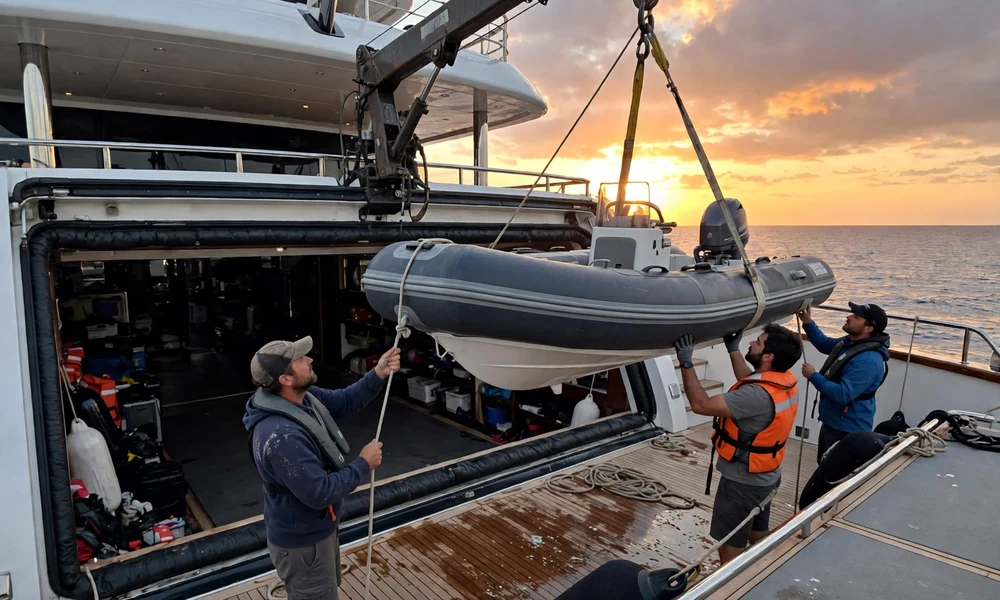
Weight is the number the crew care about most. Every kilogram of tender is a kilogram the yacht’s crane must lift, often in a rolling sea, and the garage floor must carry it. A heavy tender also needs a bigger engine to reach the same speed, which burns more fuel. Builders fight weight with carbon fibre, foam-cored hulls and lightweight tubes, but lightness has a price. The lightest tenders cost the most, and they need careful handling to avoid damage. Yacht toys and tenders ranked shows how widely tenders vary once you look past the brochures, and the differences usually come down to exactly these trade-offs between weight, comfort and cost.
How a Superyacht Tender Works
A modern tender is a small system, not just a hull with an engine. Fuel, steering, navigation and safety gear all have to work together in salt water, often far from help. Here is how a typical run ashore unfolds, step by step.
- The crew launch the tender. It is lifted from its garage or chocks by crane or davit, lowered into the water, and checked for fuel, safety gear and a working radio.
- The engine starts and warms. The outboard or inboard is started, gauges are checked, and the driver confirms cooling water is flowing.
- Guests board from the yacht. A boarding gate or swim platform makes stepping aboard easy, and the driver keeps the boat steady against the yacht.
- The throttle opens smoothly. The hull rises onto the plane, lifting most of its length out of the water so it skims rather than pushes through it.
- The driver reads the sea. Speed and angle are adjusted for waves, with the deep V hull cutting through chop instead of slamming across it.
- Arrival is slow and careful. The tender approaches a beach or dock at idle speed, the driver judges wind and current, and guests step off onto dry land.
- The tender is recovered. It is lifted back aboard, rinsed with fresh water, and stowed, ready for the next run.
Price is the last specification, and it varies wildly. A well-built five-metre tender can cost roughly $60,000 to $100,000, a seven-metre boat with a strong outboard often runs $120,000 to $220,000, and a large custom limousine tender can pass $500,000. Those are estimates, and custom paint, teak decks, upgraded seating and electronics add quickly.
Fuel and range deserve a quiet word too. A tender’s fuel tank is sized for a day of short runs, not a long passage, and a thirsty engine at full throttle can empty it faster than anyone expects. A 250-litre tank at cruising speed might give three to four hours of running, which is plenty for shuttling but not for exploring a distant island and back. Some owners fit a second tank or carry jerry cans for long days. Electric tenders are arriving now, and they are quiet and clean, but their range is still shorter and charging from the yacht takes time. Hydrogen fuel cell yacht specs hint at where marine propulsion may go next, though for a working tender today, a reliable petrol outboard remains the practical choice.
Here is a rare fact that surprises even experienced owners. Some superyacht tenders are designed to be beached on purpose. Their hulls are reinforced at the keel, and the tubes are built to take the weight of the boat resting on sand. A crew can drive one gently onto a beach at high tide, unload guests and picnic gear directly onto the sand, and float it off again as the tide returns. It sounds rough on a boat that cost as much as a house, but it is exactly what the boat was built for, and it is why the humble tender, not the yacht, is often the boat that makes the best memories of a cruise.
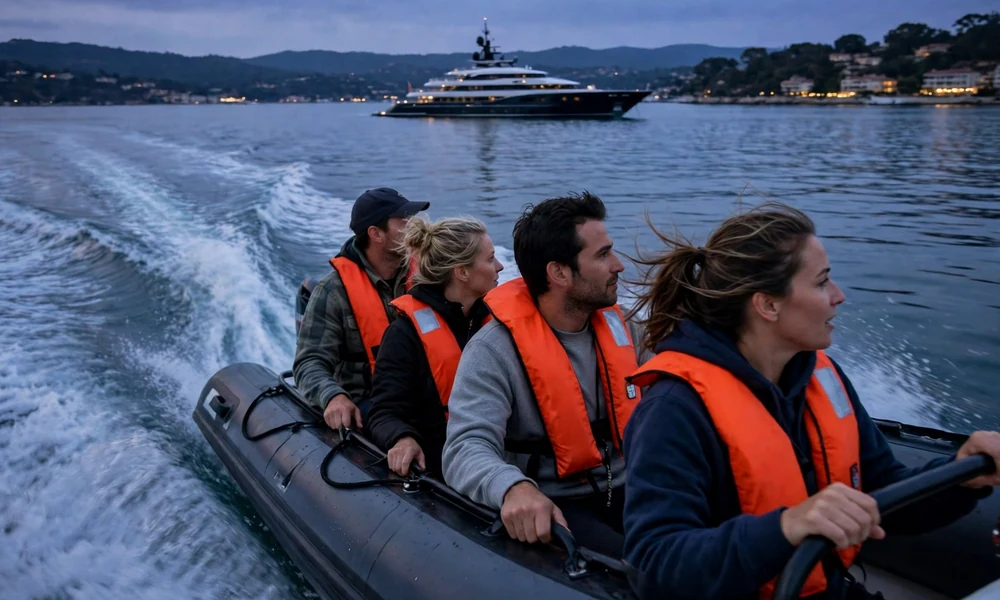
When you judge a tender, judge it loaded, in a chop, with the people who will actually use it. The brochure numbers are a starting point, nothing more. Fit, stability, comfort at cruising speed and ease of boarding matter more than top speed or a glossy finish. How autonomous yacht docking works shows how technology is changing life around the mothership, but out on the water in a tender, it is still good design, a strong hull and a careful driver that make the difference.


