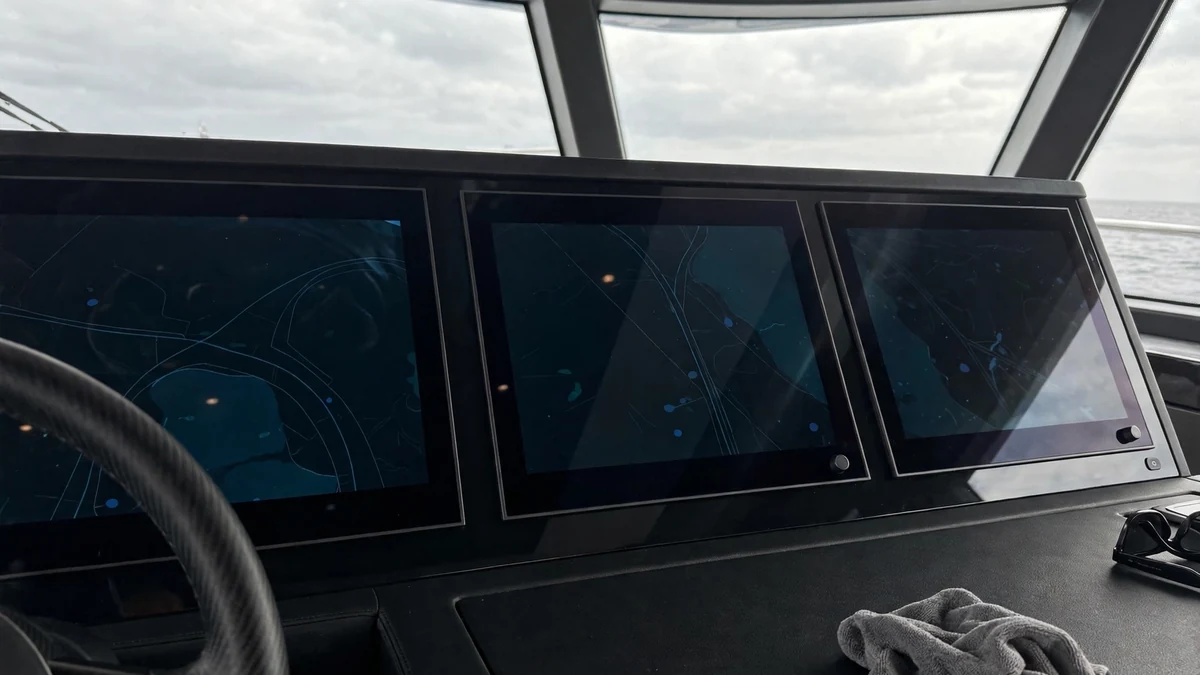
Step onto the helm of a new yacht and you may find yourself staring at a wall of glass. Where there were once rows of gauges, switches and throttles — each one doing a single job, each one findable by touch in the dark — there is now a touchscreen, or three, running everything from navigation to lighting to the anchor windlass through layers of menus. It looks like the future. And on a boat, in weather, with wet hands, it is a bad idea that the marine industry copied from the car industry without learning the car industry’s lesson.
This is the case against touchscreen everything in yachts. Not against screens — a modern chartplotter is a marvel, and nobody wants to navigate by paper alone. It is a case against the idea that every control on a boat should live behind glass, with nothing physical left for the moments when glass fails, hands are wet, or the sea is doing its best to throw the crew across the helm.
Wet hands are not an edge case at sea
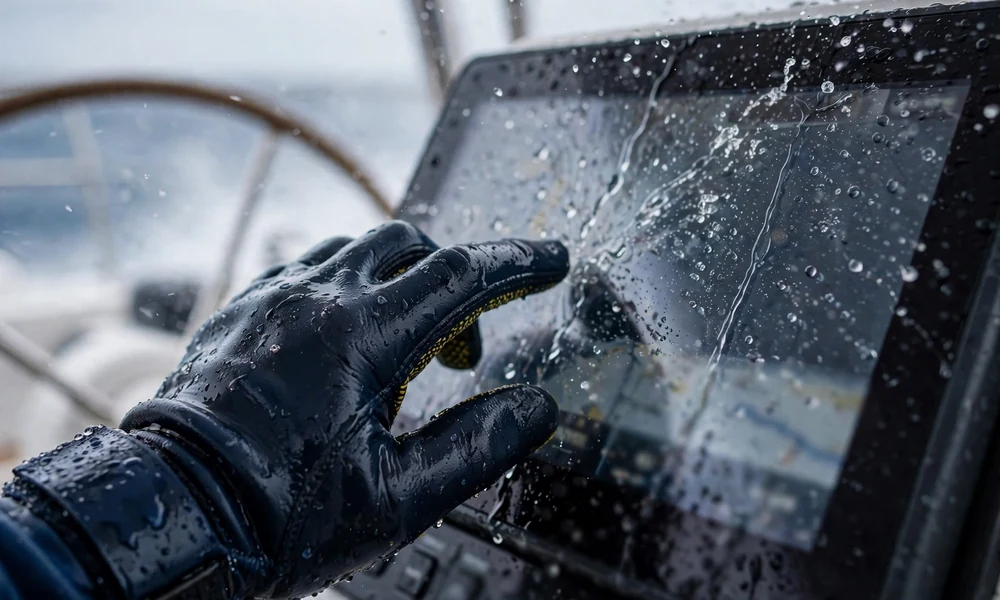
The core problem is physical, and it is not fixable with a software update. The touchscreens on most yachts use projected capacitive technology — the same as a phone — which senses the tiny electrical change a bare finger makes near the glass. At sea, the operator’s hands are wet with spray, or covered in sunscreen, or inside thick foul-weather gloves, and the screen is running with rain and salt. Capacitive screens struggle with all of it: wet fingers register badly or not at all, gloves block the signal entirely, and salt water sitting on the glass can fire false touches, pressing buttons nobody pressed.
Ask the people who actually drive boats and the stories are consistent. Owners on sailing forums report touchscreens that are nearly impossible to use with wet, cold hands in the rain, and impossible with any glove on regardless of the weather. Either way, the screen is making a compromise that a physical button never has to make. A toggle switch does not care whether your hands are wet. It does not care whether you are wearing gloves. It moves, it clicks, and the job is done. That reliability is not old-fashioned. It is the whole point of a control.
A moving boat is the worst place for a menu
The second problem is motion. A car driver sits still, on a smooth road, reaching for a screen that stays where it was put. A yacht helm moves in three dimensions: the boat pitches over waves, rolls in a swell, and vibrates under the engines, and the person reaching for the screen is moving with it.
Menus make this worse. A physical throttle has one job and one position; you can find it in the dark and feel where it is set. A touchscreen buries the same function two or three taps deep, behind icons that all look alike, and demands that the operator look at the screen to confirm each step. A boat is not a living room, and a helm is not a tablet. The stakes of a missed tap are not a wrong song choice; they are a missed manoeuvre.
One screen is a single point of failure
The third problem is what happens when the screen itself fails. Consolidating every system — navigation, engine data, lighting, bilge pumps, air conditioning — into one or two glass panels creates a single point of failure for the whole boat. A cracked screen, a failed backlight, a software crash or a saltwater leak behind the panel can take out not one system but all of them at once. Digital switching fails as a system, and when it does, the crew is left with a dead piece of glass where the boat’s controls used to be.
The marine environment is uniquely hostile to electronics. Salt air corrodes contacts, moisture creeps into seals, and vibration works connectors loose over seasons of use. Traditional switches were designed for exactly this world: sealed, chunky, tolerant of abuse, and replaceable with a screwdriver in a remote anchorage. Our guide to yacht engine room specs shows how the machinery spaces are built around access, redundancy and repair at sea — principles the helm should share.
The defence, heard fairly
Touchscreens have genuine advantages, and the case against them is weaker if it pretends otherwise. A screen can show the same information ten different ways, which is why one display can replace a dozen separate gauges and free up helm space. Volvo Penta’s Glass Cockpit system, developed with Garmin, collects all navigation data into touch displays from eight to nineteen inches, and its makers point out that a remote input device with fixed buttons can always be added for those who want it.
That last point is the telling one. Even the makers of glass cockpits offer physical buttons as the safety net, which is an admission that the glass alone is not enough. The right answer is not to ban screens but to stop pretending they can do everything. Keep the screens for what they are good at — charts, radar overlays, system monitoring, the rich information display that no row of gauges can match. But keep physical controls for the things that must work every time, in any weather, with any hands: throttle, steering, horn, navigation lights, bilge pumps, engine start and stop. A hybrid helm is not a compromise between old and new. It is the design that takes both seriously.
The car world has already arrived at the same conclusion. After a decade of swallowing every function into a central screen, carmakers are bringing back buttons and knobs for the controls drivers use most, because regulators and customers alike noticed that eyes-off-road time was rising. Our opinion piece on the case for physical buttons in cars makes the same argument for the road — and a boat has no brakes, no lane markings, and no hard shoulder.
What a good helm looks like
The best helms being built today are not the ones with the most glass. They are the ones where every control earns its place by the job it does: screens where information matters, switches where action matters, and redundancy where failure matters. A chartplotter for navigation, a rotary knob for the radio, a proper lever for the throttle, a row of sealed toggles for the lights and pumps — each chosen for the conditions it will face, not for how it photographs at a boat show. Our guide to superyacht tender boat specs shows the same lesson: equipment that survives real use, not first sight.
The Takeaway
Touchscreens belong on yachts, but they do not belong in charge of yachts. A screen is the best way to show information and the worst way to guarantee an action, and a boat is a place where guaranteed actions matter more than anywhere else on earth. The industry should keep its beautiful displays and bring back its buttons — not out of nostalgia, but because wet hands, rough seas and salt air are not edge cases at sea. They are the sea.


