Open any electric scooter listing and the first number they want you to see is the battery. A thousand watt-hours. Two thousand. More range than you will ever ride in a week, in a machine you are supposed to fold up and carry. The industry has decided that a bigger battery is a better scooter, and it has been stuffing ever-larger packs into decks that were never meant to hold them. It is time to say the unfashionable thing: the giant scooter battery is a bad idea, and the scooter that carries one is worse than the scooter that does not.
This is not an argument against range. Nobody wants to push a dead scooter home. It is an argument against the way range is being bought: by bolting a heavy, expensive, slow-charging block of lithium under a rider’s feet and pretending the rest of the machine has not changed. A scooter is a small, light vehicle, and everything that makes it useful — the fold, the carry, the dart through traffic, the lift onto a train — depends on it staying small and light. The giant battery attacks every one of those virtues at once.

The weight you carry is the range you lose
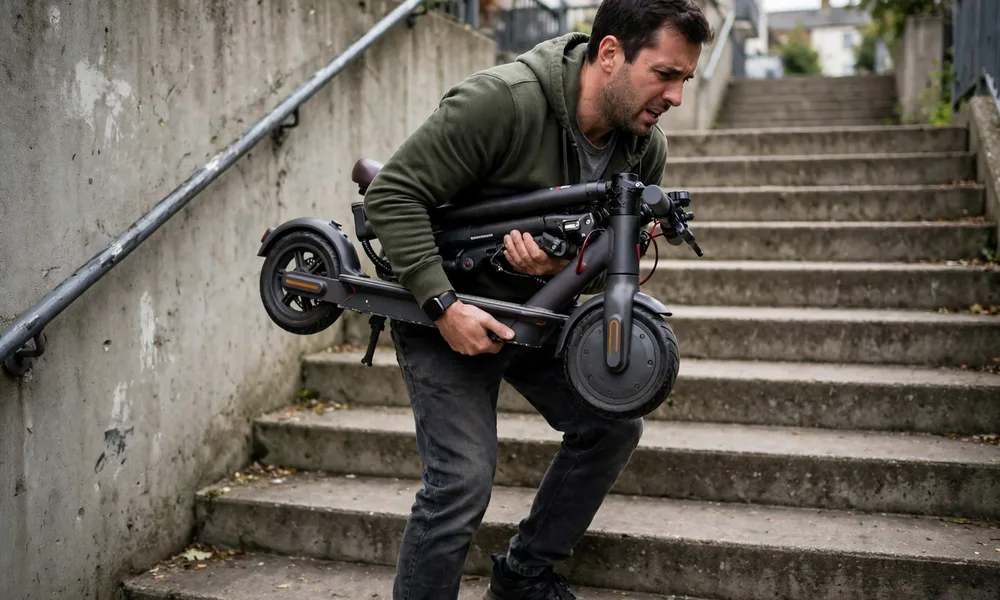
Start with the simplest fact, the one the brochures skip. A lithium pack of around one kilowatt-hour weighs roughly five to six kilos on its own, and once it is cased, wired and bolted into a reinforced deck with the bigger motors and suspension needed to carry it, the finished scooter commonly lands at 25 to 32 kilos. That is not a scooter you fold and carry. That is a scooter you drag, bump up steps, and leave locked outside because getting it upstairs is a workout in itself. The whole point of a scooter — that it goes where a bike cannot, up the station steps and onto the train — disappears the moment it weighs as much as a small adult.
Weight does more than hurt your back. It eats the very range the battery was bought to provide. Every acceleration, every hill, every stop-start at a traffic light costs energy proportional to mass, and a heavy scooter spends a large share of its giant pack simply moving its own battery around. It is the same trap that swallowed early electric cars, and scooter makers are walking into it with their eyes open. Our ranking of the best electric scooters for commuting in 2027 shows the pattern clearly: the scooters that work best as daily transport are the ones that balance range against weight, not the ones that win the specification sheet.
A bigger pack is a bigger fire
The second argument is the one nobody in the industry wants to discuss, and it is the most serious. A lithium-ion battery that goes into thermal runaway does not smoulder politely. It vents flammable gas, it can explode, and it can set fire to everything around it in seconds. The larger the pack, the more energy there is to release, and the harder the fire is to fight. Fire researchers testing a typical sit-on scooter pack of just 1.2 kilowatt-hours measured peak heat release rates of around 1.6 megawatts when the pack failed during overcharging — roughly the heat output of a fully involved room fire, from a single scooter battery.
That is a 1.2 kilowatt-hour pack. The giant packs now being sold are larger still, and they are being charged in hallways, bedrooms and flats, often overnight, often with cheap replacement chargers. New York City recorded 268 fires from micromobility batteries in 2023, with 150 injuries and 18 deaths, and the city has since required independent certification of batteries and devices. A scooter battery is not a phone battery. It stores enough energy to burn a flat down, and doubling its size doubles the stakes without doubling the safety engineering around it.
The engineering response to this risk is real but incomplete. Good packs have a battery management system that watches every cell, and good cells are certified to standards such as UL 2271. But certification and management systems are only as good as the cheapest cell in the pack, and the race to offer the biggest number on the box puts constant pressure on cost. The guide to e-bike battery specs makes the same point for bikes: what matters is not the headline capacity but the quality of the cells, the management system and the charger. A giant pack built to a price is a bigger version of the same risk, not a safer one.
Charging time and the second-vehicle problem
There is a practical cost too, and it shows up every evening. A giant pack takes far longer to charge than a modest one, and the difference is not trivial. A scooter with a one-kilowatt-hour pack on a standard charger can need eight to ten hours from empty, which means it must be plugged in the moment its rider gets home and cannot be topped up quickly before an evening trip. Riders who wanted freedom from the car end up planning their lives around a charging cable, and many solve the problem by buying a second charger, a faster charger, or a second scooter — each of which costs money and adds risk.
And the giant pack ages badly. Lithium cells lose capacity with every cycle, and a pack that started at a heroic range figure will quietly lose a quarter of it within a few hundred cycles. The motor, meanwhile, is built around the big pack’s voltage and current, as our look at how an electric scooter motor works explains — torque and power delivery are designed around the battery, so a degraded pack does not just lose range, it loses performance too.
The honest case for big packs, answered
None of this means big batteries never make sense. A delivery rider doing sixty miles a day, or a rural rider with no public transport and no charging at work, genuinely needs capacity that a small commuter pack cannot offer. For those riders, a large pack is a tool, and the weight and charging time are a fair price for a working day without range anxiety. The industry should build for them — honestly, with certified cells, proper management systems and realistic range figures.
But the delivery rider is not who the giant-battery scooter is being sold to. For those riders, the honest answer is a pack of 350 to 500 watt-hours, a scooter that weighs under 15 kilos, and a charger that fills it in an afternoon. That scooter can be carried, stored in a flat, charged safely and ridden hard, and it will still cover a week of commuting on two charges. The range figure on the box will be smaller. The scooter will be better.

Verdict
The giant electric scooter battery is the wrong answer to the right question. Riders want to stop worrying about range, and the industry has answered by selling them weight, fire risk, slow charging and a machine they can no longer carry. The better answer is a smaller, better battery: certified cells, an honest range figure, a scooter light enough to lift and quick enough to charge. Stop buying kilowatt-hours you will never ride. Buy the scooter you can actually live with, and let the battery be the size the journey needs — not the size the brochure boasts about.


