In February 2015, a small aluminium ferry called Ampere began crossing a Norwegian fjord, carrying 120 cars and 360 passengers on battery power alone. It was an experiment, and a modest one: a twenty-minute crossing, a battery of about one megawatt-hour, a charging stop at each end. A decade later the largest battery ship in service carries more than 2,100 passengers and 225 vehicles on a battery of more than 41 megawatt-hours, and it charges at up to 15 megawatts between crossings. In eleven years the electric ferry went from a curiosity to the largest battery vessel on earth, and it did so because the ferry is, by design, the easiest ship in the world to electrify.
The case for electric ferries is not a case for electric ships in general. Ocean-going cargo vessels, cruise liners and long-haul ferries will burn fuel for a long time yet, because their routes are too long and their energy demands too large for any battery that can be built today. The short crossing is different. It is short, it is repeated dozens of times a day, it starts and ends at the same two quays, and the ship spends a useful part of every hour sitting still, loading and unloading, at a place where a cable can be plugged in. No other vessel offers the battery such a forgiving job, and no other vessel rewards electrification so quickly.
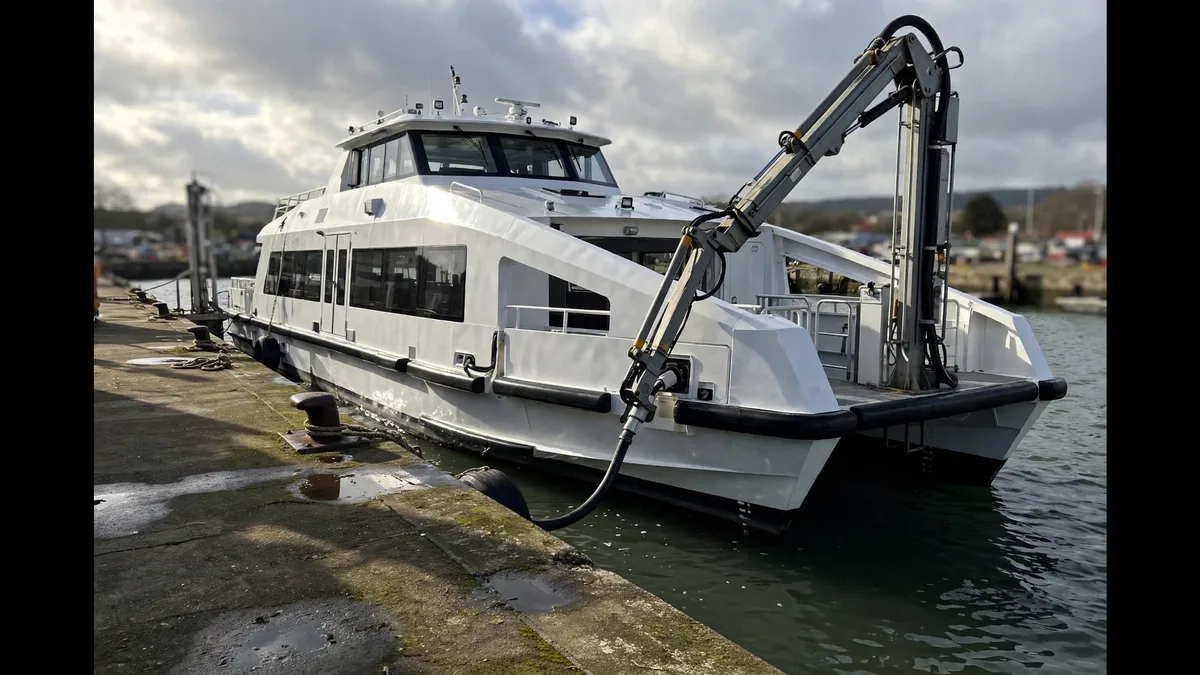
The Route Is the Battery’s Best Friend
A ferry crossing is a fixed, known quantity in a way almost no other transport job is. The distance is the same every time, the speed is the same, and the energy needed for one crossing can be measured to the kilowatt-hour. Ampere uses 150 to 200 kilowatt-hours per crossing — about three days of electricity for a typical Norwegian household — and it does the crossing 34 times a day. Because the energy per trip is fixed, the battery only has to hold one or two crossings plus a reserve, and because the ship returns to the same quay every twenty minutes, the battery never has to hold a whole day’s energy at once.
That is the crucial difference from an electric car, which has to carry a whole day of driving in one charge. The ferry’s battery is small because the ferry’s job is small and repeated, and the charger is large because the ferry’s dwell time is short. Putting a megawatt-hour back into a battery in ten minutes takes six megawatts at the quay, and modern terminals now deliver far more: Bastø Electric, on Norway’s busiest crossing between Moss and Horten, charges at up to 7.2 megawatts, and the terminals serving China Zorrilla each have two 15-megawatt chargers. The engineering challenge moved, in a decade, from the battery to the shore connection, and the shore connection is a solved problem: an automated plug or a charging arm that connects as the ramp drops.
The Money Works Too
The environmental case is the one that gets quoted — Ampere saves about a million litres of diesel a year and more than 570 tonnes of carbon dioxide, along with fifteen tonnes of nitrogen oxides — but the financial case is what has kept operators ordering electric ferries after the first one. Siemens reported that switching Ampere to battery cut fuel costs by up to sixty percent, and the reason is simple: electricity is cheaper than diesel per unit of energy, and an electric motor converts far more of that energy into motion than a diesel does. A diesel engine throws roughly two-thirds of its fuel’s energy away as heat. An electric drivetrain throws away a fraction of that, and it recovers energy when the ship slows for berthing.
The infrastructure cost is real, and it is the honest obstacle. A terminal that needs six or fifteen megawatts often needs a new grid connection, a transformer and sometimes a shore-side battery buffer, and that work costs money before the first electric ferry arrives. But it is spent once, at a fixed place, for a service that runs for decades. The shore power systems that already serve cruise ships at berth are the same technology at a smaller scale, and every year of operation spreads the cost thinner.
Scale Has Already Arrived
The most persuasive argument for electric ferries is that the scale argument has already been settled. Ampere proved the short crossing in 2015. Ellen, in Denmark, proved a 22-nautical-mile route on a 4.3-megawatt-hour battery in 2019, charging at one end only. Bastø Electric proved the busy commuter crossing in 2021, with 200 cars and 600 passengers. And in October 2026, China Zorrilla entered service across the Río de la Plata with more than 41 megawatt-hours, 2,100 passengers and 225 vehicles — a ship the size of a small cruise ferry, running on batteries alone. Batteries that were one megawatt-hour are now forty, and the ships that carry them have grown from fjord ferries to river giants without changing the underlying idea. The battery systems have scaled because the chemistry, the packaging and the charging have all improved together.

The Counter-Argument, Honestly Stated
The strongest case against electric ferries is the long route. A crossing of a hundred nautical miles, or a route with no grid connection at one end, or a service that runs through the night with no time to charge, is a poor fit for batteries today, and pretending otherwise would be dishonest. Hydrogen fuel cells and hybrid diesel-electric systems all have a role on those routes, and some operators will need them for a long time. The battery is not a universal answer, and the ferries that need it most — the remote island services with weak grids — are often the ones least able to build the shore infrastructure.
There is also the question of where the electricity comes from. An electric ferry charged from a coal-fired grid still produces emissions, just somewhere else, and the carbon saving depends on the grid being clean. Norway’s ferries charge largely from hydropower, which is why Ampere’s saving is so large; a ferry in a coal-heavy grid saves less. That is an argument for cleaning the grid, not for keeping the diesel, because the ferry can only get cleaner as the grid does, while a diesel ferry is as dirty on its last day as on its first.
An electric ferry costs more to build than a diesel one, and the terminal work adds to the bill, so the business case depends on fuel and maintenance savings repaying the premium. On a busy short route, that payback is measured in years. On a quiet route, it may never arrive. The newest ferry designs are closing the gap, but it has not closed everywhere yet.

The Verdict
Every short ferry crossing in the world should be electric, and the only honest question is the order in which they are converted. The route is fixed, the energy is known, the charging fits inside the time the ship already spends at the berth, and the fuel and maintenance savings repay the investment on any route busy enough to matter. The diesel ferry had a century to prove itself on short crossings, and it did — noisily, expensively, and with a plume of exhaust over every harbour it served. The electric ferry does the same job, on the same timetable, for less money and without the smoke.


