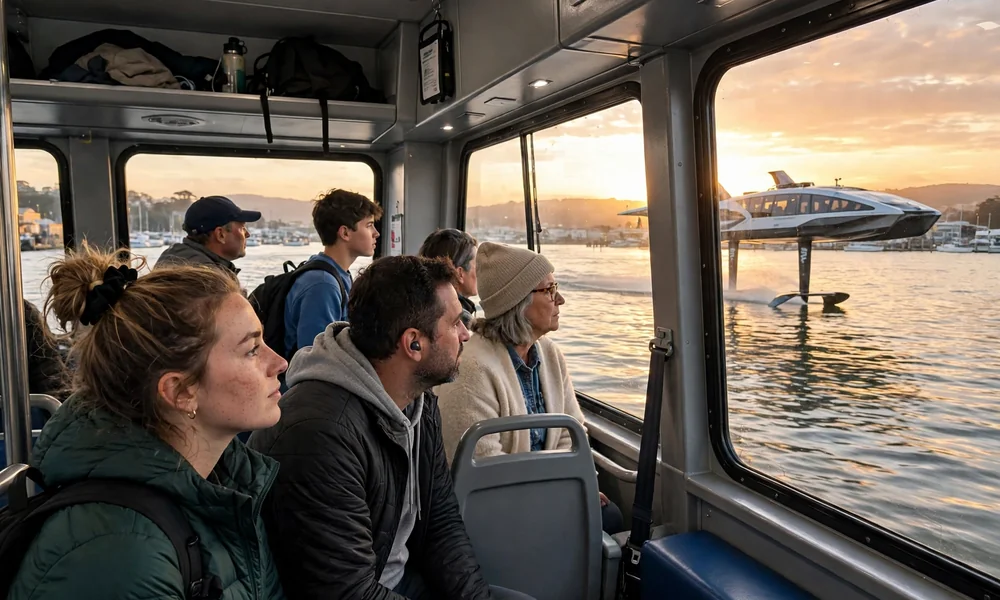
The ferry left the harbour on a grey morning, and for the first few minutes it looked like any other boat: low in the water, pushing a bow wave, engines humming. Then the hull began to rise. The bow wave flattened, the spray fell away, and suddenly the whole vessel was gliding a metre above the surface on thin stilts, silent except for the soft rush of water. Passengers pressed to the windows. The boat was flying, and the sea had let go of it.
That is the moment an electric hydrofoil ferry earns its keep. A normal ferry drags its hull through the water, fighting friction every metre of the crossing. A hydrofoil ferry lifts its hull clear of the waves on underwater wings, called foils, and the drag drops by as much as eighty percent. Add electric motors and batteries, and the result is a ferry that crosses a harbour faster, quieter, and cleaner than anything that came before it, with no diesel smoke and no rolling wake slapping the shore.
Building one is not a matter of bolting wings onto a boat. The foils, the motors, the batteries, and the control system have to work as a single machine, lifting tonnes of steel and people out of the water and holding them there through wind, waves, and turning. It is shipbuilding, aircraft engineering, and electric vehicle design, all welded into one hull.

How It’s Made
Step 1: Designing a hull that leaves the water
Engineers start with the route, not the boat. A hydrofoil ferry is built for a specific crossing: its length, its waves, its passenger load, and its speed. The hull is drawn narrow and light, usually from marine-grade aluminium, because every extra kilo is a kilo the foils must lift. Designers model the whole vessel in software, simulating how it will rise, bank into turns, and settle back down in rough water. The hull itself is a cousin of the ferry hull, built the same way, but it is designed to spend most of its working life out of the water rather than in it.
Step 2: Shaping the foils
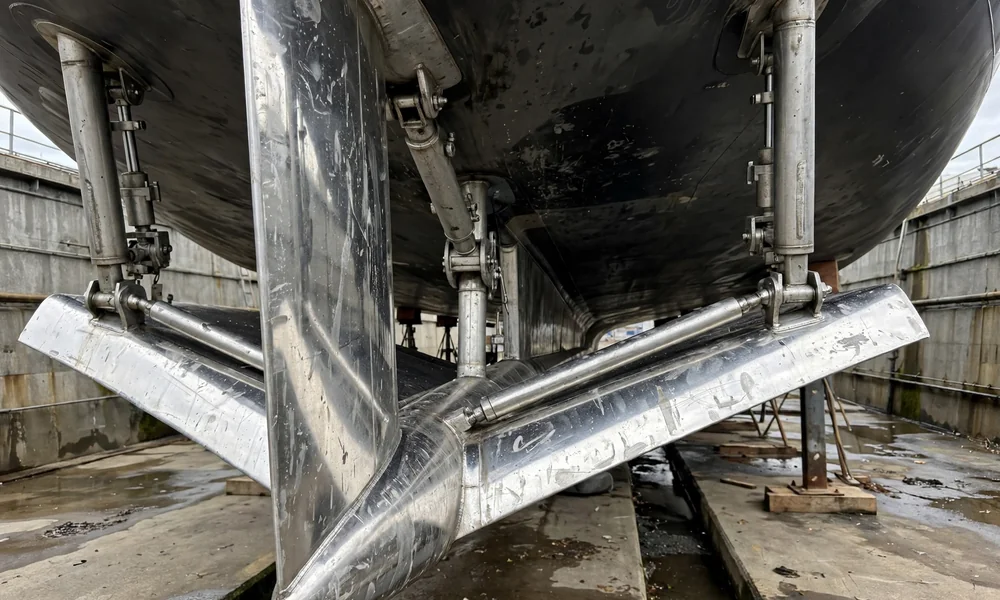
The foils are the wings of the ferry, and they are shaped like aircraft wings turned upside down. Water flows faster over one side than the other, and the difference creates lift. The foils are milled from stainless steel or carbon composite, polished to a mirror finish, because even a rough patch creates drag and turbulence. They are mounted on slender struts that pierce the surface, and their angle can be adjusted in flight, flaps moving like an aeroplane’s, to keep the ride level. A foil that is wrong by a single degree will make the ferry porpoise, bobbing up and down, so each one is tested in a water tunnel before it ever meets the sea.
Step 3: Fitting the electric propulsion
The motors sit in streamlined pods at the base of the struts, right where the foils meet the water, so the thrust pushes exactly where the lift is. Each motor is a compact electric unit, sealed against salt water and cooled by the sea itself. Power comes from large battery packs housed low in the hull, where their weight keeps the vessel stable. The packs are built from hundreds of cells, wired and cooled like the batteries in an electric car, and they are sized to cover the route with a reserve for a missed landing or a detour. There is no gearbox, no exhaust, and no fuel tank, just cables, cooling, and software.
Step 4: Building the flight control system
A hydrofoil ferry cannot be steered by feel alone, because it is balancing on wings under water. Sensors measure the height of the hull above the waves, the pitch, the roll, and the speed, hundreds of times a second. A computer adjusts the foil flaps and the motor thrust to keep the ride smooth, lifting the hull over a wave instead of smashing through it. If a sensor fails, a backup takes over; if the computer fails, the ferry settles gently back onto its hull and becomes an ordinary boat. That fallback matters, because a ferry full of commuters cannot afford a bad day at sea.
Step 5: Assembly and launch
The hull is welded up in sections, the foils and struts are bolted on, and the battery packs are lowered in through hatches in the deck. Then the ferry is launched and the real testing begins. Sea trials run for weeks: takeoffs and landings in different sea states, emergency stops, turns at speed, and full passenger loads. Engineers watch the foil loading, the battery temperature, and the ride height, tuning the control system after every run. The ride quality they are chasing is closer to a train than a boat, and the stability work owes a debt to the same thinking behind ship stabilizers, which keep big vessels level in rough seas.
Step 6: Charging for the next crossing
A hydrofoil ferry lives or dies by its turnaround. At each end of the route, it plugs into a fast charger while passengers board, topping up the batteries in the time it takes to load a hundred people. The charging system is part of the vessel’s design, not an afterthought, and the route is planned around it. Once charged, the ferry casts off, accelerates, rises onto its foils, and flies again. The hull that carries it all is built and tested like any other working ferry, as described in how a ferry hull works, but it spends its working life doing something no ordinary hull ever does: leaving the water behind.
Specs
| Specification | Typical value |
|---|---|
| Passenger capacity | 100–150 people |
| Hull material | Marine-grade aluminium |
| Foil material | Stainless steel or carbon composite |
| Cruising speed | 25–30 knots on foils |
| Ride height | About 1 metre above the water |
| Drag reduction vs hull-borne | Up to 80 percent |
| Propulsion | Electric pod motors on the foils |
| Range per charge | 20–40 nautical miles |
| Charging | Fast dockside charging between crossings |
What Does It Cost?
An electric hydrofoil ferry is not cheap, and nobody pretends otherwise. A vessel of this size typically costs an estimated $8–$15 million to build, depending on capacity, range, and fit-out, with the battery packs and foil systems accounting for a large share of that figure. That is an estimate, and it varies by shipyard and specification. Operators accept the price because the running costs are lower: electricity is cheaper than diesel, electric motors need far less maintenance than marine diesels, and the smooth ride means less wear on the hull and less seasickness among passengers.
A Rare Fact
Here is the detail most people miss: when a hydrofoil ferry is flying, the only parts of the vessel touching the water are the foils and their struts, an area smaller than a dining table. The entire weight of the ferry, its batteries, and a hundred and fifty passengers is carried by wings the size of a door, riding on water pressure alone. It is the same physics that lifts an aeroplane, applied upside down, under the sea, and it turns a commuter boat into the closest thing to flying that most passengers will ever experience.


