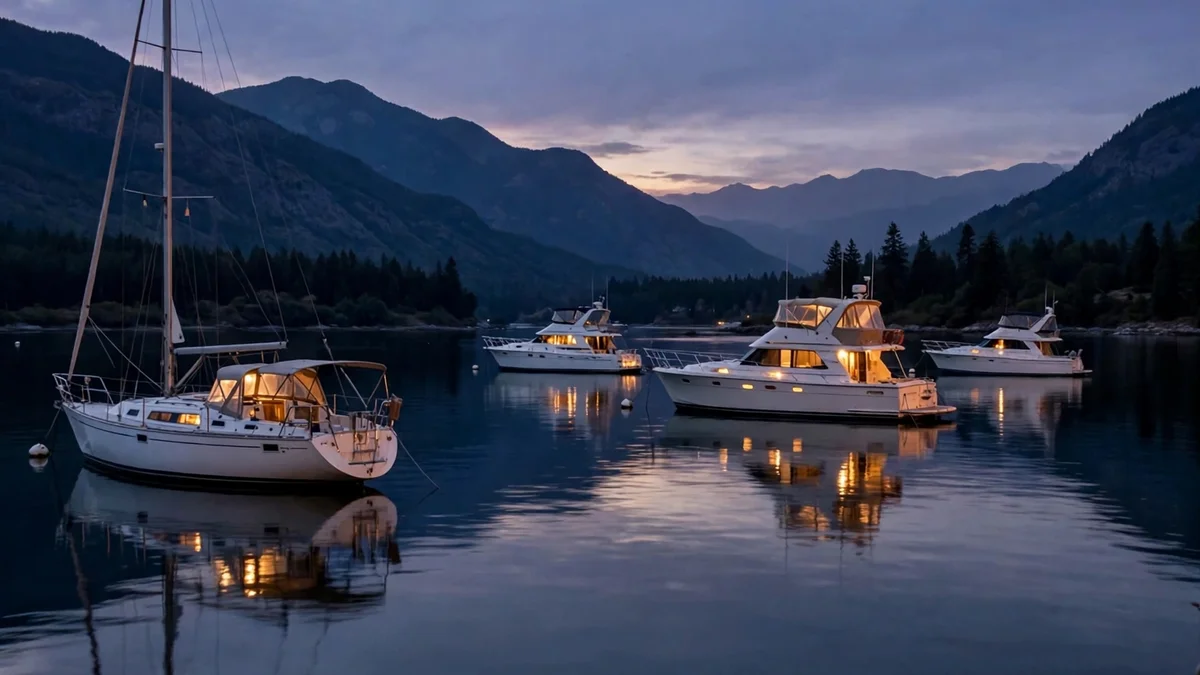
There is a sound that ruins more nights at anchor than any storm, and it is not the wind. It is the low, relentless drone of a yacht’s generator, humming through the hull, through the water and through the thin air of a quiet bay, long after the sun has gone down and everyone on board is trying to sleep. Ask any sailor what they remember about a crowded anchorage and they will not mention the sunset. They will mention the boat three berths away whose generator ran all night, and the fact that nobody on that boat seemed to notice, because they were inside, behind insulation, while the rest of the bay listened to their air conditioning. The case for quieter yacht generators is simple, and it is not about comfort. It is about the fact that a yacht’s noise does not stop at its own hull, and that the quiet of an anchorage is a shared thing, which one loud generator can take from everyone.
Generators are necessary. A modern yacht at anchor needs power for air conditioning, refrigeration, water-making, lighting and charging, and solar panels alone will not cover it on a hot night with a full guest list. Nobody is arguing for sitting in the dark. The argument is that the generator doing that work should be as quiet as engineering can make it, and that owners, builders and buyers should treat generator noise as a specification that matters, not as an afterthought to be hidden behind a layer of foam and a shrug. A yacht that is quiet at anchor is a better yacht, for its own crew, for its own guests, and for every other boat in the bay.
The numbers are worse than owners think
Start with the figures, because they are worse than most owners imagine. A typical marine generator in a soundproof canopy is rated at around fifty-five to sixty-two decibels at seven metres, and an uncanopied or poorly installed unit can be considerably louder at the same distance. That is the level of a loud conversation, running all night, and it is measured in open air. Inside the yacht, the picture is different: measured noise in guest cabins at anchor, with generators running, is typically around forty to forty-five decibels, and in an owner’s suite around thirty-eight to forty-three. Those numbers sound modest, and they are, for the people inside. But the people inside are not the only people listening. The sound travels through the hull, through the exhaust and across the water, and the boat anchored fifty metres away hears it far more clearly than the boat that is making it.
Quiet is engineering, not luck
The good news is that quiet generators are not a fantasy. They are a matter of engineering, and the engineering is well understood. A soundproof canopy, properly sealed and lined, can cut the noise of a generator dramatically. Vibration-isolated mounts stop the engine’s shake from travelling through the hull and turning the whole yacht into a speaker. A well-designed exhaust, routed and silenced properly, stops the drone from escaping through the stack. Variable-speed generators, which run slower and quieter when the load is light, rather than hammering away at a fixed speed all night, cut both noise and fuel. None of this is new technology. It is careful installation, and it costs money, which is why it is the first thing cut when a build runs over budget.
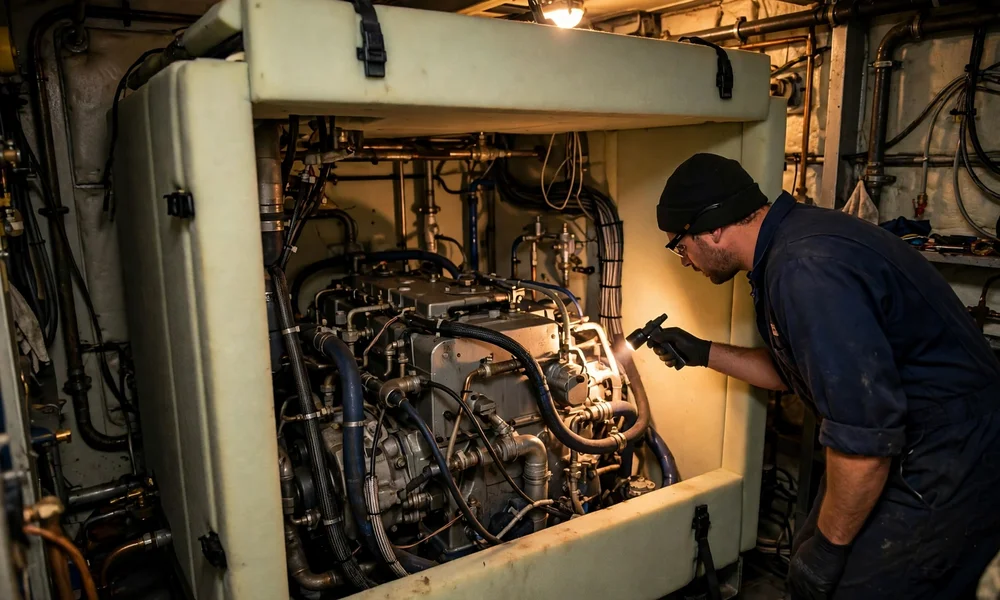
The yacht engine room specs show how much of a yacht’s engineering lives in a small, hot, noisy space, and the generator is the part of that space that never sleeps. Builders who treat the engine room as a place to hide machinery, rather than as a system to be designed, produce yachts that are loud at anchor and expensive to fix later. Builders who design the engine room around noise from the start, with space for a proper canopy, proper mounts and proper exhaust routing, produce yachts that are quiet for their whole life. The difference is decided on the drawing board, years before the owner ever hears it, and it cannot be fixed with a layer of foam after the fact.
Batteries are changing the argument
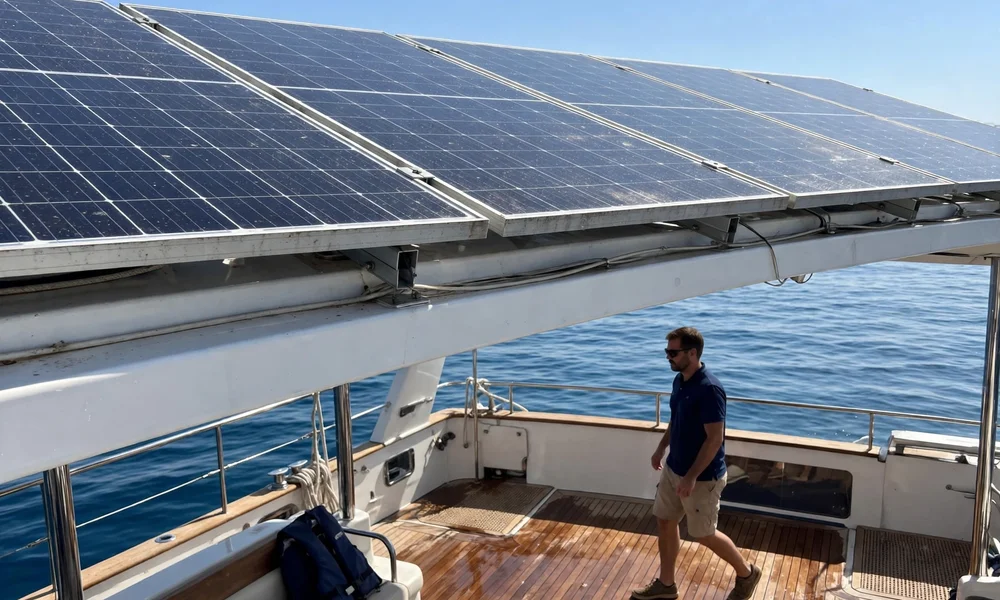
The most exciting change is not a quieter diesel generator. It is the generator that does not run at all. Large battery banks, charged by the generator during the day and by solar panels on the roof, can carry a yacht silently through the night, with the generator silent and the cabins cool. Measured on a modern hybrid explorer yacht, cabins at anchor on battery power run at around thirty-six to forty decibels, against forty to forty-five on generator power, and the difference, in a quiet bay at two in the morning, is the difference between sleep and no sleep. How a yacht solar panel works explains the other half of the equation: the panels that charge those batteries during the day, silently, from the sun, so that the night can be silent too.
This is not a luxury for the largest yachts only. Battery prices have fallen, solar panels have improved, and the combination is now practical on yachts of twenty to thirty metres, not just on eighty-metre explorer yachts. The quietest electric yachts of 2027 show how far the idea has come, with yachts that run silently at anchor and silently under way, and the lesson is not that every yacht should be electric. It is that every yacht should be able to be silent at anchor, and that the technology to do it is already here, waiting for owners to ask for it.
The counter-argument, answered honestly
What should change
The fix starts with buyers asking the right question. When you buy or charter a yacht, ask for the generator noise figure, measured at seven metres and in the cabins at anchor, and compare it with other yachts in the same class. If the builder cannot give you the figure, that tells you everything you need to know about how seriously they take it. Ask whether the yacht can run silently overnight on batteries, and for how long, and what the generator’s night mode does to its speed and noise. These are not difficult questions, and a builder who has done the engineering will be proud to answer them.
The verdict
A yacht is a machine for escaping noise, and a generator that fills a quiet bay with its drone defeats the purpose of the machine. Quieter generators, better installed, running less often and backed by batteries and solar panels, are not a luxury. They are the difference between a yacht that respects the sea it floats on and a yacht that treats the sea as a place to put its exhaust. The technology exists, the cost is modest, and the benefit is shared by everyone in the anchorage, including the owner who will sleep better for it. Build the quiet yacht, buy the quiet yacht, and let the bay stay as quiet as the evening promised.


