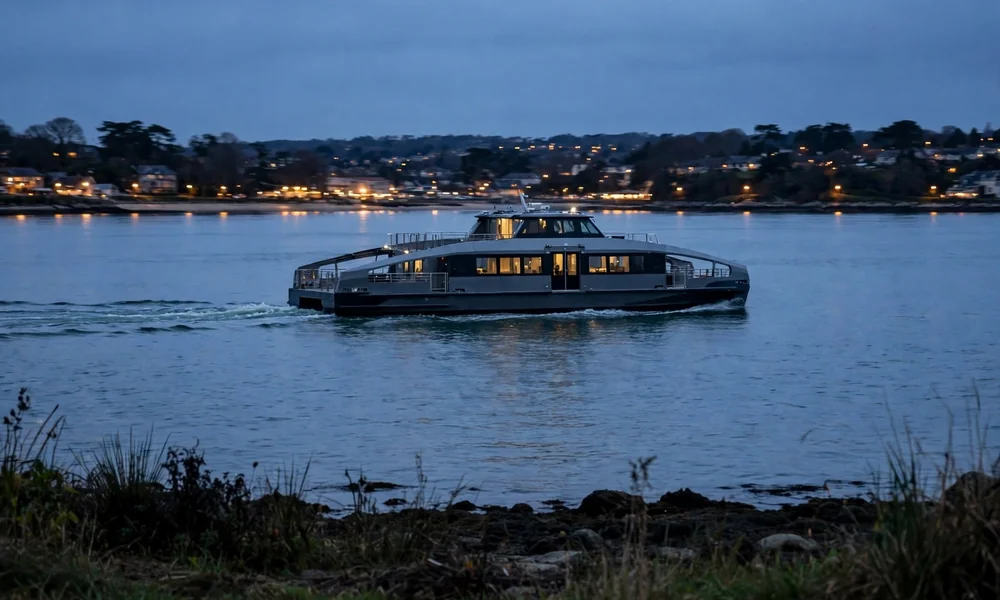
For decades the diesel ferry was the only sensible choice. It could run all day, refuel in minutes, and cross any distance an operator asked of it. That era is ending, at least on short routes. On crossings of an hour or less, with charging at one or both ends, a full-electric ferry is now simply the better machine: cleaner, quieter, cheaper to run, and nicer to travel on. The diesel ferry is not being beaten by regulation. It is being beaten on its own merits.
This is a case for full electric, not for a halfway house. A hybrid ferry still carries a diesel engine, still burns fuel, and still needs the maintenance of two propulsion systems. Hybrids have their place on routes too long for batteries alone, and the case for hybrid ferries makes that argument well. But where batteries can do the whole job, adding a diesel engine is dead weight. Operators should stop hedging and go fully electric on the routes that suit it.

Clean air where people actually stand
The strongest argument for electric ferries has nothing to do with distant climate targets. It is about the air on the pier. Ferries work in the middle of towns, next to homes, schools and cafes. A diesel ferry at the berth pours exhaust into the air where passengers are queuing, and it does so all day, every day, on every sailing.
An electric ferry produces no exhaust at all. It berths, loads and departs silently, with no smoke and no diesel smell hanging over the terminal. Anyone who has waited on a pier behind a diesel ferry knows the difference immediately: the air is cleaner, the noise is gone, and the ferry stops being the dirtiest neighbour in town. That benefit arrives on day one, on every sailing, and it is felt by the people who live and work around the harbour, not just by the passengers.
The ride is quieter in every way
A diesel ferry is a noisy place to be. Engines thrum through the deck, vibration runs through the seats, and conversation on the car deck means raising your voice. An electric ferry replaces that with the hum of motors and the sound of water against the hull. The difference is not subtle; it changes what a crossing feels like.
Passengers notice it most on early-morning and late-night sailings, when a quiet boat lets people rest instead of enduring engine noise. Crew notice it too, because a quieter working environment is a safer and less tiring one. And the towns at either end notice it, because a ferry that arrives and departs without a diesel roar is a better neighbour. Quiet is not a luxury extra on a ferry. It is part of the service, and electric propulsion delivers it in a way no diesel engine can match.
Electric motors are simpler machines
A diesel engine is a complicated piece of machinery: hundreds of moving parts, fuel injection, exhaust treatment, cooling, lubrication, and a regular schedule of servicing and overhauls. An electric motor has far fewer moving parts, no exhaust system to maintain, and no oil changes in the same sense. The maintenance burden is smaller, the breakdowns are fewer, and the ferry spends more of its life in service.
That reliability is what passengers actually experience. A ferry that runs on time, every time, is worth more than any brochure claim about green credentials. Diesel versus electric ferry propulsion, compared sets out the engineering trade-offs in detail, and the maintenance gap is one of the clearest: electric drivetrains ask less of their operators, and they give back more days in service. For a ferry company, a boat that does not break down is a boat that earns money.
Running costs fall once the boat is built
Electric ferries cost more to build than diesel ones, and it would be dishonest to hide that. Batteries are expensive, and the charging equipment on shore is a real investment. But the running costs tell a different story. Electricity is cheaper than diesel per unit of energy, electric motors waste far less of it as heat, and the maintenance bill is smaller year after year.
On a short route with many sailings a day, those savings add up quickly, because the ferry is using energy constantly and the diesel alternative would be burning fuel just as constantly. The more a ferry runs, the better the electric arithmetic looks. That is exactly the profile of a commuter ferry: short crossings, frequent sailings, and a timetable that never stops. For those routes, the higher purchase price is repaid by the lower cost of every single sailing.
Charging fits the ferry timetable
The usual objection to electric ferries is charging time: a diesel ferry refuels in minutes, while a battery ferry needs time plugged in. On a short route, that objection misses how ferries actually work. A ferry already spends time at the berth on every crossing, loading and unloading cars and passengers. Charging during those turnarounds, plus overnight charging when the boat is idle, covers most routes without changing the timetable at all.
Operators can also charge opportunistically, topping up the battery a little on every stop rather than waiting for a long charge. How electric ferry charging works explains the systems behind this, from plug-in connections at the berth to automated charging arms that connect as the ferry docks. The infrastructure is real work, and it takes planning, but it is a one-off project on shore — not a daily compromise aboard the boat.

The honest counter-case
Electric ferries are not the answer everywhere, and the limits are real. Batteries are heavy and take up space, which limits range and payload. On a long crossing, a battery ferry cannot carry enough energy to make the trip, and the charging infrastructure at a remote island or a small port may not exist. Diesel ferries can run any route, in any weather, with fuel available everywhere, and that flexibility is genuinely valuable.
There is also the question of where the electricity comes from. An electric ferry charged from a dirty grid is cleaner at the pier but less clean overall, and the batteries themselves carry an environmental cost in mining and manufacturing. These are fair points, and they mean electric ferries should be judged route by route, not adopted as a slogan. But on short, busy routes with grid power available, the counter-case collapses. The diesel ferry’s flexibility is not needed there, and its exhaust is not wanted there either.
The verdict
On short routes, the diesel ferry has lost the argument. The electric ferry is cleaner where people breathe, quieter for passengers and crew, simpler to maintain, and cheaper to run once it is built. Its limits are real but narrow: long crossings and remote ports still need diesel, and hybrids still have a role there. The mistake is letting those exceptions hold back the routes where electric already wins.
Operators, ports and regulators should treat full-electric as the default for short crossings and make diesel justify itself, rather than the other way round. Build the chargers, order the boats, and let passengers discover what a quiet, smoke-free crossing feels like. Once they have, they will not want to go back to diesel. The ferry of the future is not a compromise with a diesel engine hidden inside it. It is a boat with no engine smoke at all, and it is ready now.