Every ferry operator faces the same temptation: build one big boat instead of two small ones. A big ferry carries more cars, more passengers and more freight on every crossing, and on a spreadsheet the arithmetic looks unbeatable. For most short crossings, the better answer is not a bigger ferry. It is a smaller one, running more often, docking at simpler piers, and fitting the route instead of dominating it.
This is a case for size, not for propulsion. Electric ferries already win the argument against diesel on short routes, and the case for electric ferries over diesel makes that argument well. What operators get wrong is assuming that an electric ferry should be a scaled-up version of the diesel boat it replaces. A smaller electric ferry is a different kind of machine: lighter, cheaper to charge, quicker to turn around, and able to serve routes and piers that a big boat can never reach. Small is not a compromise. On a short crossing, small is the point.

Frequency beats capacity
The single most valuable thing a ferry can offer is not space. It is frequency. A passenger who misses a big ferry waits an hour for the next one; a passenger who misses a small ferry waits fifteen minutes. That difference changes how people plan their day. They stop checking the timetable and start treating the ferry like a bridge, turning up when it suits them and crossing without thinking about it.
Two small ferries running a shuttle can carry the same number of people as one large boat, but they do it with shorter waits, shorter queues and a timetable that bends around demand instead of forcing demand to bend around it. A big ferry, by contrast, is a single point of failure: when it is out of service, the crossing simply stops.
Small boats fit small places
Big ferries need big infrastructure. They need deep water, long piers, wide turning basins, heavy fenders and reinforced ramps built to take the weight of a fully loaded car deck. That infrastructure costs millions, takes years to build, and can only be justified where traffic is already heavy. It locks a route into one shape for decades, and it leaves smaller communities with nothing at all.
A small electric ferry needs far less. It can dock at a modest pier, turn in a narrow channel, and serve a village landing that would never justify a major terminal. That opens up crossings that were never viable before: short hops between islands, river crossings in small towns, and links to communities that have waited years for a service. The boat fits the place, instead of demanding that the place be rebuilt to fit the boat. For the thousands of short crossings that big ferries ignore, small is the only size that works.
Lighter boats charge faster and cheaper
Batteries are heavy, and on a ferry that weight matters twice over: the boat must carry the batteries, and it must push them through the water on every crossing. A big ferry needs an enormous battery bank, which means a huge charging installation on shore, a heavy grid connection, and a long charge time between sailings. The bigger the boat, the more the charging problem grows.
A small ferry sidesteps most of that. Its battery bank is modest, so it can charge from a smaller shore connection, top up during short turnarounds, and run all day on overnight charging. How electric ferry charging works explains the systems behind this, and the pattern is clear: the smaller the battery, the simpler the shore-side work. An operator can put a small electric ferry into service with charging equipment that costs a fraction of what a big boat demands, and can do it at a pier that already exists rather than one that must be built from scratch.
The ride is better when the boat is smaller
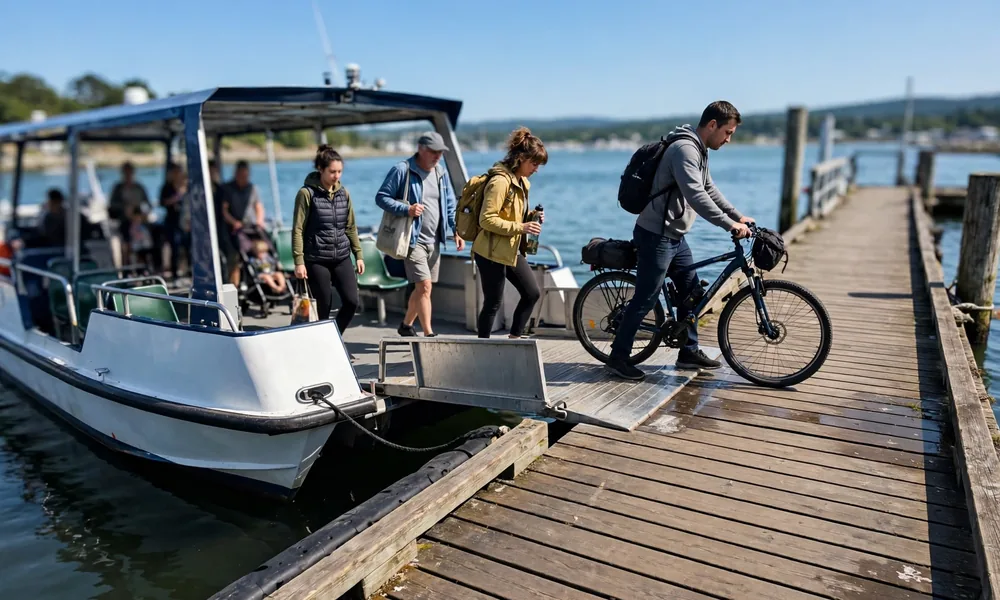
There is a human argument too, and it is easy to miss in a planning meeting. A big ferry is a floating car park: hundreds of passengers funnelled through a cavernous vehicle deck, long walks from the car to the lounge, and a boarding process that feels like an airport without the charm. A small ferry is a different experience. Passengers step aboard, find a seat in seconds, and can see the water from wherever they sit.
Crew notice the difference as well. On a small boat the crew know the regulars, loading is a quick and visible job rather than a logistical operation, and the whole crossing has the feel of a neighbourhood service rather than a transport system. The best electric ferries, ranked shows how varied the class already is, from compact harbour shuttles to larger coastal boats, and the small end of that list is where the passenger experience is at its most direct.
Small boats are cheaper to build and replace
A big ferry is a bet-the-company purchase. It costs tens of millions, takes years to design and build, and commits an operator to a single route shape for decades. If traffic falls, or a route changes, or a new technology arrives, that boat cannot adapt. It is too big, too expensive and too specialised to move anywhere else.
Small ferries spread that risk. An operator can order one, test a route, and add a second boat when demand proves itself. If a route fails, the boat can be moved to another crossing, sold to another operator, or replaced without a crisis. The fleet can grow one boat at a time, in step with real demand, instead of gambling on a forecast made five years before the first sailing. In a world where travel patterns shift quickly, that flexibility is worth more than the economies of scale a big boat promises and rarely delivers.
The honest counter-case
Small ferries are not the answer everywhere, and the limits deserve a fair hearing. On a busy commuter route with hundreds of cars per sailing, a small boat cannot keep up: it would need to run constantly, and the crew costs of that many crossings would eat the savings. A big ferry moves more vehicles per crew member, per sailing, and on high-volume routes that efficiency is real.
Bad weather is the other honest objection. A small boat feels the sea more than a large one, and on an exposed crossing in rough conditions passengers will notice the motion. But most ferry crossings are short, sheltered and lightly loaded for much of the day. The counter-case wins on a handful of busy, exposed routes. It does not justify building big boats for the many quiet crossings where a small ferry would do the job better.
The verdict
For most short crossings, the small electric ferry is the better boat. It runs more often, fits the piers that already exist, charges from modest shore power, gives passengers a simpler ride, and lets operators grow a route one boat at a time instead of betting everything on a single hull. Its limits are real but narrow: the busiest car routes and the roughest open-water crossings still need big boats, and nobody should pretend otherwise.
Operators, ports and planners should stop treating size as a sign of seriousness. The serious question is not how many cars a ferry can carry, but how well it serves the crossing it runs. On a short route, the answer is a small boat, running often, charging easily, and turning up when people need it.


