Walk into a modern boatyard and you will see something odd: a yacht hull the size of a bus, wrapped in clear plastic like a giant piece of leftovers, with hoses snaking away from it and a pump humming quietly in the corner. The plastic is the whole point. Under that film, liquid resin is being sucked through layers of dry carbon fibre by nothing more than the pressure of the air outside, and when the resin cures, that hull will be lighter and stronger than anything the yard could have built by hand.
That is vacuum infusion, the process that quietly took over the world of composite boats, wind turbine blades, and aircraft fairings. Before it, builders laid up composites by hand, brushing sticky resin into cloth with rollers and hoping they had used the right amount. Vacuum infusion replaced the brush and the guesswork with physics: a vacuum bag, a pressure difference, and resin that flows exactly where it is needed.
The numbers behind the process decide whether a hull comes out feather-light or overweight. Vacuum pressure, resin viscosity, fibre volume fraction, and flow distance are the specifications printed on every infusion plan. This guide explains them in plain English: what each number means, and how vacuum infusion compares with the older ways of making composite parts.

How It Works
Step 1: Laying the dry fibre in the mould
Everything starts dry. Sheets of carbon fibre, glass fibre, or aramid cloth are cut to shape and laid into the mould, layer by layer, exactly as they will sit in the finished part. Because the cloth is dry, it is easy to position and adjust before anything is sealed. A foam or honeycomb core is often added between the skins to make a sandwich panel.
Step 2: Adding the flow layers and bagging the mould
Over the dry fibre goes a stack of disposable layers: a peel ply that will strip away later, a flow mesh that gives the resin easy channels to travel through, and then the vacuum bag itself — a tough plastic film sealed to the mould flange with tacky tape. Feed lines and spiral tubing are placed at one end, vacuum lines at the other. The whole assembly is a sealed envelope with only two openings: resin in, air out.
Step 3: Pulling the vacuum
A vacuum pump is switched on, and the air is drawn out of the bag. The pressure inside falls to roughly 90 to 98 percent of a full vacuum, and the atmosphere outside presses down on the bag with about a tonne of force per square metre. That pressure squeezes the dry fibre tight against the mould, compressing it to its final thickness before a single drop of resin arrives.
Step 4: Infusing the resin
The resin feed line is opened, and the pressure difference does the work. Resin is drawn from its bucket through the spiral tubing and across the flow mesh, soaking into the fibre from one end of the part to the other. The builder can speed the flow up or slow it down by opening or closing feed lines. On a large hull, filling the whole part before the resin starts to gel can mean a race against the clock lasting an hour or more.
Step 5: Curing under vacuum
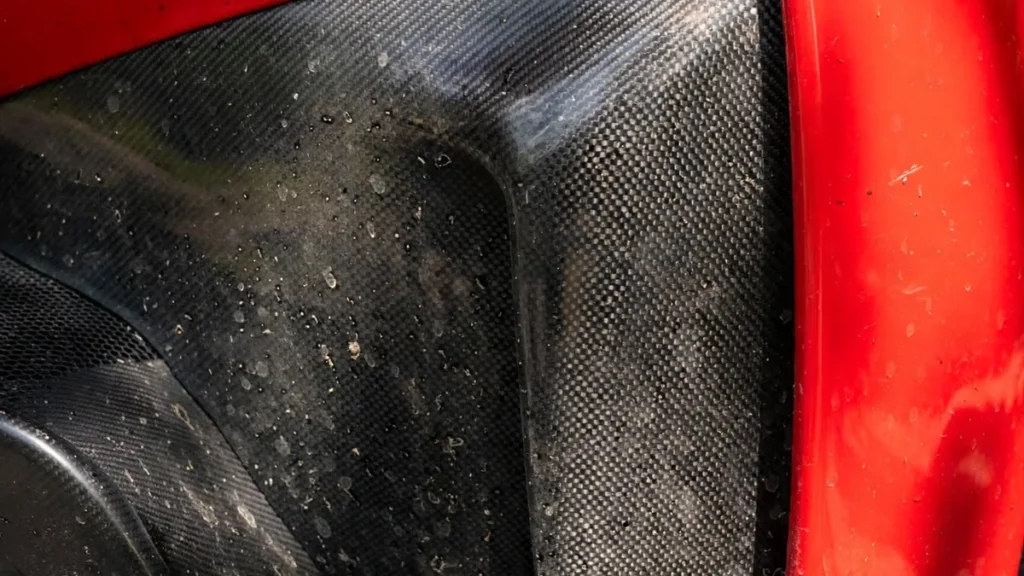
Once the fibre is fully wet, the feed lines are clamped shut and the vacuum is held while the resin cures. The pressure keeps squeezing the laminate, pushing out trapped air and excess resin, and the part hardens in the shape of the mould. Most infusions cure at room temperature, which avoids the cost and thermal stress of oven curing. The same low-heat logic makes infusion the natural partner of the cloth it usually wets out — the carbon fibre weave that gives a hull its strength — and of tough fibres such as those in Kevlar composite parts.
Step 6: De-bagging and finishing
When the resin has hardened, the bag is peeled away, the flow mesh and peel ply come off with it, and the part is lifted from the mould. The surface that was against the mould is smooth and glossy, ready for paint, while the bag side is rougher and needs a light sanding. Because infusion uses exactly the resin the fibre needs, the finished part is lighter and more consistent than a hand-laid one, with fewer voids and a higher fibre content. That consistency is why production boats and wind blades are infused, and why a fair hull surface matters as much as the structure beneath it — the same obsession that drives yacht hull fairing.

Vacuum Infusion Specs
| Specification | Typical range |
|---|---|
| Vacuum level | About 90 to 98 percent vacuum (roughly -0.9 to -0.98 bar gauge) |
| Resin viscosity | About 100 to 500 millipascal-seconds at infusion temperature |
| Fibre volume fraction | About 50 to 60 percent in a cured laminate |
| Flow distance per feed line | About 0.5 to 2 metres, depending on resin and fibre |
| Resin gel time | About 30 to 120 minutes at room temperature |
| Cure temperature | About 20 to 25 degrees Celsius, room temperature |
| Laminate void content | Less than about 1 percent in a good infusion |
| Compaction pressure | About 1 tonne per square metre from atmospheric pressure |
What Does Vacuum Infusion Cost?
Vacuum infusion is cheaper to set up than an autoclave, but it is not free. The consumables — vacuum bag film, flow mesh, peel ply, tubing, and sealant tape — are estimated to cost roughly $5 to $20 per square metre of part, and a vacuum pump and resin trap setup is estimated at roughly $1,000 to $10,000 depending on size. The resin itself is estimated at roughly $5 to $25 per kilogram, and carbon fibre cloth is estimated at roughly $20 to $80 per square metre. All prices are estimates only and vary widely by material, supplier, and part size.
A Rare Fact
Vacuum infusion has an unlikely ancestor: the humble plastic bag used to fix leaky boats. In the 1970s, boatbuilders discovered that sealing a leaking hull repair under a plastic sheet and sucking the air out pressed the patch flat and squeezed out excess resin. That repair trick, called vacuum bagging, grew into a full manufacturing process when builders realised they could wet out the entire laminate under vacuum instead of just pressing a repair.

Learn to read the specifications — vacuum level, viscosity, fibre volume, and flow distance — and the bagged hull stops being a mystery and starts being engineering you can see through.