The motorcycle stands on a rug in a collector’s garage, not on a showroom floor. It is smaller than a modern bike, narrower, and lower, with a fuel tank painted in a deep green that has faded in places to something softer. The owner starts it with a kick, and the engine catches with a sound like a slow drumbeat, uneven and alive.
A visitor asks the obvious question: how fast does it go, and how much power does it make? The owner smiles, because those are the wrong questions. A vintage motorcycle is not slow by accident. It was built in a world where the numbers meant something different, and reading its specification sheet the modern way misses everything that makes the machine remarkable.
To read a vintage motorcycle properly, you have to translate. Horsepower was measured differently, top speed was measured on roads that no longer exist, and weight was quoted without the fluids a modern sheet takes for granted. The specification sheet is a record of what was possible before computers, before wind tunnels, and before mass production.
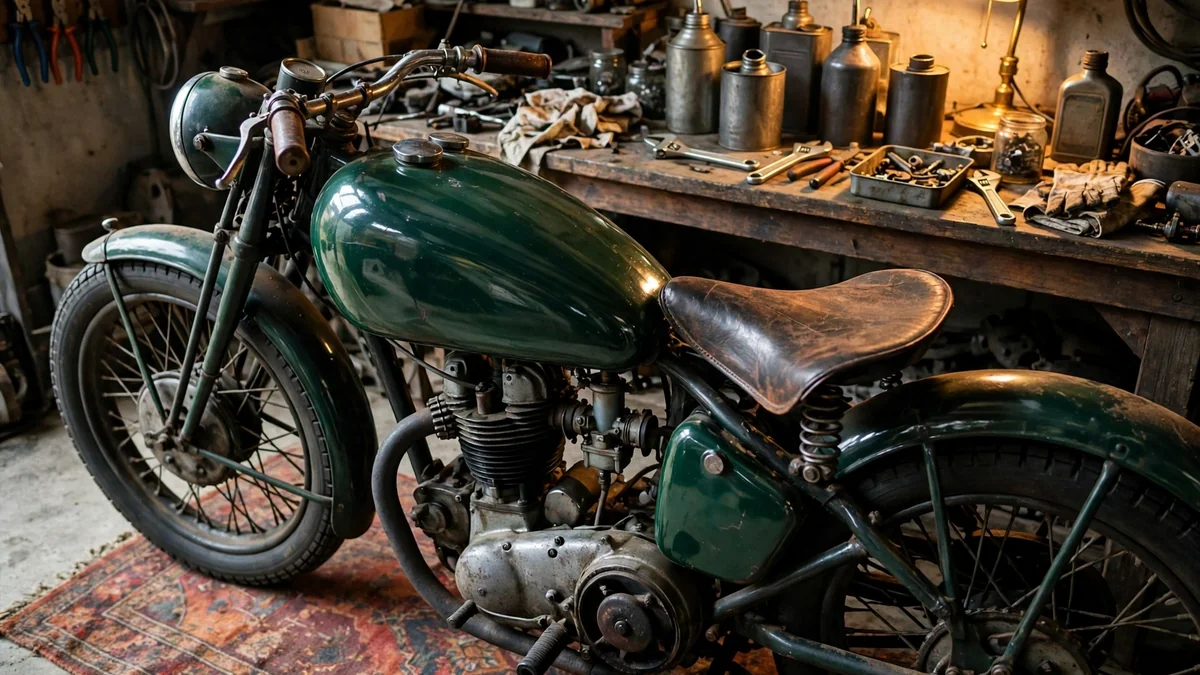
Vintage Motorcycle Specs, Explained
The engine: small capacity, long stroke
Most desirable vintage motorcycles have engines of 350 to 1,000 cubic centimetres, and the majority sit at the smaller end of that range. A 500 cubic centimetre single-cylinder engine from the 1930s is a common sight, and it makes about 20 to 30 horsepower, a figure a modern 125 cubic centimetre commuter bike can beat. The number that matters is torque, and the way it arrives. These engines have a long stroke, which means the piston travels a long way in a tall cylinder, and they make their pulling power low in the rev range, at 2,000 to 3,500 revolutions per minute. The compression ratio is low by modern standards, typically 6 to 1 or 7 to 1, because the fuel of the era was poor and the cast iron cylinder head could not take more.
The frame: thin tubes and a rigid back
The frame of a vintage motorcycle is a cradle of thin steel tubes, brazed together by hand, and the number that defines it is the wheelbase, usually about 1,350 to 1,450 millimetres, shorter than a modern motorcycle. The weight is the surprise. A vintage 500 weighs about 150 to 180 kilograms, lighter than many modern middleweight motorcycles, because there is so little on it: no electric starter, no battery, no fairing, no radiator, and a fuel tank that holds 12 to 15 litres.
The gearbox and brakes: four speeds and a prayer
The gearbox on a vintage motorcycle usually has three or four speeds, operated by a hand lever or a foot lever, and the clutch is a set of cork-lined plates running in oil. The brakes are drums, not discs, with a diameter of about 180 to 200 millimetres, and they are operated by rods or cables rather than hydraulics. Stopping distance is the number modern riders find hardest to believe: from 60 kilometres per hour, a vintage motorcycle can need 25 to 30 metres to stop, roughly twice the distance of a modern bike. That is why the top speed matters less than the braking, and why experienced vintage riders leave a large gap to the vehicle ahead.
Top speed and fuel: what the numbers meant then
A vintage motorcycle’s top speed is usually quoted at 110 to 160 kilometres per hour, and the fastest pre-war machines could reach 170 or more, but those figures were measured under ideal conditions, often on a long straight with a light rider and a following wind. The cruising speed, the speed the machine could hold all day without strain, was closer to 80 to 100 kilometres per hour, and that was the number owners actually cared about. The fuel tank, at 12 to 15 litres, gives a range of 300 to 450 kilometres, enough to cross a country on a single fill.

What the Numbers Mean on the Road
On the road, a vintage motorcycle feels nothing like its specification sheet suggests. The engine vibrates through the handlebars and the footrests, the exhaust note is a slow thump rather than a scream, and the wind hits the rider without any fairing to deflect it. At 80 kilometres per hour the machine feels fast, because the rider is exposed, the brakes are weak, and the tyres are narrow, and the senses report speed in a way a modern motorcycle, insulated by fairings and electronics, never does. That involvement is what owners value, and it is why a machine with 25 horsepower can be more thrilling than a modern bike with ten times as much.
The numbers also explain the maintenance. The cost of that care is part of the price of ownership, and it is set out in why vintage motorcycles cost a fortune, which follows the craft, the rarity, and the restoration bills behind the market. A modern electric motorcycle, by contrast, has almost no moving parts to service, and the difference is described in luxury electric motorcycle specs explained, where the numbers tell a very different story about power and silence.
| Specification | Typical range |
|---|---|
| Engine capacity | About 350 to 1,000 cubic centimetres |
| Power | About 20 to 40 horsepower |
| Torque peak | About 2,000 to 3,500 revolutions per minute |
| Compression ratio | About 6 to 1 or 7 to 1 |
| Weight | About 150 to 180 kilograms |
| Top speed | About 110 to 160 kilometres per hour |
| Cruising speed | About 80 to 100 kilometres per hour |
| Fuel consumption | About 25 to 35 kilometres per litre |
| Fuel tank | About 12 to 15 litres |
| Brakes | Drum brakes, about 180 to 200 millimetres |
What Does a Vintage Motorcycle Cost?
A vintage motorcycle is estimated to cost roughly $15,000 to $150,000, depending on the model, its condition, and its history. A common 1950s single in good running order is estimated at the lower end, while a rare pre-war machine with matching numbers and a documented past is estimated at the top end or far beyond, with the most famous examples selling for more than a million dollars at auction. The hand-built world that produced these machines is still alive in a different form, and why a custom motorcycle costs so much shows how modern builders charge for the same kind of one-at-a-time craft.
A Rare Fact
Some vintage motorcycles were built with a hand-operated oil pump on the fuel tank, and the rider had to give it a stroke every few miles to keep the engine lubricated. Forget to pump, and the engine would seize. Remember, and the motorcycle would run all day. The motorcycle did not look after itself. The rider looked after it, and that partnership is still the point.

A vintage motorcycle’s specification sheet looks modest until you read it the way its builders intended, as a record of what thin steel, cast iron, and a pair of skilled hands could do before the modern world arrived. The numbers are small. The machine they describe is not.


