The Auction Room Goes Quiet
At a London auction in the autumn, a motorcycle built before the Second World War rolled onto the stage under the lights, and the room went quiet in a way that has nothing to do with politeness. The machine was small by modern standards, a single-cylinder engine in a frame of thin steel tubes, with brakes that a modern cyclist would consider inadequate. It had no electric starter, no suspension worth the name, and a top speed lower than a family hatchback. When the hammer finally fell, the price was higher than a new luxury sports car. Nobody in the room thought that was strange. They had all come to bid on it.
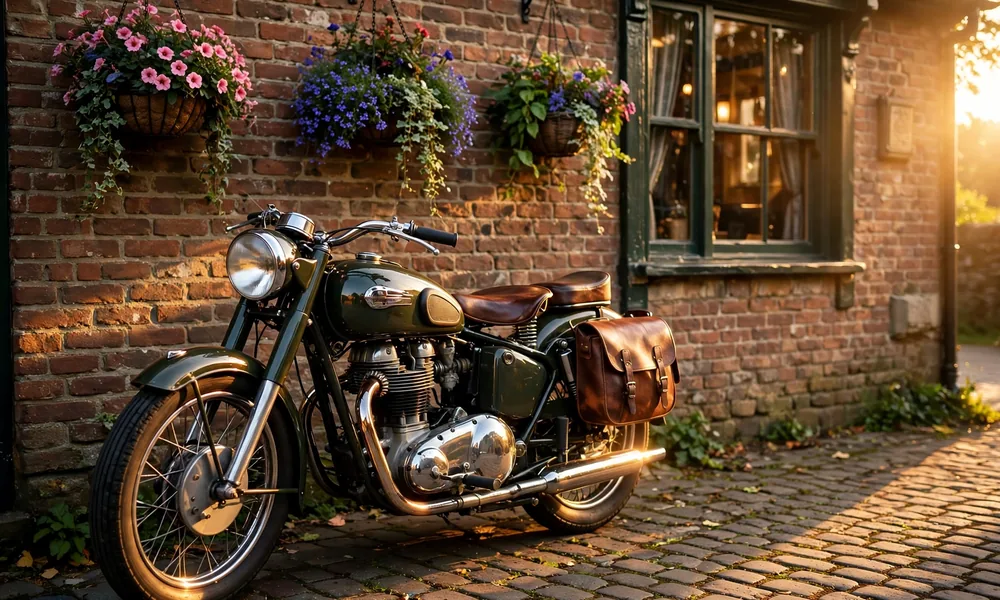
Vintage motorcycles occupy a peculiar place in the collecting world. They are slower, less reliable, and less comfortable than the cheapest modern bike, yet the best examples command six-figure prices and, in rare cases, more than a million. The reasons have little to do with performance and everything to do with craft, scarcity, history, and the strange economics of objects that can never be made again. To understand the price, it helps to forget the motorcycle as a vehicle and think of it as a piece of industrial art that happens to have an engine.

Craft: Built by Hand, One at a Time
A vintage motorcycle was built in a world before robots and automated assembly lines. Frames were brazed by hand, fuel tanks were shaped over wooden forms by panel beaters, and engines were assembled by a single fitter who filed and matched each part until it worked. That labour is visible in the finished machine. The welds, the hand-painted pinstripes, the castings with their rough edges polished smooth by hand, all of it carries the marks of individual workers in a way that no modern mass-produced bike can match.
Restoring such a machine to the standard collectors demand is itself an extraordinary undertaking. A proper restoration can take a thousand hours or more, carried out by specialists whose skills are disappearing. There are only a handful of people left in the world who can correctly rebuild a pre-war magneto, or reline a vintage brake drum, or mix the exact shade of paint a factory used in 1938. Their time is expensive because it cannot be scaled, and every hour they spend is an hour no one else can buy. The cost of a restoration often exceeds the value of the finished bike, which is why the best restorations are acts of devotion rather than investment.
Rarity: They Are Not Making Any More
Scarcity is the simplest explanation for vintage motorcycle prices, and the most powerful. Many of the most desirable models were built in runs of a few hundred, and most of those were ridden hard, crashed, or scrapped during wartime metal drives. A model that left the factory in a run of five hundred may survive today in numbers you could count on your fingers, and of those survivors, only a few will be in original, matching-numbers condition. When demand from collectors around the world meets a supply that shrinks every year, prices can only go in one direction.
Provenance multiplies rarity. A motorcycle with a documented history, a known first owner, a record of competition success, or a connection to a famous rider is worth a multiple of an identical machine without that story. The most famous example in the vintage world is a machine ridden to victory in a major race, or one owned by a celebrity of its era. The paperwork matters as much as the metal: logbooks, factory records, period photographs, and old registration documents are scrutinised like the provenance of a painting, because they are the proof that the story is real.
The market is also global in a way it never was before. A rare British motorcycle that once traded among a small circle of enthusiasts in the Midlands is now chased by collectors in Japan, the United States, and the Gulf, all bidding in the same online auctions. That global demand has pushed prices for the best machines far beyond what their original builders could ever have imagined. A new custom machine faces a different set of pressures, and our piece on why a custom motorcycle is so expensive shows how modern hand-built bikes earn their prices in a market the vintage world helped to create.

History You Can Ride
Part of what buyers are paying for is the experience of riding history. A vintage motorcycle does not insulate its rider from the machine. There is no electric starter, no fuel injection, no anti-lock braking. Starting one requires a ritual of tickling the carburettor, finding compression, and kicking with conviction. Riding one demands constant attention to oil, to temperature, to the road ahead, because the machine will not forgive inattention. For collectors who have ridden everything modern, that rawness is the appeal. It is motorcycling as it was before it became easy.
The community around vintage motorcycles is part of the value too. Clubs, rallies, and specialist events give owners a social world that modern biking rarely offers, and the knowledge shared in those circles, which specialist to trust, which parts are correct, which bikes are coming to market, is itself a form of currency. A buyer is not only acquiring a machine but entering a world with its own rules, language, and friendships. The same collector logic applies to four wheels, as our look at why a vintage hypercar is so expensive makes clear.
Key Specifications at a Glance
| Specification | Typical vintage figure |
|---|---|
| Era | 1920s–1960s, pre-war most prized |
| Engine | Single or twin cylinder, 250–1,000 cc |
| Power | 15–50 hp |
| Top speed | 70–110 mph |
| Weight | 140–200 kg |
| Starting | Kick start only |
| Brakes | Drum brakes, rod or cable operated |
| Production run | Often under 1,000 units |
| Survivors | Sometimes fewer than 20 worldwide |
| Full restoration time | 800–1,500 hours |
What a Vintage Motorcycle Costs
Prices vary enormously by model, condition, and history. A presentable but ordinary vintage motorcycle might sell for $15,000 to $40,000, while a rare model in original condition can reach $150,000 to $500,000. The most celebrated machines, with racing history or famous ownership, have sold for more than $1 million at auction. These are estimates based on recent auction results, and the market moves with fashion, with certain marques rising and falling as new generations of collectors arrive.
The vintage motorcycle market sits alongside a wider world of historic machines, and the prices of racing cars from the same era tell a parallel story. Our account of why a vintage race car is so expensive follows the same forces, craft, rarity, and provenance, to their logical conclusion on four wheels.
A Rare Fact Worth Knowing
One of the most valuable motorcycles ever sold at auction was a 1915 Cyclone board track racer, a machine built for the terrifying wooden board tracks of early American racing, where riders reached 100 miles per hour on planks with no brakes at all. Only a handful were ever built, and the surviving example sold for close to a million dollars despite being, by any practical measure, almost unrideable. Its value lay entirely in what it represented: a moment when motorcycle racing was at its most dangerous, its most inventive, and its most romantic, preserved in steel and cast iron for more than a century.


