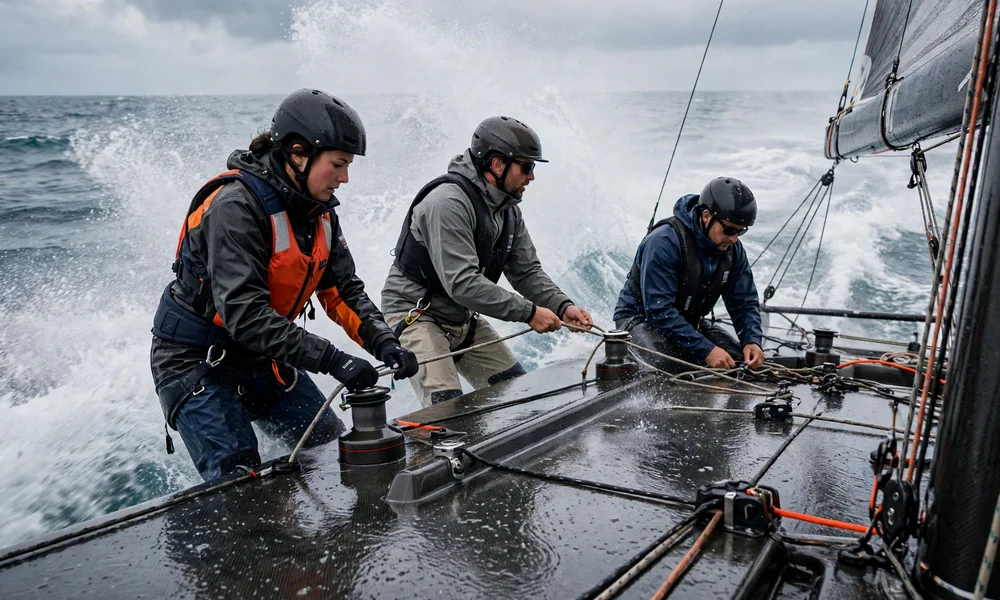
A foiling sailboat does something that looks impossible the first time you see it: it lifts its hull clean out of the water and flies, supported only by thin wings underneath. The hull hangs in the air, the crew stands on a deck that is no longer touching the sea, and the boat goes faster than the wind that is pushing it. The trick is the hydrofoil, a wing that works underwater the way an aircraft wing works in the air. Once the boat is moving fast enough, the foil generates enough lift to raise the hull, and the drag that was holding the boat back almost disappears.
The idea is old, but the execution is new. Italian inventor Enrico Forlanini reached 42.5 miles per hour in a small foiling powerboat in 1906, just three years after the first America’s Cup race of the modern era. For a century, foiling stayed on the fringes, held back by the difficulty of controlling the lift. What changed is control: sensors, hydraulics, and flight controllers that can adjust a foil’s angle dozens of times a second. The result is the modern foiling sailboat, from the America’s Cup AC75 to the small foiling dinghies that amateurs now sail at their local club.

How a Hydrofoil Lifts a Boat
A hydrofoil is a wing shaped to guide water around it. As water flows over the foil, it moves faster over one side than the other, creating low pressure on one side and high pressure on the other. The imbalance produces lift, just as it does on an aircraft wing. The difference is that water is about 800 times denser than air, so a small foil can generate a great deal of lift at relatively low speed. That is why a foil the size of a coffee table can lift a 7-tonne racing yacht.
The lift grows with the square of the speed, which creates a clear sequence. At low speed, the boat sails like any other boat, with its hull in the water. As the wind pushes it faster, the foil starts to lift, the hull rises, and the wetted surface shrinks. Less hull in the water means less drag, which means the boat goes faster, which means more lift. The feedback loop ends when the hull is fully clear and only the foils and a rudder are touching the water. At that point the boat is flying, and its speed is limited by the drag of the foils themselves rather than by the hull pushing water aside.
Takeoff speed depends on the foil and the boat. Larger foil wings lift off earlier, in lighter wind, but they create more drag at high speed. Smaller wings need more wind to take off but are faster once flying. An AC75 needs about 6.5 knots of wind to race, and it can exceed 50 knots of boat speed, several times the speed of the wind. The hull, once airborne, becomes an aerodynamic shape, a fuselage that carries the crew, and its design is about cutting through air rather than water.
The AC75: Foiling at the Extreme
The America’s Cup AC75 is the fastest monohull class in the world, and it is also the strangest looking. It has no keel. Instead, it carries two foil arms, one on each side, each ending in a T-shaped wing. The leeward foil goes underwater and provides the lift, while the windward foil is raised out of the water and its weight acts as ballast, holding the boat upright against the heeling force of the sails. When the boat tacks or jibes, battery-driven hydraulic rams lower one foil and raise the other.
The foil arms are a one-design part, built by Persico and supplied to every team, with a fixed shape that no team may alter. What teams can design is the foil wing itself, and that is where the Cup is won and lost. The wings carry articulating trailing flaps, adjusted by hydraulics, that control the amount of lift. A larger wing lifts off earlier in light wind; a smaller wing is faster at the top of the range, where racing is capped at 23 knots of wind. Teams are limited in how many foil wings they can build, but they have wide latitude to reshape them during the competition.
The AC75’s lineage runs through the AC72 catamarans of 2013, the first Cup boats to foil. Those boats shaped their daggerboards into foils, but the rules forbade any part of the foil from moving independently, so the crews controlled lift by moving the whole foil to change its angle of attack. The AC75 rule specifically allows flaps, which is what makes stable, controllable flight possible at 50 knots.

Control: The Hard Part
Lift is easy; stable flight is hard. A hydrofoil that generates too much lift will breach the surface, lose its grip on the water, and drop the boat back down with a crash. Too little lift and the hull settles back into the water, dragging speed away. The boat needs to hold a steady ride height, and it needs to do it while the wind gusts, the waves pass underneath, and the crew moves around.
The other control problem is the turn. When a foiling boat tacks, it has to swap which foil is down and which is up, while keeping the hull flying through the manoeuvre. The AC75 does this with its hydraulic foil arms, and a good tack keeps the boat airborne throughout. A bad one drops the hull into the water, and the boat has to accelerate from displacement speed all over again. In racing, the difference between a foiling tack and a splashdown can decide the race.
What Foiling Changes About Sailing
A foiling boat does not sail like a normal boat. Because it can go faster than the wind, it generates its own apparent wind, the wind the crew actually feels, and that apparent wind always comes from ahead. An AC75 sailing downwind is effectively sailing close-hauled, with the wind on the bow, and the crew trims the sails as if they were beating upwind. The boat’s speed comes from the efficiency of the foils, not from the power of the sails alone, and the tactics change with it: a foiling boat wants clean air and flat water, and it will sail a longer course to stay flying rather than take a shorter one that drops it off the foils.
The technology is moving downmarket. Foiling dinghies and boards are now within reach of club sailors, and foiling ferries are entering service in cities. The AC75 remains the extreme, a boat that costs tens of millions and needs a team of engineers to keep it flying, but the physics it demonstrates is the same physics in a foiling Moth. Our explainer on what a hydrofoil really is covers the basic principle, while the foiling electric ferry shows the same idea carrying passengers, and the electric hydrofoil surfboard is the smallest version of all.