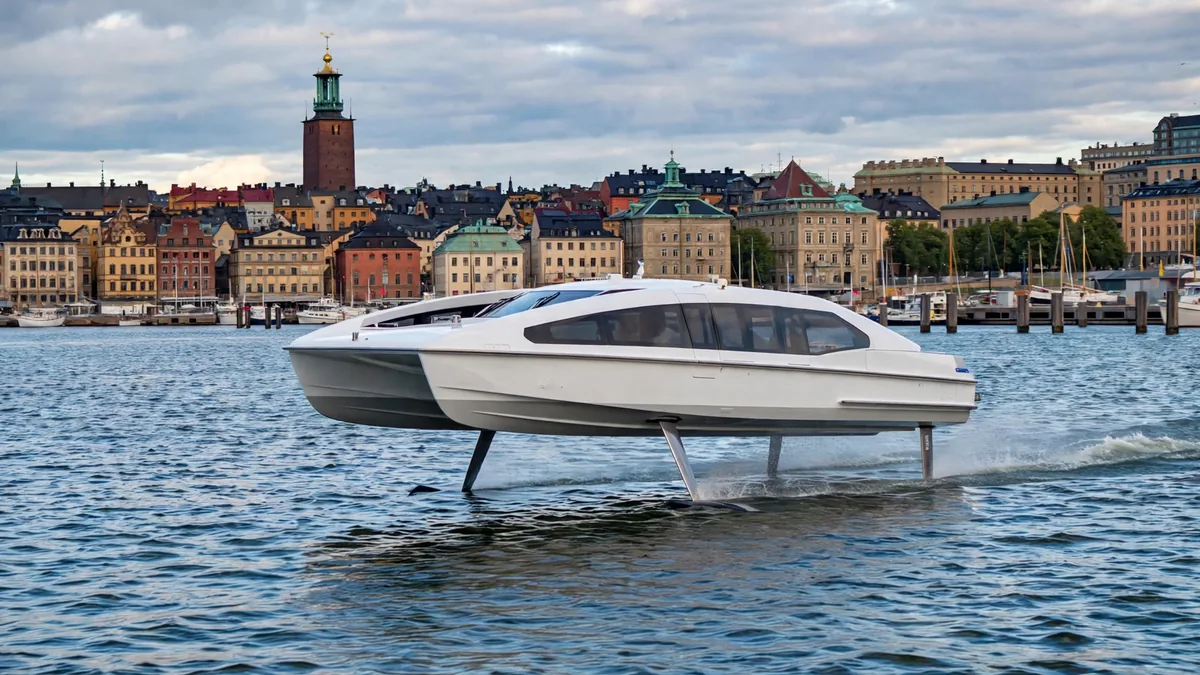
A ferry pulls away from the quay, accelerates, and then something strange happens. The hull rises out of the water, the bow lifts, the wash behind it shrinks to almost nothing, and the boat glides along on thin legs that nobody can see. There is no roar of diesel engines and no pounding through the waves. Passengers sip coffee at 25 knots while the sea slides past underneath, smooth as a train ride. The boat is not floating. It is flying, just above the surface, on wings hidden below the waterline.
This is a foiling electric ferry, a passenger boat that combines two ideas that were useless apart and remarkable together: hydrofoils, which lift a hull clear of the water to kill drag, and electric motors, which are quiet and clean but have always been held back by the huge energy a hull wastes pushing water aside. Together, they make a ferry faster, further, and quieter than either idea alone.
What Is a Foiling Electric Ferry?
A foiling electric ferry is a passenger vessel that runs entirely on batteries and rides on hydrofoils, submerged wings that generate lift as the boat speeds up, raising the hull out of the water. Once foilborne, only the thin foils and their struts touch the sea, so the drag that normally limits a boat’s speed and range mostly disappears. The best-known example is the Candela P-12, a 12-metre Swedish ferry that entered public service in Stockholm in 2024, carrying 30 passengers on a route that used to take 55 minutes by bus and now takes 25 minutes by water.
Step 1: The hull pushes through the water like any boat
At low speed a foiling ferry behaves like an ordinary boat. Its hull sits in the water, displacing it, and the electric motors push it forward. The drag is high, the wash is wide, and the energy use is no better than any other electric boat. This phase lasts only a short while. The ferry accelerates out of the harbour, the foils below begin to bite, and the whole point of the design is about to show itself.
Step 2: The hydrofoils generate lift and the hull takes off
The foils are shaped like aircraft wings, mounted on struts beneath the hull. As water flows over them, they generate lift, just as a wing does in air, only water is about 800 times denser than air, so a small foil can lift a heavy boat. At a lift-off speed of about 16 knots the lift equals the weight of the vessel, and the hull rises clear of the surface. The P-12 uses three carbon-fibre foils, and the drag falls so sharply that energy use drops by up to 80 percent compared with a conventional diesel vessel. The wing itself is explained in what a hydrofoil really is.
Step 3: A flight controller flies the boat, one hundred times a second
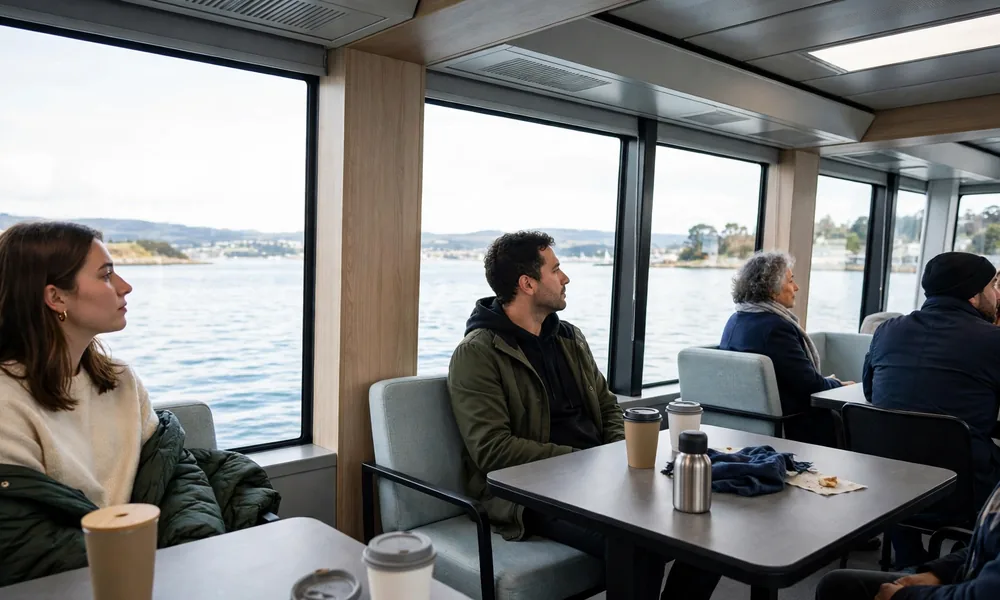
A hull on foils is inherently unstable, like balancing on a knife edge, and no human could keep it level by hand. The ferry is flown by a computer, a flight controller that reads motion sensors, wave height, wind, and speed, then adjusts the angle of the foils up to 100 times a second. The result is a ride so smooth that passengers in Stockholm trials reported drinking coffee at 25 knots without spilling it, over waves a metre high.

Step 4: Electric motors turn battery power into silent thrust
Once foilborne, the ferry needs surprisingly little power to stay flying, which is why batteries finally make sense. The P-12 carries a 252 kilowatt-hour battery pack and two podded electric motors, called C-PODs, with a combined peak output of 320 kilowatts, mounted on the rear foil strut so their propellers sit in clean, undisturbed water. At its 25-knot service speed the ferry covers up to 40 nautical miles on a charge, with a top speed of 30 knots in trials, a record for an electric passenger vessel. The motors are nearly silent, the cabin measures just 63 to 64 decibels at cruise, quieter than most diesel ferries, and there is no exhaust at all. The battery side is covered by how an electric ferry is made.
Step 5: The ferry docks, charges, and turns around in minutes
A city ferry lives or dies on turnaround time. The P-12 was designed for it: an extendable bow ramp adjusts to quay heights from 0.3 to 1.8 metres, passengers walk straight on and off, and the whole stop takes under two minutes. The podded motors can push the boat sideways for precise docking, and the vessel is designed for single-crew operation. Between runs it charges at up to 300 kilowatts on DC fast charging, so a stop at the quay is a top-up, not an overnight layover. Its near-zero wake earned it an exemption from the harbour’s 12-knot speed limit.
Step 6: The economics work because the energy bill collapses
The P-12 Shuttle, the 30-seat public transport version, is priced at about 1.7 million euros, roughly the same as a comparable diesel ferry, which is remarkable for a new technology. The running costs are where it wins: with energy use up to 80 percent lower, Candela reports the cost per passenger-kilometre falls by up to 50 percent, to a level similar to a hybrid electric bus. There are no fuel deliveries, no oil changes, and the electric pods need minimal servicing. The wider field is ranked in the best electric ferries, ranked.
Foiling Electric Ferry Specifications
| Specification | Typical figure |
|---|---|
| Example vessel | Candela P-12 |
| Length | 11.99 metres |
| Passengers | 30, Shuttle version |
| Battery | 252 kWh |
| Motors | Two C-PODs, 320 kW peak |
| Service speed | 25 knots |
| Top speed | 30 knots |
| Lift-off speed | About 16 knots |
| Range | Up to 40 nautical miles at 25 knots |
How Much Does a Foiling Electric Ferry Cost?
A Candela P-12 Shuttle costs an estimated 1.7 million euros, about $1.84 million, which is roughly the price of a comparable diesel ferry of the same size. That headline figure hides the real story: the ferry’s running costs are far lower, because it uses a fraction of the energy, needs little maintenance, and can run with a single crew member. These are estimates based on the manufacturer’s published pricing, and they vary with version and fit-out.
A Rare Fact
Here is something few people realise: the foiling ferry’s foils are designed to break. The carbon-fibre wings have a built-in breaking point, so if a foil strikes a log or a rock at speed, it snaps off cleanly instead of tearing a hole in the hull or flipping the boat. It is the same thinking as a crumple zone in a car: sacrifice the cheap part to save the expensive one, and design the failure in before the sea designs it for you.
So the next time a ferry glides past with no wash and no roar, look below the waterline in your mind: three carbon wings, a computer adjusting them a hundred times a second, and two quiet electric motors doing the work that once needed a hold full of diesel. The foiling electric ferry does not beat the sea by fighting it. It beats it by leaving it, leaving the water behind.


