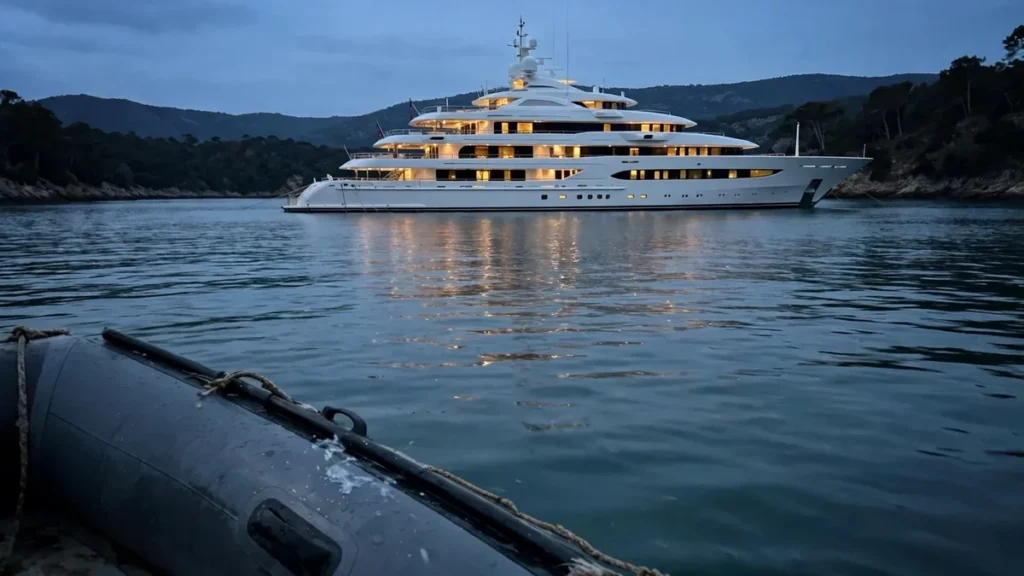
A superyacht at anchor on a still evening makes almost no sound. No diesel rumble, no exhaust haze, no vibration through the deck. The lights are on and the air conditioning is running, yet the engines are off. The yacht is running on its batteries, and it will keep doing so for hours. When it is time to leave, the diesel engines wake up and the yacht is underway at full speed. One vessel, two ways of moving, and a system that decides which to use. That is a hybrid superyacht.
A hybrid superyacht is a large yacht that combines a conventional diesel engine with electric motors and a battery bank, so it can run on diesel, on electricity, or on both at once. It is not a fully electric yacht, nor a conventional diesel yacht with a bigger battery. It is a deliberate combination, engineered so each power source does the job it does best.
Here is what a hybrid superyacht is, how its power system works, and why more large yachts are built this way.
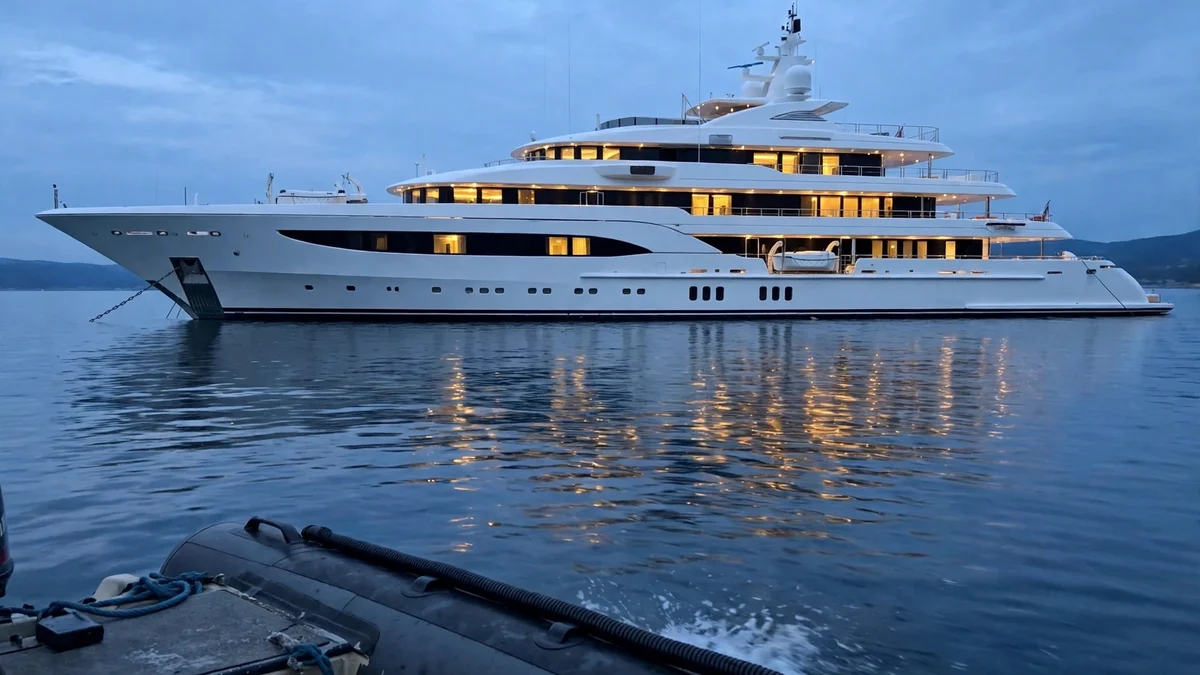
What Makes a Superyacht a Hybrid
1. Two power sources, one propeller shaft
At the heart of most hybrid superyachts is a simple idea: the propeller shaft can be driven by diesel, by an electric motor, or by both. In a parallel hybrid, the electric motor sits between the diesel engine and the gearbox, all on the same shaft. The captain can run on diesel alone for speed, on electric power alone for silence, or on both for maximum power. In a serial hybrid, the diesel engine never touches the shaft at all: it drives a generator that charges the batteries, and electric motors alone turn the propellers. The choice between diesel and electric power is one smaller yachts face too, and the diesel versus electric yacht propulsion comparison shows how the two systems trade range against silence.
2. The battery bank, the heart of the silence
The battery bank is what makes a hybrid superyacht quiet. Modern yachts use lithium-ion banks, often storing hundreds of kilowatt-hours, enough to run the yacht at low speed and power its hotel loads, air conditioning, lighting, galley and stabilisers, for several hours with the engines off. The batteries live in a dedicated, climate-controlled compartment, watched by a system that tracks every cell. They are heavy and expensive, but they buy something no diesel engine can: a yacht at anchor that makes no noise and no exhaust.
3. The electric motor, which is also a generator
The electric motor in a hybrid system does two jobs. Driven by the batteries, it turns the propeller and moves the yacht silently at six to nine knots, enough for harbour manoeuvres and short passages. When the diesel engine is running, the same motor works in reverse as a generator, spun by the engine through the shaft, recharging the batteries while the yacht is underway. This regeneration is one of the cleverest parts of a hybrid: the diesel runs at its most efficient load, some power goes to the propeller and some into the batteries, and nothing is wasted.
4. The power management system, the brain of the yacht
Deciding when to run on diesel, when to run on batteries, and when to charge is not left to the crew. A power management system watches the battery state of charge, the hotel loads, the speed the captain has asked for, and the fuel in the tanks, and switches modes automatically. It starts a generator when the batteries run low, stops it when they are full, and blends diesel and electric power for a burst of speed. On many yachts the crew sets a mode, silent, eco, or boost, and the system does the rest. The engineering behind it defines the best electric yachts, and the best electric yacht brands show how far that integration has come.
5. The hotel loads, where hybrids save the most fuel
A superyacht burns a surprising amount of fuel just sitting still. Air conditioning, refrigeration, lighting, water makers and stabilisers can demand hundreds of kilowatts, and on a conventional yacht that means a generator running all day and night. A hybrid runs those loads from its batteries instead, recharging them in short bursts from a generator, from shore power, or from solar panels. The result is fewer generator hours, less fuel burned, less noise, and less vibration above.
6. The cost, and why owners accept it
Hybrid propulsion costs more than conventional diesel. The batteries, motors, power electronics and extra engineering can add millions to a superyacht’s build cost, and the batteries need replacing after a decade. Owners accept it because a hybrid is quieter at anchor, cleaner in port, and cheaper to run, and because many ports now restrict noise and emissions. A hybrid also has redundancy: if a diesel engine fails, the electric motors can still move the yacht, and if the batteries run low, the diesels take over. That backup is worth a great deal far from the nearest shipyard.
Hybrid Superyacht Power, at a Glance
| Part of the system | What it does | Why it matters |
|---|---|---|
| Diesel engine | Drives the shaft or a generator | Long range and full speed |
| Electric motor | Drives the shaft, or generates power | Silent running, recharges batteries |
| Battery bank | Stores energy for propulsion and hotel loads | Hours of silent operation |
| Power management system | Chooses the power source automatically | Efficiency without crew input |
| Hotel load system | Runs services from the batteries | Fewer generator hours, less fuel |
| Regeneration | Turns engine power into charge | Wasted energy is recovered |
What Does a Hybrid Superyacht Cost?
A hybrid superyacht is one of the most expensive vessels to build, and the hybrid system is a large part of the premium. A large one can cost $50 million to well over $200 million depending on size and finish, with the hybrid package adding several million over a conventional diesel installation. The running costs tell a different story: owners report fuel savings of 20 to 30 percent over an equivalent diesel yacht, and the generators run far fewer hours, cutting maintenance too. The most powerful electric yachts show what batteries alone can do, and the most powerful electric yachts of 2027 rank the vessels pushing that technology furthest. A hybrid is the compromise that lets a yacht keep its range while gaining most of that silence.
A Rare Fact
Hybrid propulsion at sea is older than the hybrid car. Diesel-electric ships have sailed since the early twentieth century, and submarines have combined diesel engines and batteries for more than a hundred years, running on diesel on the surface and on batteries underwater. What is new is the batteries: modern lithium-ion cells store so much energy in so little weight that a superyacht can now cruise silently for hours, something the lead-acid batteries of a century ago could never do. The superyacht industry borrowed the idea from submarines, then added a hotel, a beach club, and a sun deck.


A hybrid superyacht is not a compromise made for marketing. It is built around a simple truth about how yachts are used: most of the time they move slowly, sit at anchor, or run their air conditioning, and only rarely need full speed. Diesel engines are good at the rare job and bad at the everyday one. Batteries are the opposite. Put them together, with a system smart enough to choose between them, and the yacht is quiet when it should be quiet, fast when it needs to be fast, and cheaper in between.