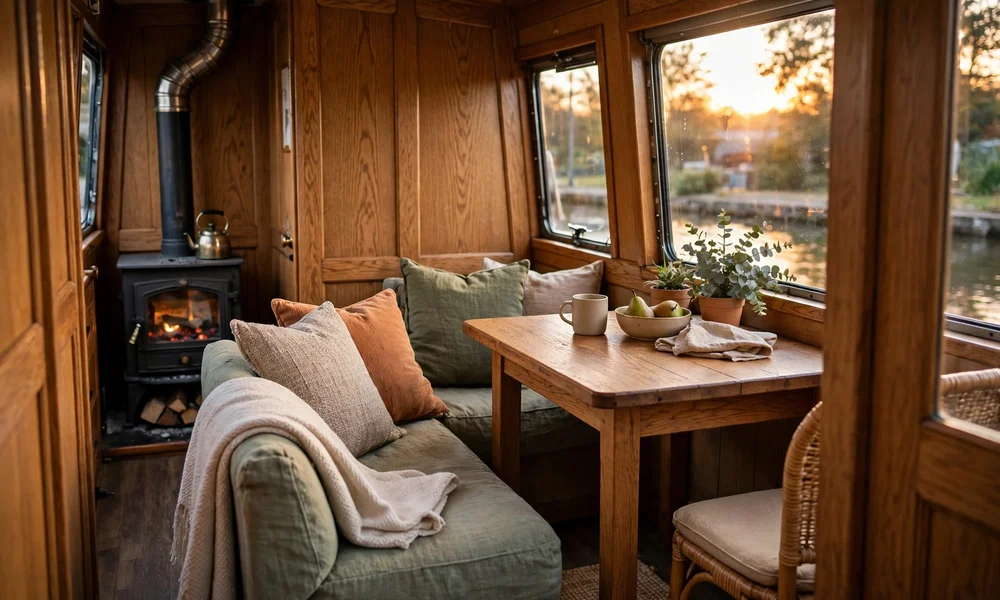
A luxury canal boat is a narrow, flat-bottomed boat built for slow travel on inland canals, fitted out to the standard of a small boutique hotel. In Britain, where most of them live, a canal boat is usually a narrowboat: a steel hull no wider than about 2.1 metres, or just under seven feet, so it can pass through the locks of the old canal network. The luxury part is what happens inside that long, thin tube. Instead of the basic bunks and a two-ring hob of a hire-boat, you get a proper double bed, a full bathroom with a shower, a fitted galley, solid wood, brass fittings, and often a wood-burning stove. The boat moves at walking pace, the scenery changes field by field, and the whole point is that you are in no hurry at all.
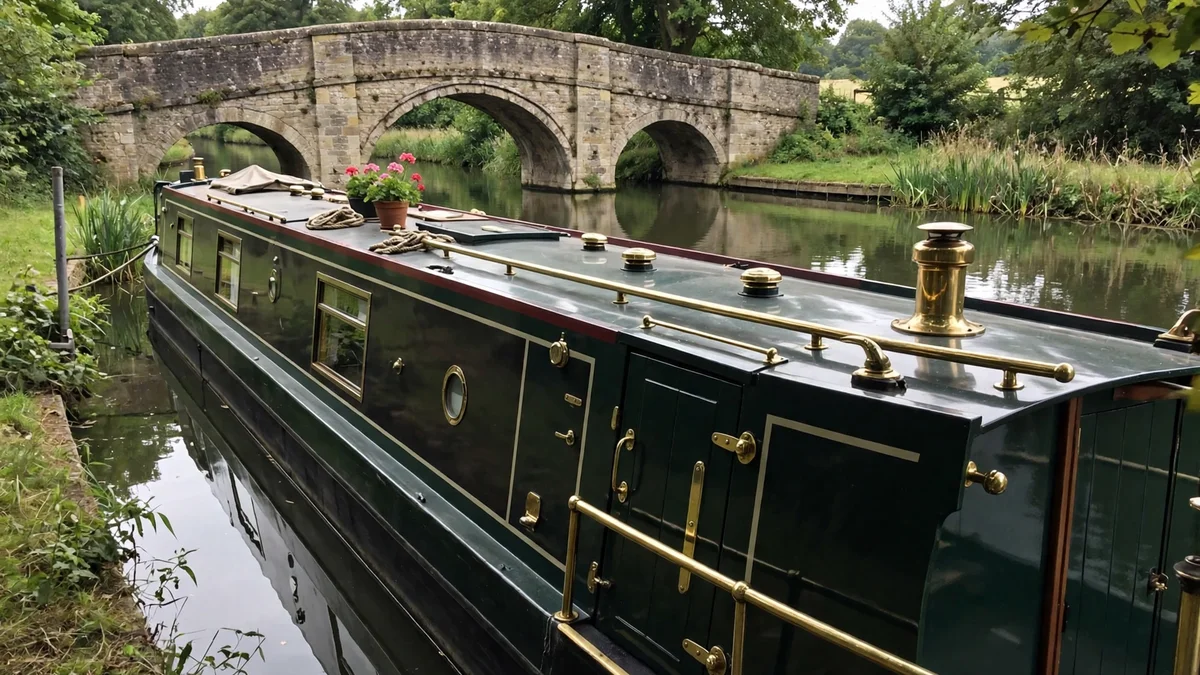
The canal network itself sets the rules. Britain’s canals were dug in the eighteenth and nineteenth centuries to carry coal, pottery, and grain, and their locks, bridges, and tunnels were built for boats of a fixed size. A full-length narrowboat is about 21 metres long, or around 70 feet, and that length is no accident: it is the longest boat that fits the shortest locks on the system. Some canals take wider boats, but the classic luxury canal boat is a narrowboat, and every part of its design is a negotiation with that 2.1-metre beam. The hull is steel, usually 10 millimetres thick at the base, and the cabin is a long, low box that keeps the boat under the lowest bridges. There is no wasted space, because there is no space to waste.
What makes it luxury
Luxury on a canal boat is not about size, because size is fixed by the canal. It is about finish, equipment, and the way the space is used. A high-end narrowboat will have oak or walnut joinery, a proper mattress rather than a foam slab, underfloor heating or a diesel-fired central heating system, a full-size fridge, a washing machine tucked under a counter, and a bathroom with a ceramic toilet and a shower you can actually stand up in. The galley often has a gas or induction hob, an oven, and solid worktops. Many boats carry a television, a sound system, and a mobile broadband router, because even slow travel benefits from a signal. The difference from a standard hire boat is the same as the difference between a budget hotel room and a suite: the same footprint, a different standard of everything in it.
How the boat is powered
Most luxury canal boats are powered by a diesel engine of about 30 to 50 horsepower, driving a single propeller through a gearbox. That sounds small, and it is, but a canal boat never needs to go faster than four miles per hour, which is the speed limit on most canals, and at that speed a small engine is plenty. The engine sits under the stern deck, and the exhaust runs up through the roof or out of the side. Fuel consumption is modest: a boat cruising for a few hours a day might use a few litres of diesel, and the main tank holds enough for weeks. The engine also charges the batteries and heats the water, so a day’s cruising fills the hot water tank for the evening shower.
Going through a lock
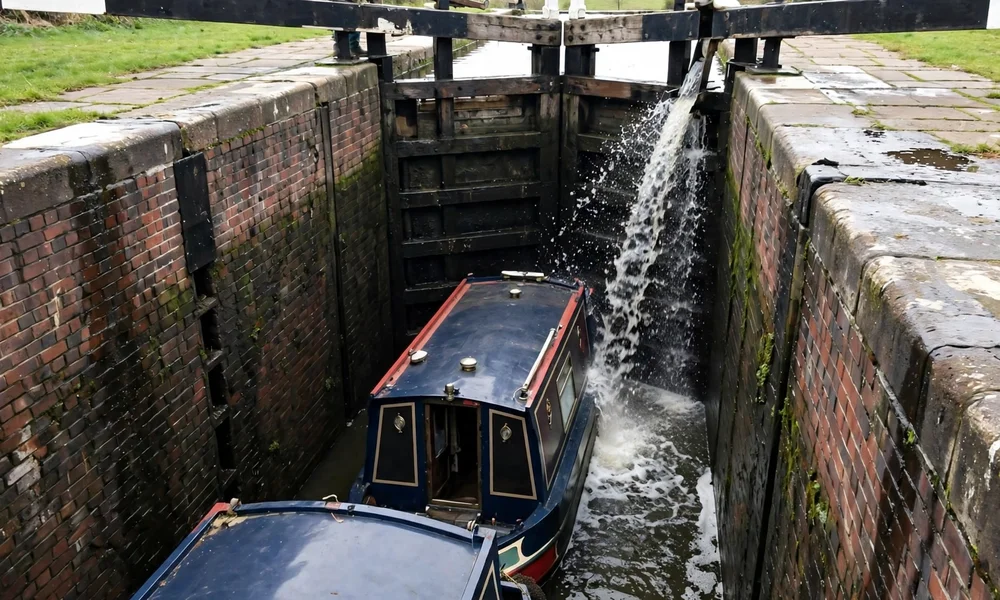
Locks are the heart of canal travel, and they are the part of the experience that surprises newcomers most. A lock is a brick or stone chamber with gates at each end, and it lifts or lowers the boat between two levels of water. To go up, you open the gates, steer in, close the gates behind you, and open the paddles, which are the sluice gates that let water in from the higher level. The boat rises slowly, sometimes by two or three metres, and when the water level matches the pound above, you open the top gates and cruise out. Going down is the same in reverse. A single lock takes about ten to fifteen minutes with a practised crew, and a flight of locks, where several locks climb a hill in a staircase, can take an hour or more.
Life aboard
Daily life on a luxury canal boat follows the rhythm of the water. You wake up, make coffee in a galley that is never more than a few steps from the bed, and decide how far to cruise that day. A typical day covers ten to fifteen miles, which takes four or five hours at canal speed, and you stop at a village pub, a farm shop, or a quiet mooring in the middle of nowhere. There is no timetable, and the boat’s water tank, fuel tank, and batteries set the real limits. Water comes from taps on the towpath, the toilet tank needs emptying every few days, and the batteries need charging. The luxury is in doing all of that in comfort: a hot shower at the end of the day, a proper meal cooked in a proper galley, and a bed that is actually comfortable.
What it costs
A new luxury narrowboat typically costs somewhere between 150,000 and 350,000 pounds, depending on length, builder, and specification, and the most elaborate bespoke boats can cost considerably more. A second-hand luxury boat in good condition might sell for half that. Hiring one is the usual way to try it: a week on a luxury narrowboat in the summer season costs roughly 1,500 to 3,000 pounds, depending on the boat and the route. The running costs are modest compared with a yacht: a canal licence, insurance, a mooring, and maintenance. A permanent mooring near a city can be expensive, but a continuous cruising licence, which requires the boat to keep moving, costs far less. The real cost is time, because canal travel is slow by design.
Compared with a houseboat, which is a broader subject in its own right, a canal boat is defined by the waterway it uses. A luxury houseboat can be wide, heavy, and largely stationary, built for living rather than travelling. A canal boat is a traveller: its whole shape exists so it can pass through locks, under bridges, and along a channel dug two centuries ago. That is the charm of it. The boat is a moving hotel room, the canal is the road, and the speed limit is a walking pace. If you want to go fast, buy a car. If you want to go slowly in comfort, a luxury canal boat is hard to beat.
Who it suits
Before choosing a boat, it helps to understand how the wider world of floating homes compares. The reasons a luxury barge costs so much overlap with canal boats: bespoke steelwork, hand-fitted interiors, and a small market of specialist builders. And for anyone weighing a canal boat against a static home on the water, how a luxury houseboat works explains the systems, from water and power to mooring rules, that the two kinds of boat share. The canal boat is the smaller, nimbler cousin: less space, more freedom, and a route that runs through the middle of the countryside at four miles an hour.