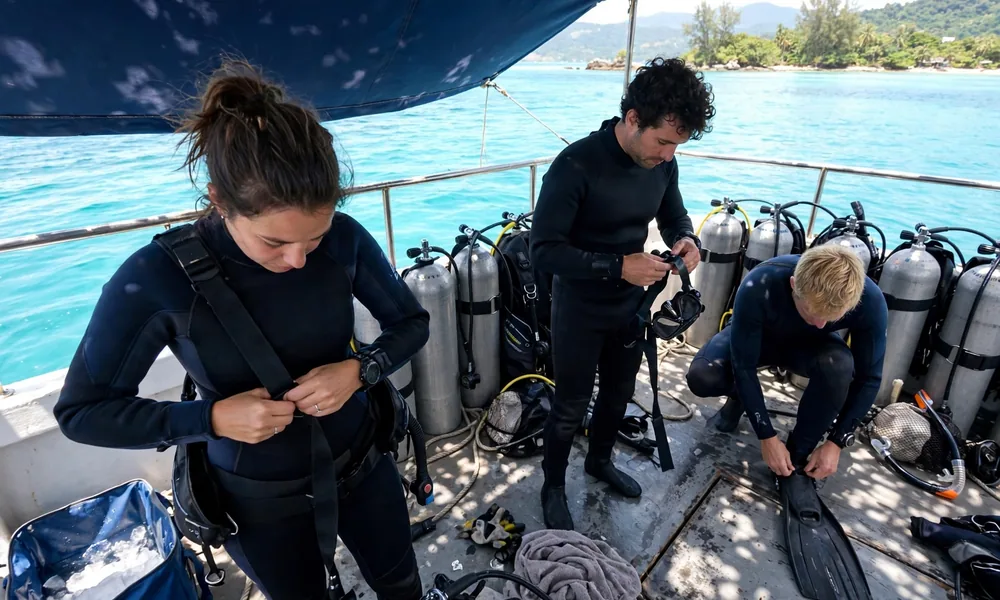
A luxury dive boat is a boat built around a single purpose: getting divers into the water, and getting them back out again, in comfort. Before the sun is properly up, tanks stand in neat rows on the aft deck, compressors hum below, and the divemaster is laying out fins, masks and weight belts with the practised calm of someone who has done this a thousand times.
What sets a luxury dive boat apart from a plain charter boat is not size alone. It is the completeness of the operation: a proper compressor room, a camera room, a shaded dive deck with room for every diver to kit up, cabins quiet enough to sleep in between dives, and a galley that serves real food to people who have burned a thousand calories before lunch. This guide explains what counts as one, how the two kinds differ, and who they are for.

Day boat or liveaboard: the two kinds
Luxury dive boats come in two kinds, and the difference is whether you sleep on board. A day boat leaves the harbour in the morning, runs out to the reef, does two or three dives, and brings everyone home by late afternoon. She carries tanks, a compressor, shade and a galley, but no cabins, and the day is built around the diving, not the living.
A liveaboard is a dive boat you live on. She carries cabins, a saloon, a full galley and a crew, and she stays out for days or a week at a time, moving between reefs while the divers eat, sleep and dive on a rhythm of three or four dives a day. The liveaboard is the fuller version of the idea: a floating hotel that happens to be a dive platform, and the one most people mean when they talk about a luxury dive boat.
The dive deck: where the boat earns her living
Everything on a dive boat starts with the dive deck, because that is where the boat earns her living. Luxury dive boats are usually built on wide, stable hulls, often catamarans, whose broad beam and shallow draught give a steady platform at anchor and a huge flat aft deck for diving operations. Stability matters more than speed here, because a rolling deck makes kitting up miserable and recovering divers dangerous.
On the deck itself, each diver gets a station: a bench to sit on, a tank rack behind it, and space for fins, mask and weights within reach. There is a rinse tank for cameras and masks, a freshwater shower for divers coming out of the sea, and a ladder or a platform that makes getting back on board easy even in a swell. The best decks are shaded, non-slip, and laid out so that nobody has to climb over anyone else’s gear.
Compressors, nitrox and the gas systems
Below deck, the machinery spaces keep the whole operation running. Twin engines drive the boat at a comfortable cruising speed, but the real workhorses are the generators, which power everything from the air compressors to the air conditioning, the watermaker and the galley. The compressors deserve a mention of their own: high-pressure machines that draw in ordinary air, filter it, dry it and squeeze it into tanks at over 200 bar, filling a diver’s tank in minutes.
On a luxury vessel the gas system goes well beyond plain compressed air. Many boats carry a nitrox system, which enriches the air with extra oxygen, letting divers stay down longer and surface with less nitrogen in their tissues. The nitrox is blended and analysed on board, every tank labelled with its oxygen percentage and maximum depth, and the divemaster checks each one before it goes on a diver’s back. How a luxury dive boat works explains the machinery and the gas systems step by step; the point here is that a luxury boat never leaves a diver waiting for air.
The camera room and the small details
Ask a serious diver what makes a dive boat luxurious and they will often mention the camera room first. Underwater photographers carry cameras worth more than the boat’s tender, and they need a dry, air-conditioned room with charging stations, a workbench, and rinse tanks for their housings. A boat with a proper camera room is a boat that takes its divers seriously.
The small details add up the same way: a shaded lounge for surface intervals, a sun deck for the afternoon, a library of fish identification books, and a crew that remembers how each diver likes their tank set up.
Cabins, food and life between dives
On a liveaboard, the cabins decide whether the trip is a holiday or an endurance test. Luxury boats offer proper cabins with real beds, air conditioning, an en-suite bathroom, and enough storage for a week of dive gear and clothes. The saloon is a comfortable lounge, not a corridor with chairs, and the dining area serves meals at a table, not on a lap on deck.
Food matters more on a dive boat than on any other kind of yacht, because diving burns energy fast. A good galley serves a big breakfast before the first dive, a hot lunch between dives, and a proper dinner in the evening, with snacks and fruit available all day. The crew plans the menu around the dive schedule, so that nobody is diving on a full stomach or going hungry between dives.

Finding the reef: navigation and safety
Finding the dive site is a science in itself. The bridge carries chart plotters, sonar and GPS, and the captain uses them to anchor over the reef with the precision the diving needs. The boat carries a tender, a small inflatable or rigid boat, for dropping divers on a drift dive and picking them up at the end, and for running to shore when the big boat cannot get close.
Safety runs through the whole operation. A luxury dive boat carries oxygen for first aid, a first aid kit built for diving injuries, a radio link to the nearest recompression chamber, and a crew trained in dive rescue. The divemaster briefs every dive, counts every diver in and out of the water, and keeps a log of depths and times. It is the least glamorous part of the boat, and the most important.
What it costs and who it is for
A luxury dive boat is not cheap, whether you are chartering one or booking a cabin on a liveaboard. A week on a good liveaboard costs several thousand pounds or dollars per person, and a private charter of a whole boat costs many times that.
It suits divers who want to dive a lot, in comfort, without thinking about tanks, boats or timetables. It suits photographers, who need the camera room and the unhurried schedule, and it suits groups of friends or families who want the boat to themselves. The closest alternatives are the expedition yacht, which trades diving for range, and what a luxury expedition catamaran is explains that long-range cousin. A hybrid yacht offers a different kind of quiet cruising altogether, and what a hybrid electric yacht is covers that option. But for a diver, there is no substitute for a boat built around the dive deck, and that is what a luxury dive boat is.