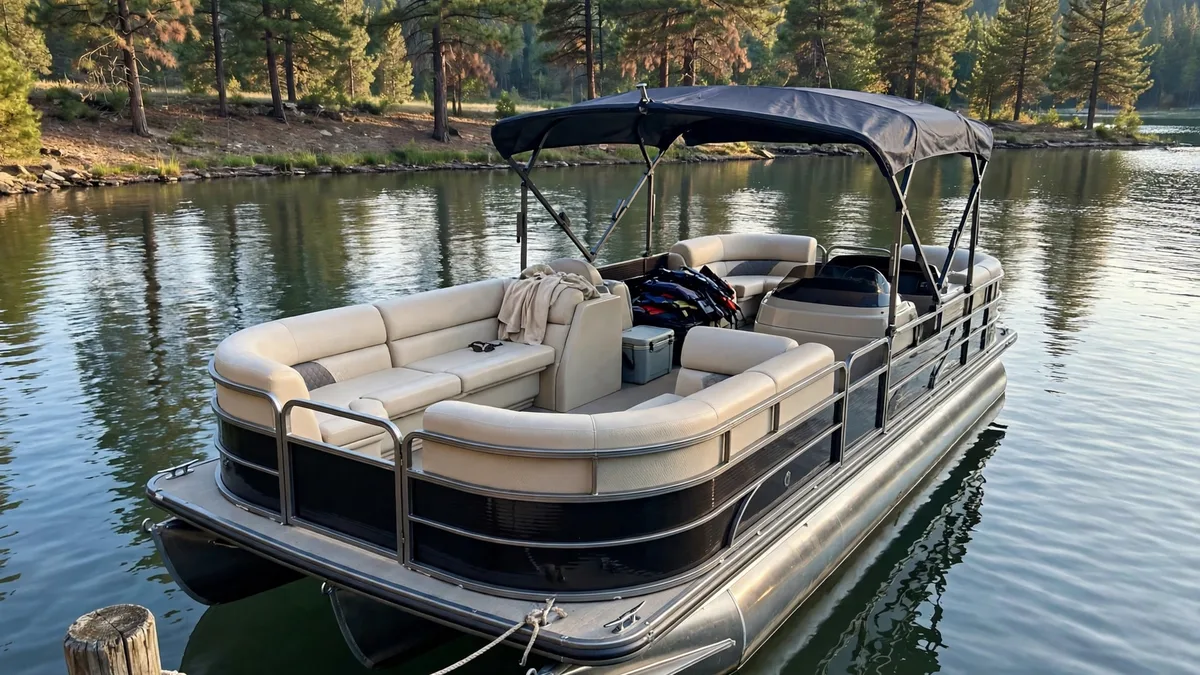
A luxury pontoon boat is a flat-decked boat carried on two or three aluminium tubes — the pontoons — and fitted out to the standard of a good living room. It has deep, comfortable seating, a shaded helm, a proper sound system, and often a small kitchen, a changing room and a sun pad. The luxury part is the difference between a basic pontoon boat, which is essentially a floating platform with benches, and one where every surface, seat and fitting has been chosen for comfort.
How the twin-hull design works
The pontoon boat’s secret is its platform. Two or three long aluminium tubes run the length of the boat, and the deck sits on top of them like a raft. Because the tubes are far apart, the boat is very stable: it does not roll the way a single-hull boat does, and it stays level when people move around on deck. That stability is the whole point. Passengers can stand, walk, carry food and drink, and step on and off without the boat tipping, which makes it ideal for families with children, older passengers, and anyone who is nervous on the water.
The deck is the other half of the design. Because the deck is flat and spans the full width between the tubes, the layout can be almost anything the maker wants: a lounge at the front, a helm in the middle, a sun pad at the back, or a bar, a grill and a changing room. There is no hull to work around, no engine room below, and no narrow cabin to squeeze through. The luxury pontoon boat’s specifications show how that freedom is used: the numbers that matter are deck length, seating capacity and engine size, not hull depth or draught, because the pontoon boat is a platform first and a boat second.
The luxury layout
Step aboard a luxury pontoon boat and the layout reads like a garden party. At the bow there is usually a pair of lounge seats, often facing forward so passengers can watch the water go by, with a table between them for drinks. Amidships is the helm, with a proper console, a steering wheel, gauges and a screen for the chartplotter and the sound system. Behind the helm there is often a bar or a galley unit, with a sink, a small fridge and sometimes a grill. At the stern there is a sun pad or a rear lounge, and a swim platform with a ladder for getting back aboard after a swim.
Engines and performance
Most luxury pontoon boats are powered by a single large outboard, mounted on the transom at the stern. The engine size depends on the boat: a two-tube boat might carry 115 to 150 horsepower, while a three-tube boat can carry 250 horsepower or more. The outboard is chosen for quiet running and easy maintenance, and it is usually a four-stroke, which is cleaner and quieter than the two-stroke engines of the past. The helm controls are simple — a throttle, a steering wheel, and a few switches — and the boat is easy to drive, which is part of its appeal to owners who are new to boating.
Fuel use is reasonable for the size of the boat, because the hull is light and the engine is only working hard when the boat is planing. At cruising speed, a large pontoon boat might use a few litres of fuel per hour per person on board — an estimate, since the real figure depends on the engine, the load and the speed. The solar-powered catamaran shows a different answer to the same question, using sun and batteries instead of petrol, but the pontoon boat’s answer is simpler: a light platform, a modern outboard, and a speed that does not ask much of either.
Pontoon boat or houseboat?
The pontoon boat is often confused with the houseboat, and the confusion is understandable: both are flat-decked, both are stable, and both are fitted out for comfort. The difference is what they are for. A pontoon boat is a day boat: it has seating, a helm and an engine, and it goes back to a trailer or a slip at the end of the day. A houseboat is a home: it has bedrooms, a kitchen, a bathroom and the tanks and batteries to live aboard for weeks. A pontoon boat has no bedrooms, no proper kitchen, and no holding tank, because it does not need them. It is built for a day, not a season.
The test is the same one that separates the two in practice. Could you sleep on it, cook a proper meal on it, and live on it through a week of bad weather? A luxury pontoon boat will fail that test gracefully — it is not trying to pass it. Its test is different: can ten people spend a comfortable afternoon on it, swim from it, eat on it, and get home without anyone feeling cramped or seasick? That is the test it is built to pass, and it passes it better than almost any other boat of its size. The luxury chase boat and how it works is the opposite kind of craft — a fast, narrow boat built to keep up with a yacht — and the contrast shows how specialised boats have become: the pontoon boat is for the afternoon, the chase boat is for the chase.
What to look for when buying
Buying a luxury pontoon boat starts with the tubes. Three tubes are better than two if the budget allows: the boat will be faster, more stable, and able to carry a bigger engine. The deck length matters too, because it sets the seating capacity, and the layout matters more than the length: a well-laid-out 22-foot boat can feel roomier than a poorly laid-out 25-foot one. Check the upholstery, the flooring and the canopy, because those are the parts that wear first, and check the storage, because a boat that cannot hold life jackets, towels and a cool box is a boat that will feel cluttered by noon.

Costs and keeping it
A luxury pontoon boat costs far less than a yacht of the same length, and that is a large part of its appeal. A new luxury model typically costs in the tens of thousands rather than the hundreds, and a well-kept used one holds its value reasonably well, because the design changes slowly and the tubes last a long time. Running costs are modest: fuel, insurance, a mooring or a trailer, and the occasional replacement of upholstery or carpet. The aluminium tubes need little maintenance beyond a wash and an inspection, and the outboard is serviced like any other.
Who it is for
A luxury pontoon boat is for the family or the group of friends who want a day on the water without the complications of a yacht. It suits people who swim, who picnic, who watch the sunset from the deck, and who want to bring the children and the grandparents along. It does not suit the sailor who wants speed, the fisherman who wants to go offshore, or the owner who wants to sleep aboard. It is a social boat, and it is happiest with a full deck, a cool box, and nowhere in particular to be.


