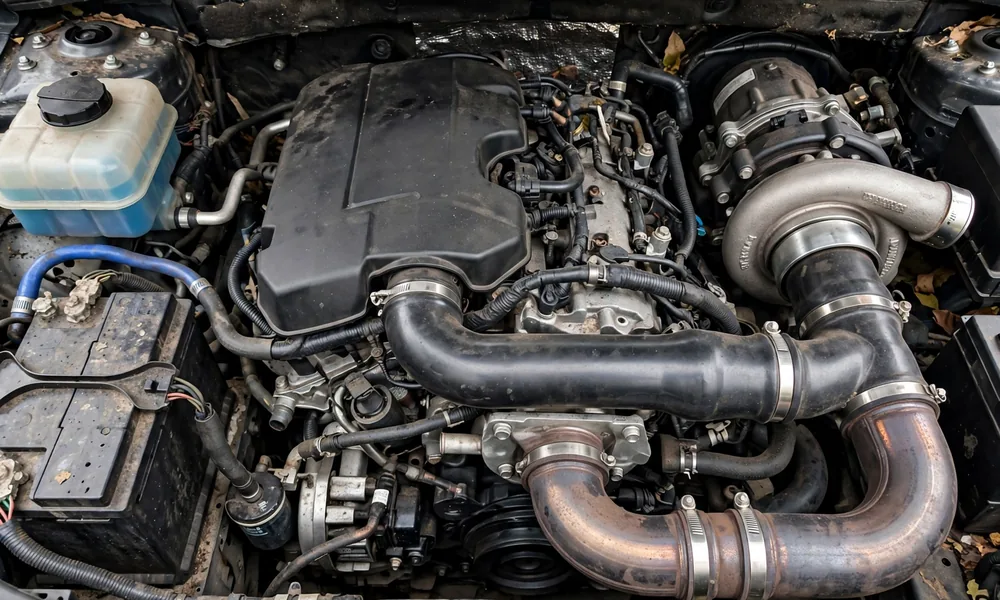
A turbocharger has always faced an impossible choice. Make it small and it spools up instantly — but at high revs it chokes, strangling the engine it was meant to help. Make it big and it flows huge volumes of air at the top end, but at low revs it barely turns, leaving a dead pause before the power arrives. That pause is turbo lag, and for fifty years it was the price of forced induction. A variable geometry turbocharger, or VGT, refuses to choose: it changes its own size while you drive, acting small when the engine is slow and large when the engine is fast.
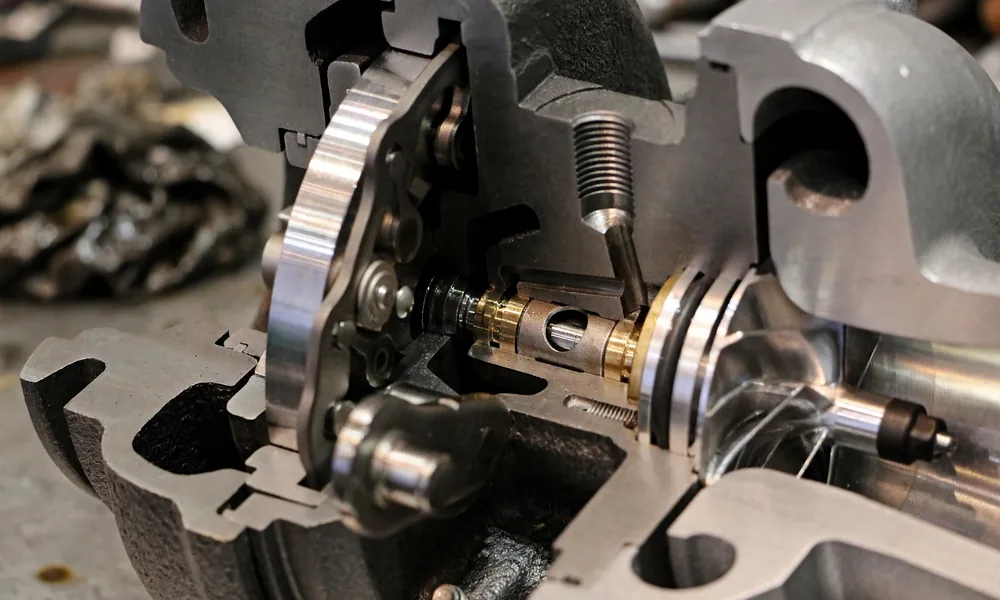
The trick is a ring of movable vanes inside the turbine housing, between the exhaust inlet and the turbine wheel. Those vanes are the whole technology: by pivoting them, the turbo changes the angle and speed at which exhaust gas strikes the turbine, and with it the effective size of the whole machine. Everything else in a VGT — the actuator, the sensors, the control software — exists to put those vanes in the right place at the right moment.

How the vanes change the turbo’s size
At low engine speed there is little exhaust gas to work with, so the vanes pivot nearly closed. The narrow gaps between them act like a nozzle: the same small volume of gas forced through a smaller area accelerates to a much higher speed before it hits the turbine blades — the thumb-over-the-garden-hose effect. The fast gas spins the turbine up quickly, the compressor builds boost where a fixed turbo would still be asleep, and the car pulls hard from barely above idle.
As revs climb and exhaust volume grows, the vanes open progressively. The passage widens, gas flows through without restriction, and the turbo behaves like a large fixed-geometry unit, supporting high power without choking the engine or building dangerous back pressure. The transition is continuous and fast: the engine computer reads boost pressure, exhaust temperature, throttle position, and engine speed, commanding the actuator to reposition the vanes dozens of times a second. A VGT therefore holds its turbine near its ideal point across the whole rev range — minimal lag, a low boost threshold, and high efficiency at high speed all at once.
The actuator is the muscle of the system. Early VGTs used vacuum or pneumatic actuators; modern units use electric servos for speed and precision, and heavy-duty engines sometimes use hydraulic actuators fed by engine oil. Whatever the drive, the loop is the same: sensors report, the ECU decides, the actuator moves the vanes, and the boost pressure reports back. The way a hypercar turbocharger works shows the fixed-geometry baseline — same turbine and compressor, with the geometry frozen in place.
The three designs
Most VGTs you will meet are variable-nozzle turbines, or VNTs: a ring of vanes pivoting in unison around the turbine wheel, each rotating on its own pin. It is the design in almost every modern turbodiesel car, from a Volkswagen Golf to a BMW, and it offers the highest flow rates and peak efficiency of the three. The rotating-vane VGT was developed under Garrett and patented in 1953, but it took decades of materials and control engineering before it was cheap and reliable enough for mass production.
Heavy-duty engines more often use sliding-wall turbines: the vanes do not rotate, and instead the effective width of the turbine passage changes, usually by sliding the turbine axially so the vanes retract partly into the housing. Fewer moving parts sit in the hot gas stream, which suits a truck engine running at full load for hours. The third design, the variable-flow turbine, uses a two-volute housing with a blend gate: at low flow the exhaust goes through one volute only, at high flow the gate opens the second. It is simpler and cheaper than a vane ring, for applications where cost matters more than ultimate precision.
| Variable-nozzle (VNT) | Sliding wall | Variable flow | |
|---|---|---|---|
| How it varies | Vanes pivot in unison | Passage width slides | Gate opens second volute |
| Common use | Diesel cars, light commercial | Heavy trucks, industrial | Cost-sensitive applications |
| Peak efficiency | Highest | High | Good |
| Moving parts in gas stream | Many, small | Few | One gate |
Why diesels got it first
VGTs dominate the diesel world: nearly every modern turbodiesel car, pickup, and truck uses one, from the 6.7-litre Cummins in Ram heavy-duty trucks to almost every European diesel car. The reason is temperature — diesel exhaust runs cooler than petrol exhaust, and that matters because the vanes, pins, and linkages all live inside the hot gas stream. Cooler gas means the mechanism survives, materials stay cheaper, and vanes are less likely to seize.
Petrol engines took far longer: their exhaust gas can exceed 950 degrees Celsius, hot enough to destroy the alloys and lubrication of a vane mechanism, and only high-temperature nickel alloys and better cooling made petrol VGTs viable — Porsche’s 911 Turbo was the first production petrol car to use one, in 2006. Even today a petrol VGT is exotic and expensive, while a diesel VGT is ordinary hardware. The twin-scroll turbocharger is the cheaper answer to the same problem on petrol engines: instead of moving vanes, it separates exhaust pulses from different cylinders into two scrolls, so the turbine sees cleaner, stronger pulses at low speed.
What goes wrong
The VGT’s weakness is its strength: moving parts in an exhaust stream. Soot and carbon build up on the vanes, especially on diesels with exhaust gas recirculation, and the vanes can stick or seize. A stuck vane usually means no boost at low revs or overboost at high revs, and the engine computer will throw a fault and cut power to protect itself. Actuators fail too — servos burn out, vacuum lines leak, linkages wear — and because the system is software-controlled, a sensor fault can look exactly like a mechanical one. Diagnosis starts with checking whether the vanes move freely and the actuator responds, before anyone orders a new turbo.
When a VGT works, though, it also does jobs a fixed turbo cannot. Because the vanes can close down to restrict exhaust flow, a VGT can create the back pressure needed for exhaust gas recirculation without a separate valve, and on a diesel it can act as an exhaust brake, holding a loaded truck back on a long descent. Those side benefits are part of why truck makers adopted the technology so completely. The specs of a hypercar turbocharger show what the fixed-geometry alternative has to give up to match it: bigger turbos, more lag, and anti-lag systems to cover the gap.
The VGT’s real achievement is not a number on a specification sheet; it is the end of the compromise that defined turbocharging for half a century. A turbo no longer has to be chosen for one part of the rev range and tolerated everywhere else — it can be small when the engine needs small and large when the engine needs large, switching faster than the driver can notice. That is why the technology spread from a 1953 patent to nearly every diesel on the road, and why the turbo lag that once defined driving a turbocharged car is now something younger drivers have barely felt.