Turbochargers have a reputation problem. Ask a driver about them and you will hear two stories at once: the rush of extra power when the turbo wakes up, and the frustrating pause before it does, when you press the throttle and nothing much happens for a second. That pause has a name, turbo lag, and for decades it was simply accepted as the price of free power. Engineers tried many ways to shrink it, and one of the cleverest is also one of the simplest.
Instead of giving the turbocharger one exhaust pipe to work with, give it two. Keep the exhaust pulses from different cylinders separate, so they arrive at the turbo in clean, strong bursts instead of tripping over each other. That is the twin-scroll turbocharger, and it is now one of the most common ways to make a small engine feel like a much bigger one.
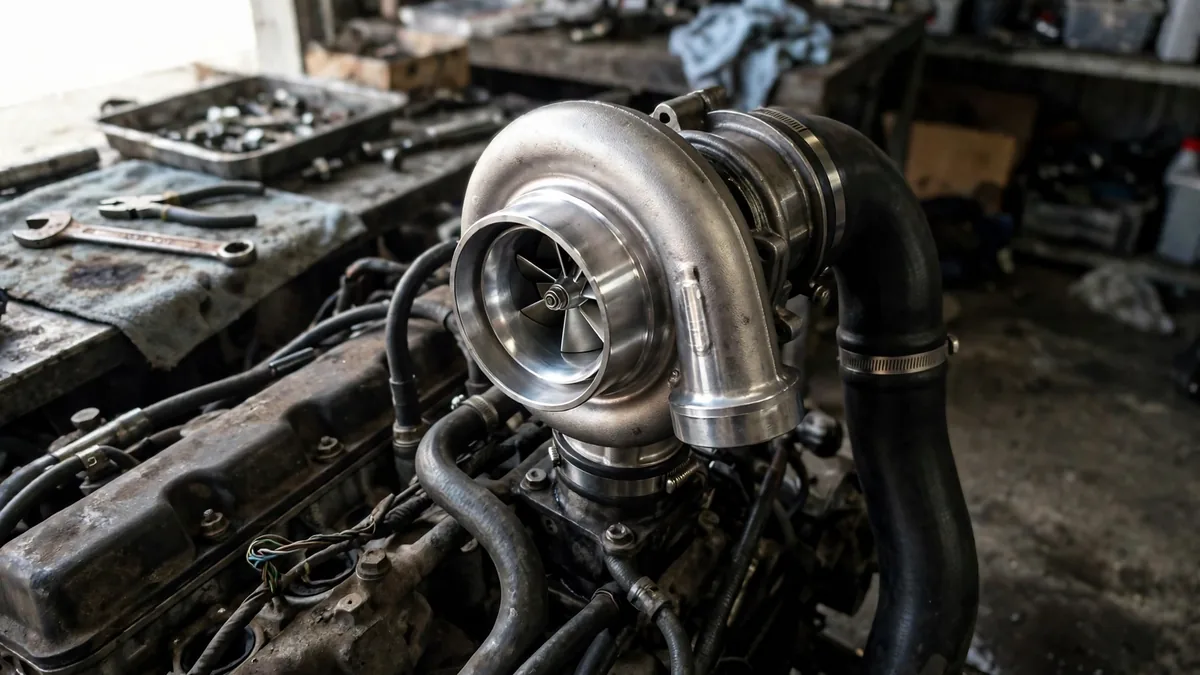
What a Twin-Scroll Turbocharger Is
A normal turbocharger is powered by the engine’s exhaust. Hot gas leaving the cylinders spins a turbine, and that turbine drives a compressor that forces more air into the engine. More air means more fuel can be burned, and more fuel burned means more power.
In a conventional single-scroll turbo, all the cylinders feed into one exhaust manifold and one turbine inlet. The problem is that the cylinders do not fire one at a time in a tidy sequence; their exhaust pulses overlap, and a pulse from one cylinder can push back against the exhaust valve of another cylinder that is still trying to empty itself. That interference weakens the pulses and slows the turbine down, which is part of why the turbo takes time to wake up.
A twin-scroll turbocharger splits the difference. The exhaust manifold is divided into two separate passages, or scrolls, and each one feeds its own half of the turbine housing. Cylinders whose firing order would interfere with each other are placed in different scrolls, so each scroll receives clean, evenly spaced pulses. The turbine gets a steadier, stronger push, and it spins up faster.
How the Two Scrolls Work Together
The pairing of the cylinders is the clever part. In a four-cylinder engine, for example, cylinders one and four might feed one scroll while cylinders two and three feed the other, because those pairs fire far enough apart that their pulses never collide. The turbine housing itself is divided by a wall down the middle, so the two streams stay separate right up to the turbine wheel.
Because each pulse arrives without interference, it hits the turbine with more energy. The turbine spins up sooner, which means the compressor starts forcing air into the engine at lower revs. The driver feels that as less lag: press the throttle at low speed and the power arrives sooner, more smoothly, and with less of the sudden surge that old turbos were famous for.
Why It Matters More Than It Sounds
Turbo lag is not just an annoyance; it changes how a car feels to drive. A car with a lazy turbo can feel hesitant at junctions, slow to respond when overtaking, and unpredictable when the power finally arrives in a rush. A car with a responsive turbo feels alert and willing, closer to a larger naturally aspirated engine. The twin-scroll design closes much of that gap, and it does so without adding much cost or complexity. The numbers behind that efficiency are part of the wider story of modern turbocharging, and our guide to hypercar turbocharger specs explained shows what happens when the same ideas are pushed to their absolute limit.
That balance is why twin-scroll turbos have become so common. A manufacturer can fit a small, efficient engine in a car, add a twin-scroll turbo, and get the power of a bigger engine with the fuel consumption of a smaller one. It is one of the main reasons modern cars can be both quicker and more economical than their predecessors, and it is why even ordinary family cars now have turbochargers that would once have belonged only on sports cars.

Variations on the Idea
Twin-scroll is not the only way to make a turbo respond faster, but the twin-scroll design sits in a sweet spot. It needs a divided manifold and a divided turbine housing, but it uses a single turbo, a single compressor, and no moving vanes or second turbo to control. That simplicity is why it appears on so many production cars: it delivers most of the benefit of more complicated systems for a fraction of the price. Some manufacturers even combine ideas, pairing a twin-scroll turbo with variable valve timing or an electric compressor to cover the last remaining bit of lag. The high-revving engines that benefit most from clean exhaust flow are covered in our look at how a hypercar V12 engine works, where breathing and exhaust flow are treated as seriously as power itself.
There are limits, though. The divided manifold is more complex to cast and package than a simple one, and the cylinder pairing has to be worked out for each engine, which means the design cannot simply be copied from one engine to another. The exhaust system that feeds the turbo matters enormously here, and our look at inside a titanium exhaust system’s production shows how much engineering goes into getting hot gas from the engine to where it needs to be.
Where You Find It
You will find twin-scroll turbochargers across the modern car market, from small hatchbacks to luxury saloons and sports cars. BMW popularised the design under its TwinPower name, but the idea is now used by almost every major manufacturer, and it is a key part of how small turbocharged engines replaced larger ones over the last fifteen years. If your car has a small petrol engine that feels surprisingly strong, there is a good chance a twin-scroll turbo is doing much of the work.
It also appears in performance cars, where the faster response matters most, and in diesel engines, where the exhaust pulses are strong and the twin-scroll layout helps the turbo work efficiently across a wide range of speeds. In both cases the principle is identical: keep the pulses separate, keep them strong, and let the turbine do its job sooner.

The Simple Version
A twin-scroll turbocharger is a turbo with its exhaust inlet split in two, so that cylinders which would interfere with each other feed separate passages. The clean, evenly spaced pulses spin the turbine up faster, which means less turbo lag, better response at low revs, and cleaner breathing at high revs, all from a single turbocharger with no extra moving parts.
It is a good example of how the best engineering ideas are often about organisation rather than power. Nobody added a bigger turbo or a stronger engine; somebody simply stopped the exhaust pulses from getting in each other’s way. The result is an engine that feels bigger than it is, responds faster than it should, and uses less fuel doing it, which is why the twin-scroll turbo has quietly become one of the most important parts of the modern car.