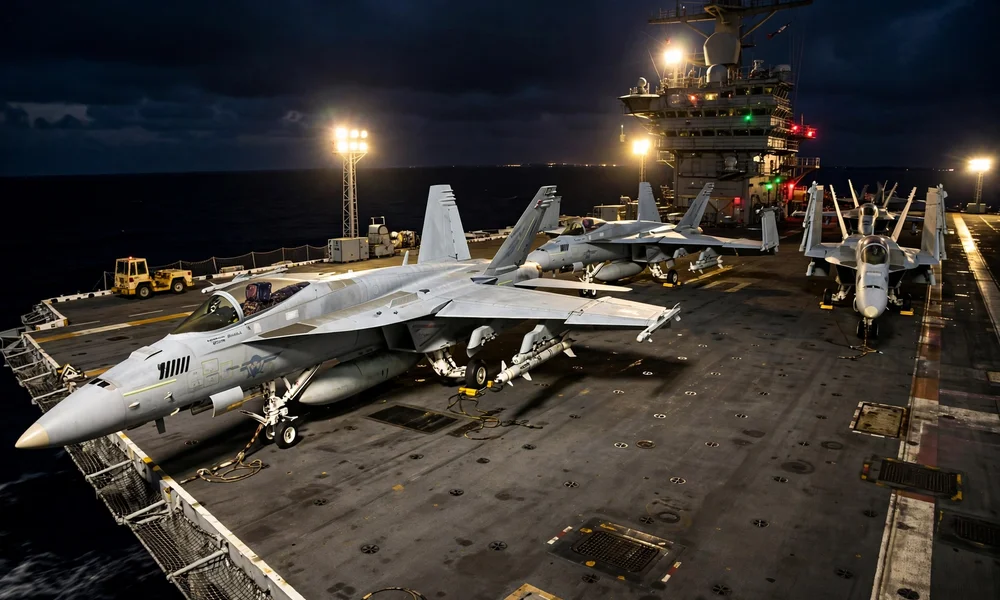
Stand on the flight deck of an aircraft carrier and the first thing you notice is the noise. Jets scream past at full power, arresting wires hum, and the deck itself vibrates under your boots. The second thing you notice is the size: a runway longer than three football fields, floating on the ocean, moving at thirty knots, with nowhere to go if anything goes wrong. This deck is the most expensive piece of flat surface ever built, and almost none of its cost is visible from above.
An aircraft carrier’s flight deck looks like an airport runway that happens to be at sea. In truth it is a precision machine, armoured against jet blast, wired with catapults and arresting gear, and coated with a surface that grips aircraft tyres in rain and salt spray. Building it is one of the hardest engineering jobs in the world, and the price reflects every tonne of steel, every metre of cable and every hour of testing behind it.

Why It Costs So Much
A flight deck must do what no runway on land ever does: launch and recover jets from a moving, rolling, pitching ship, in weather that would close a normal airport, and keep doing it for fifty years. Every system on the deck exists because a jet at sea is unforgiving of mistakes.
Reason 1: The deck is armour, not tarmac
Unlike a land runway, a carrier deck is made of thick steel plate, armoured against the heat and blast of jet exhaust and against the impact of a landing aircraft. The steel must resist corrosion from constant salt spray, support the weight of parked jets, and flex with the ship without cracking. Its non-skid coating must survive jet blast temperatures that would melt ordinary paint, and it is reapplied regularly. The hull beneath it is built like the largest ships afloat, and modular ship construction shows how such giants are assembled piece by piece.
Reason 2: Catapults launch jets like slingshots
A carrier deck is too short for a jet to take off under its own power, so catapults do the work. Modern American carriers use electromagnetic catapults, which accelerate a 30-tonne aircraft to flying speed in about ninety metres using linear motors and enormous bursts of electrical energy. The system needs power generation, energy storage and cooling on a scale no other ship carries, and it must launch aircraft every few seconds without a fault. A catapult failure at the wrong moment can cost an aircraft and its crew.
Reason 3: Arresting wires catch a controlled crash
Landing on a carrier is often described as a controlled crash, and the arresting gear is what makes it survivable. A jet snags one of several steel cables stretched across the deck with its tail hook, and hydraulic engines below deck absorb the energy, stopping the aircraft in about a hundred metres. Each cable and its machinery must withstand forces that would tear a normal structure apart, and the wires are replaced after a set number of landings. The precision and violence of the system have more in common with a pressure hull than a runway: both must survive forces that would destroy ordinary engineering, as the pressure hull that keeps a submarine alive demonstrates.
Reason 4: The island and the angled deck
Modern carriers use an angled flight deck, set about nine degrees off the ship’s centreline, so that a jet that misses the wires can fly off the end and try again instead of crashing into parked aircraft. That angle, the island superstructure with its radar and bridge, and the elevators that lift jets from the hangar below are all part of the deck system, designed together so that launching, landing and parking can happen at the same time. Fitting it all onto a deck a few dozen metres wide is a problem in choreography as much as in steel.
Reason 5: Jet blast deflectors take the fire
Behind each catapult sits a jet blast deflector, a steel panel that rises from the deck to shield the crew and aircraft behind from the exhaust of a jet at full power. The deflector must survive temperatures of hundreds of degrees, cooled by water piped through it, and it must rise and fall in seconds between launches. It is a machine in its own right, rebuilt many times over the life of the ship.
Reason 6: The hangar below is part of the deck
The flight deck sits on top of a hangar deck, where aircraft are maintained, armed and stored, connected by elevators big enough to lift a fighter jet. Those elevators are hydraulic platforms the size of a house, built into the side of the ship, and they must work in all weather while the ship rolls. The hangar needs fire suppression, ventilation and fuel systems that keep dozens of armed aircraft safe below deck. The whole ship is a floating airbase, and the deck is only its roof.
Reason 7: Fifty years of punishment, designed in
A carrier is expected to serve for half a century, and its flight deck must survive tens of thousands of launches and landings, salt, storms and the occasional accident. Every part is designed to be inspected, repaired and replaced at sea. The steel, the coatings, the catapults and the arresting gear are all built with a service life measured in decades, and the testing that proves they will last is priced into the build. Even the materials are extreme: the pressure sphere of a deep-diving submersible, built from titanium to survive crushing depth, shows the same philosophy in a different ocean, as Alvin’s titanium pressure sphere explains.

Specifications
| Specification | Detail |
|---|---|
| Deck length | About 330 metres on a large carrier |
| Deck width | About 78 metres at its widest |
| Deck material | Armoured steel plate with non-skid coating |
| Catapults | Electromagnetic or steam, launching jets in about 90 metres |
| Arresting gear | Steel cables and hydraulic engines, stopping jets in about 100 metres |
| Angled deck | About 9 degrees off the centreline |
| Aircraft capacity | Typically 60 to 90 aircraft |
| Service life | Designed for about 50 years |
Price
The newest American carrier, USS Gerald R. Ford, cost about $13 billion (reported), and the flight deck system — catapults, arresting gear, deflectors, elevators and the armoured deck itself — accounts for a large share of that figure, estimated in the billions of dollars (estimate). The electromagnetic catapult system alone cost hundreds of millions of dollars to develop. No other ship carries anything like it: a floating runway that launches and recovers jets in all weather, for fifty years, has no cheap version.
Rare Fact
A jet landing on a carrier touches down at around 240 kilometres per hour and stops in about two seconds, experiencing forces greater than those in a car crash — and the pilot does it by aiming at a moving deck that may be rising and falling several metres in a swell. The arresting wire that catches the jet is only a few centimetres thick, yet it stops an aircraft weighing more than thirty tonnes.
That is why an aircraft carrier flight deck costs so much: it is not a runway but a machine for throwing jets into the sky and catching them again, built from armour plate, powered by systems that exist nowhere else, and expected to work flawlessly in the middle of an ocean for half a century. Stand on it and you are standing on the most expensive flat surface humans have ever made.


