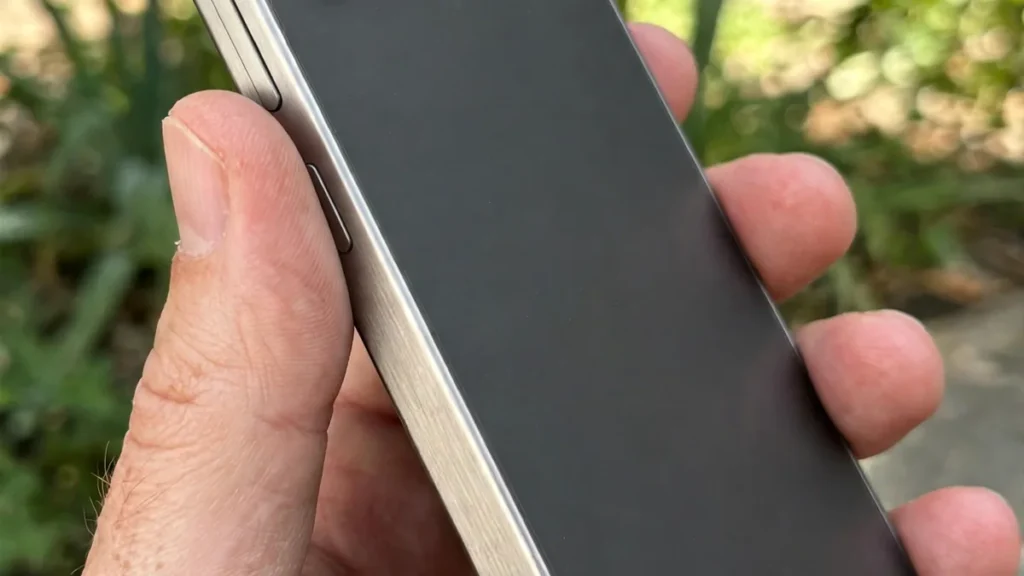
Pick up a flagship phone and the first thing your fingers meet is not glass or plastic, but a band of cool, brushed metal running around the edge. For the most expensive phones, that band is now titanium — a metal borrowed from jet engines and spacecraft, shrunk down to fit in your pocket.
Titanium was an unlikely choice for a phone. It is harder to machine than aluminium, harder to colour, and far more expensive. Phone makers chose it anyway because it solves a problem aluminium could not: it is far stronger for its weight, so a thinner, lighter frame can be just as tough as a thicker aluminium one, and it resists scratches and dents that would mark softer metals.
The Materials Behind the Smartphone Titanium Frame
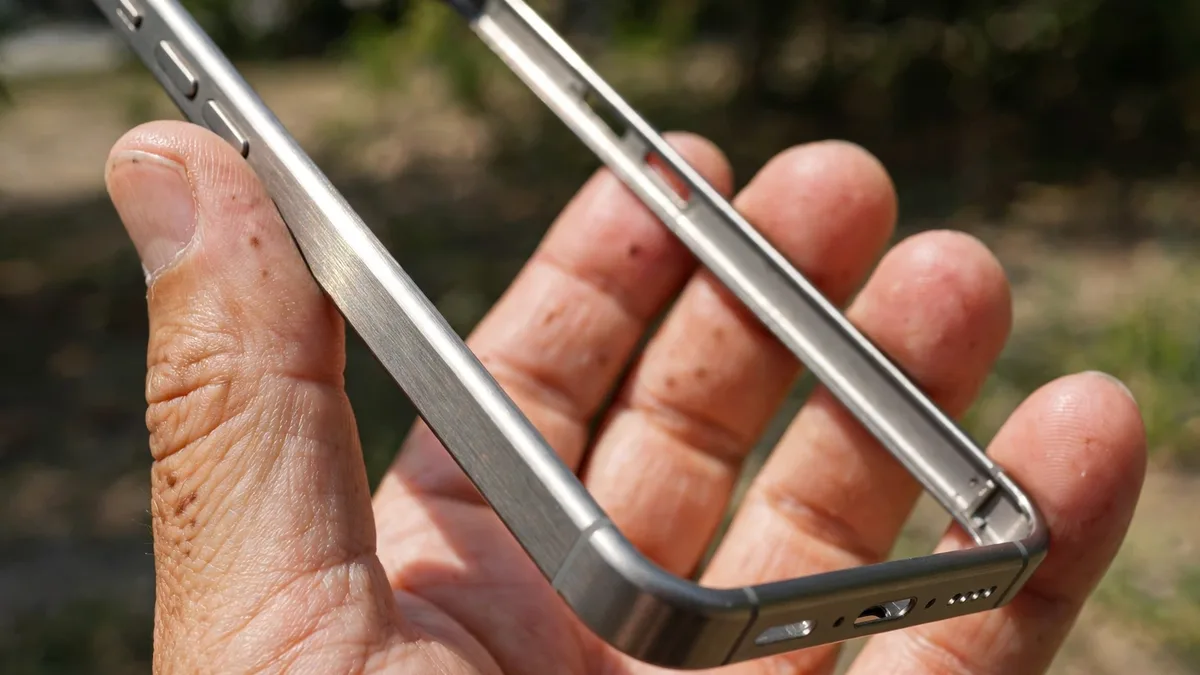
The frame of a flagship phone is typically made from Grade 5 titanium, an alloy of titanium with aluminium and vanadium, known in industry as Ti-6Al-4V. It is the same alloy used in aircraft landing gear and medical implants, chosen because it is roughly twice as strong as pure titanium while remaining light and corrosion-proof. Around it sit the other materials of the phone: glass front and back, aluminium for the internal chassis in many designs, stainless steel for the buttons, and adhesives and gaskets that seal the whole assembly against dust and water.
Step 1: Choosing titanium over aluminium
Aluminium served phones well for a decade, but it has limits: it dents, it scratches, and to make a frame strong enough designers had to make it thick. Titanium is about 60 percent denser than aluminium but roughly twice as strong, so a slimmer frame can be just as rigid — and it barely scratches, which matters for a device carried bare in a pocket full of keys. Phone makers accept the cost because the frame is the part the customer touches every minute of the day.
Step 2: Forging and machining the band
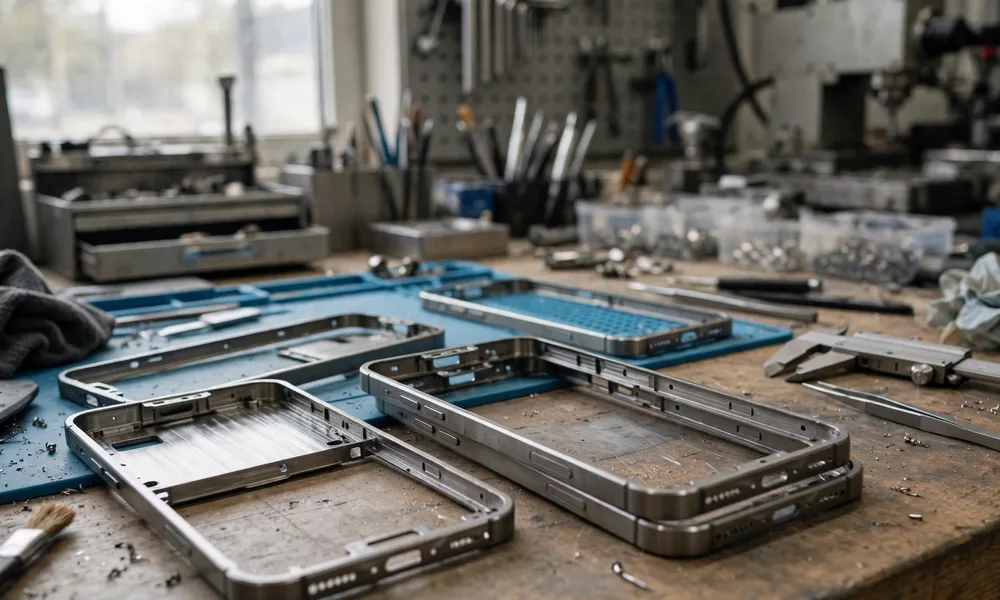
A titanium frame usually starts as a forged or extruded billet, shaped roughly to the phone’s outline, then machined to its final form. Computer-controlled mills cut the band to tolerances of a few hundredths of a millimetre, carving out the antenna breaks — the thin plastic-filled gaps that let radio signals escape the metal cage — and the recesses for buttons, speakers and the charging port. Each frame spends far longer on the mill than an aluminium one would, and the cutting tools wear out faster, which is why a titanium phone costs more to build than its aluminium predecessor. The titanium frame only exists because factories were willing to slow down for it.
Step 3: Brushing, blasting and colouring the metal
Raw titanium is a dull grey, so the frame’s finish is a material in itself. Makers brush it for a fine linear texture, bead-blast it for a soft matte, or polish the edges to a shine. Colour is the hard part: titanium does not anodise into bright colours the way aluminium does, so makers use physical vapour deposition — coating the metal with a microscopically thin layer of coloured material in a vacuum chamber — or careful heat treatments that tint the surface.
Step 4: Bonding the frame to glass and aluminium
A phone frame is rarely solid titanium all the way through. In many designs the titanium is a thin outer band bonded to an aluminium inner chassis, because aluminium is easier to shape into the complex internal structure and transfers heat better. The two metals are joined with adhesives and mechanical interlocks, and the joint must survive drops, heat and years of flexing without separating.
Step 5: Antenna breaks and the radio problem
Metal and radio signals do not mix, and a titanium band around a phone is effectively a cage. Engineers solve this by cutting the band into segments separated by tiny inserts of plastic or ceramic composite — the antenna breaks you can see as thin lines in the frame’s edge. Each segment becomes part of the antenna system, tuned to carry cellular, Wi-Fi and satellite signals. The titanium forging that forms the band must be cut with absolute precision here, because an antenna break a fraction of a millimetre out of place changes how the phone connects to the world.
Step 6: Buttons, screws and the small parts
The buttons on a titanium phone are often stainless steel rather than titanium, because steel takes a finer polish and survives millions of presses without wearing. The screws inside are tiny, specialised alloys chosen so they do not seize in the titanium — a real risk, since titanium threads can gall and lock solid if the wrong metal is used against them. These details are invisible to most owners, but they are where a titanium phone proves itself: a frame that looks perfect and jams the first time it is repaired is a failure.
Step 7: Drop testing and the real-world verdict
Before a titanium phone ships, prototypes are dropped, bent, twisted and frozen thousands of times. Titanium’s advantage shows up in the bend test: where an aluminium frame can take a permanent set after a hard drop, titanium springs back, and the glass it protects is less likely to crack at the corners. The folding phone hinge is the one place titanium has not yet fully conquered — its mechanisms still lean on steel for the moving parts — but for the rigid slab phone, titanium has become the benchmark that other materials are judged against.

Smartphone Titanium Frame at a Glance
| Specification | Detail |
|---|---|
| Frame alloy | Grade 5 titanium, Ti-6Al-4V (titanium, aluminium, vanadium) |
| Strength vs aluminium | Roughly twice as strong at similar weight |
| Inner chassis | Aluminium in many designs, bonded to the titanium band |
| Finish | Brushed, bead-blasted or polished; colour by vapour deposition |
| Antenna breaks | Plastic or ceramic composite inserts in the metal band |
| Buttons | Often stainless steel for wear resistance |
| Key advantage | Scratch and dent resistance, springs back after bending |
What Does It Cost?
Titanium adds real money to a phone: the raw alloy costs many times more per kilogram than aluminium (estimate), and the slower machining and faster tool wear add more on top. Analysts estimate the titanium frame adds tens of dollars (estimate) to the manufacturing cost of a flagship phone compared with an aluminium frame — a small sum against a thousand-dollar price tag, but enormous across tens of millions of units. It is a material choice the customer pays for directly, in the price and in the feel of the phone in the hand.
A Rare Fact
Titanium has a quirk that phone designers discovered the expensive way: it is a poor conductor of heat compared with aluminium. A phone’s processor generates heat that an aluminium frame would happily spread and shed, but titanium holds it back, so engineers had to redesign the internal heat paths — vapour chambers, graphite sheets and copper — to carry heat away from the chip without the frame’s help. The metal that makes the phone tougher also makes it harder to cool, and the thermal engineering inside a titanium phone is quietly far more elaborate than in the aluminium phone it replaced.